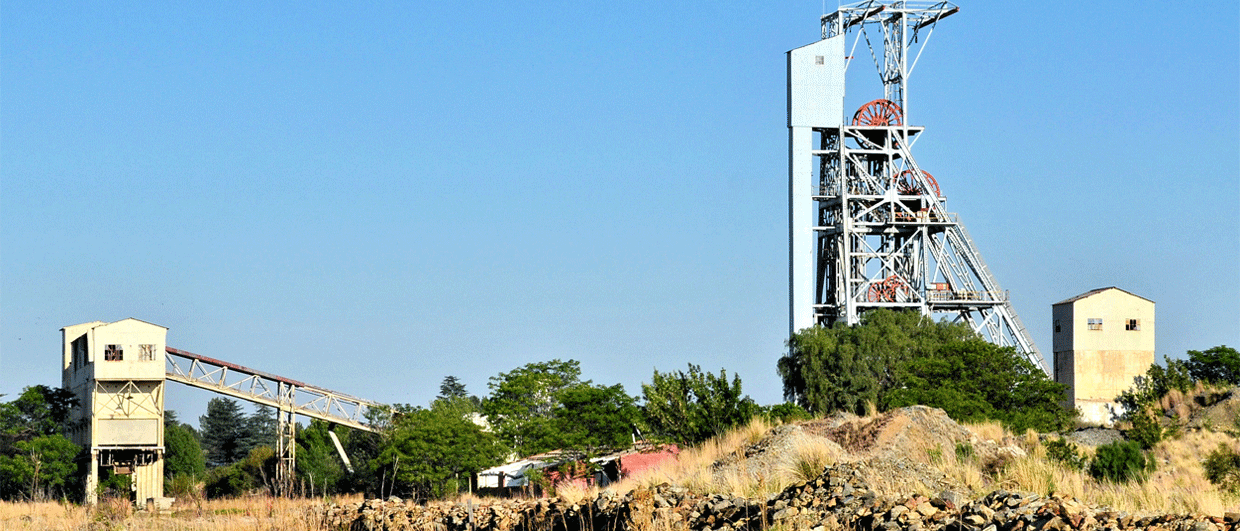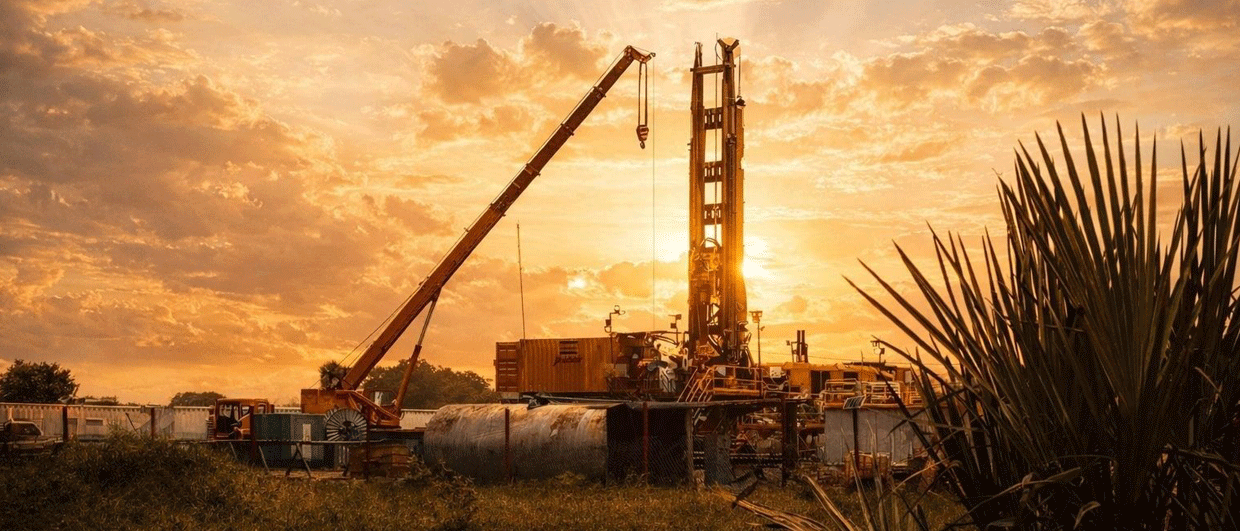
The ITW-1 wellsite during ESP testing. Source: Helium One.
A helium prospect without a trap
Most helium is co-produced with natural gas, however Helium One demonstrates in Tanzania that a classic hydrocarbon play setting is not required

After the initial hype of helium exploration in the Rukwa basin in Tanzania, things went quiet for 18 months. This is partially because Helium One’s exploration permit expired, and they had to apply and wait for a mining licence for the next phase of their operations. No doubt a lot of work was done behind the scenes, but now things are moving again at the wellsite, too.
During the exploration campaign, it took Helium One multiple wells to get things right and discover the best play type to produce helium from. Thanks to well Itumbula West-1 (ITW-1), the company found that drilling straight into basement faults and the surrounding damage zones is the best approach. Quite simply, this is because helium uses the faults as migration pathways. Helium forms in the Pre-Cambrian basement as a by-product of radioactive decay. The elevated heat flow provided by the upwelling mantle in the East African rift setting then liberates the helium from the uranium and thorium-bearing minerals, and it migrates up section. The helium subsequently accumulates in shallower aquifers, without there being a structural or stratigraphic trap. It eventually reaches the surface, as evidenced by salt ponds in the area with active seeps that contain up to 10.2 % helium.
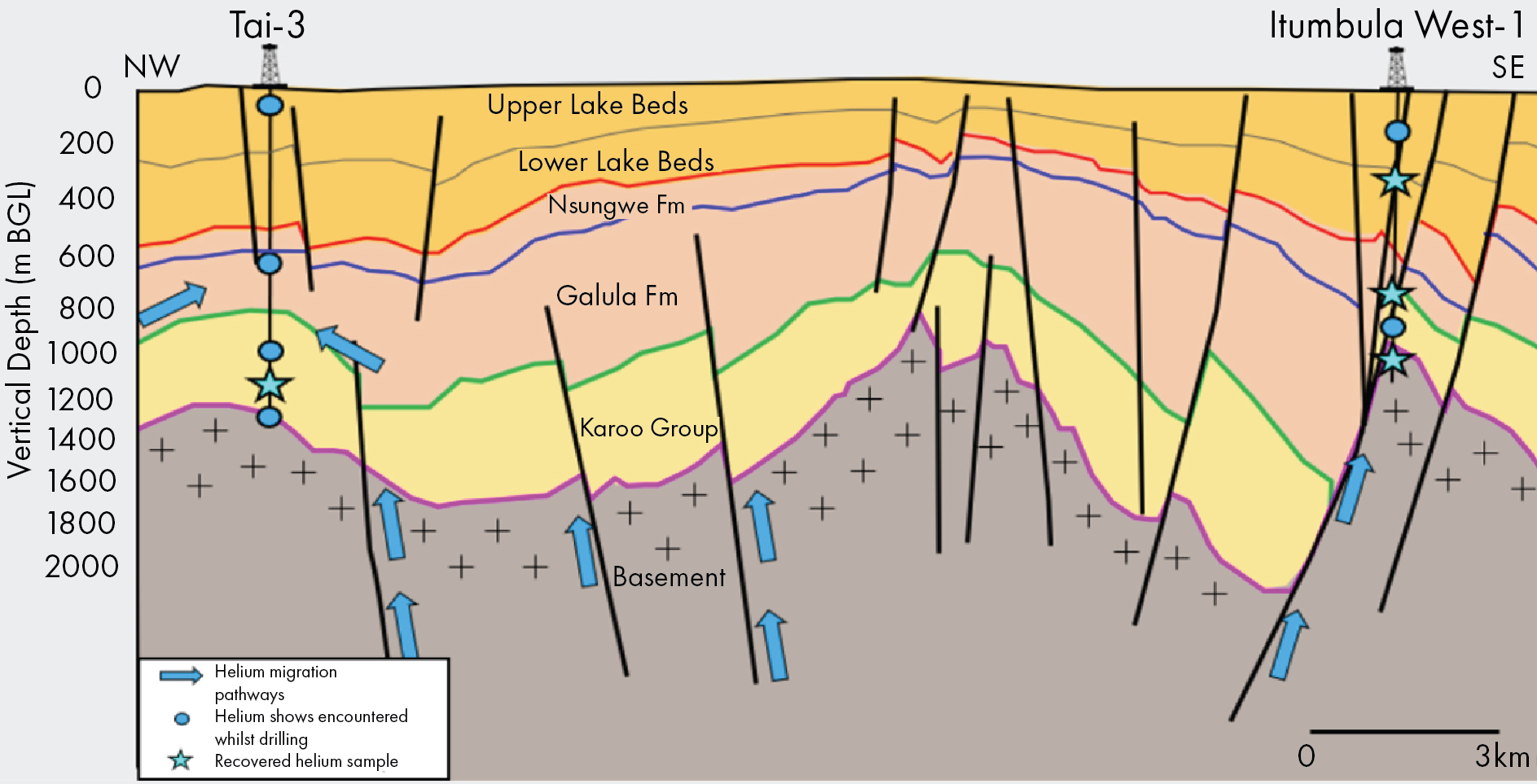
The Itumbula discovery is a fault-bounded basement horst with a thin sedimentary cover. ITW-1 tested two major faults and found helium in two aquifers: fluvial-deltaic sediments of the Karoo Formation and in weathered basement. Water samples from both aquifers contained over 5 % helium. Helium One is planning a five-well campaign to further appraise the area.
Helium One sourced an Electric Submersible Pump (ESP) to produce the basement aquifer. A 20 day test at the start of the year demonstrated a six-fold increase in flow rate to 15,000 bbls/day compared to the natural flow rate during the extended well test. The produced fluid had a Gas-Water ratio (GWR) of 0.06 m3/m3. The ESP was set at 1,061 m MD within the fractured basement, with a packer in the lowermost Karoo Formation to reduce comingled flow. However, the 90⁰ C water temperature and measured salinity suggest basement isolation was not fully achieved. The contribution of the Karoo aquifer is thought to have lowered the GWR.
There is no plan to reinject the produced water, and Helium One is evaluating disposal options. The wastewater could possibly be used for geo-thermal energy and / or irrigation. Nitrogen is the only other gas present and can be safely vented to the atmosphere. Helium One has now embarked on a farmout process to find a suitable industry partner.