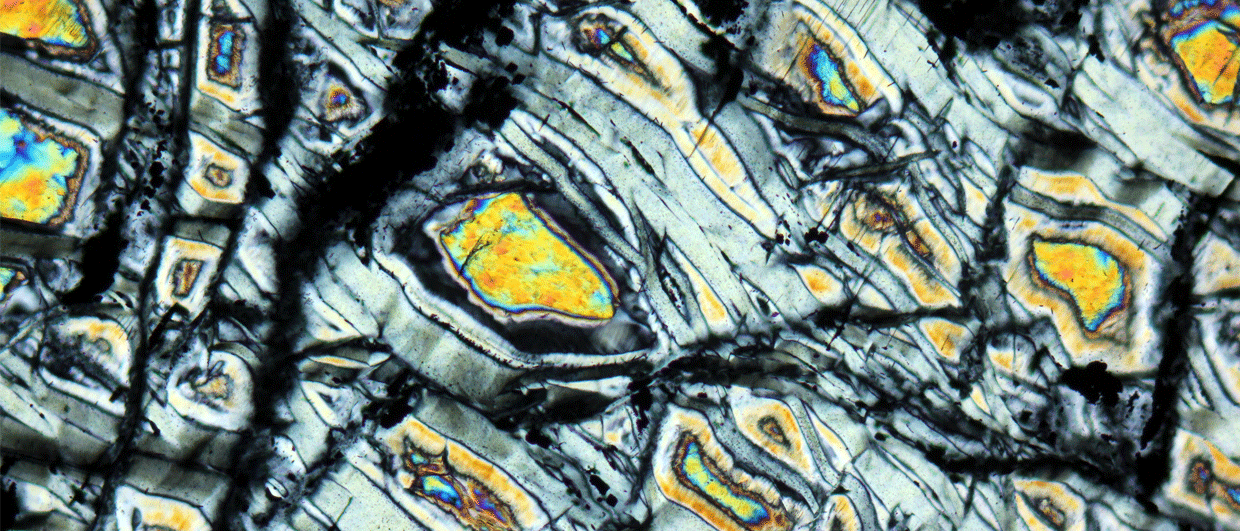
Microscope image of serpentinised peridotite (grey) with olivine islands (yellow). Field of view = 2mm. Credit: Strekeisen.
Omani research well burping hydrogen
Hydrogen gas forms naturally when water and iron-rich rocks react. What if we stimulate and accelerate this process to produce low-carbon hydrogen as an energy resource?


When Professor Alexis Templeton from the University of Colorado conducted a techno-economic analysis on stimulated hydrogen, the results suggested that generating profitable volumes of gas is nearly impossible. Still, she pushed for a pilot well to be drilled to compare theoretical calculations and lab experiments with reality. The field results exceeded everyone’s expectations, not in the least Alexis’ own; stimulated hydrogen is within closer reach than anticipated.
The pilot well is located in Oman, a country with an ophiolite belt as its backbone. Serpentinisation reactions between water, olivine and pyroxene within the peridotite generate large volumes of hydrogen. Local hydrothermal springs degassing hydrogen prove that this process is naturally occurring.
The Rock-Hydrogen pilot well was drilled in early 2024 to a depth of 1,050 m. The top 900 m were cased off, leaving 150 m of relatively fresh peridotite exposed in the well bore. The project team, headed by Alexis, pumped >4,800 m3 of water downhole and shut the well in. The formation was left to soak and iron-rich minerals reacted to serpentine. When flow testing began after a year, to everyone’s surprise, the well did not produce sparkling water but burped gas instead. Alexis: “We weren’t prepared for the volumes of both water or gas that we were going to see, we were extremely excited!” The well produced, without decline, equal amounts of gas and water over the multiple-day flow test. The vast majority of gas is hydrogen, complemented by nitrogen and methane.
This result exceeded expectations, because neither the formation nor the injected water had been primed to enhance serpentinization. For example, lab experiments at the University of Colorado show that the ideal temperature for hydrogen formation is 150° C, while the bottom hole temperature in Oman is only 55° C.
The Rock-Hydrogen Project was also restricted to use municipally treated water for injection, while their research shows this is the least favourable composition due to the high concentration of nutrients. In other words, these preliminary results provide a baseline for stimulated hydrogen, leaving room for many improvements to be made.
Additional options are fracking the peridotite to increase the reaction surface and / or adding catalysts to the water. One thing we do not have to fear, according to Alexis, is microbes consuming the hydrogen: “Microbes seem unhappy under the well conditions, the rate of hydrogen production far outstrips the rate of consumption.”
The next step in the Rock-Hydrogen Project is to drill an injection and production well array, reaching to greater depth than the pilot well. Alexis is content to have demonstrated that peridotite can be effectively stimulated: “The question is now how much more hydrogen can we make? How much can we scale this and what is the most appropriate way to do it?”