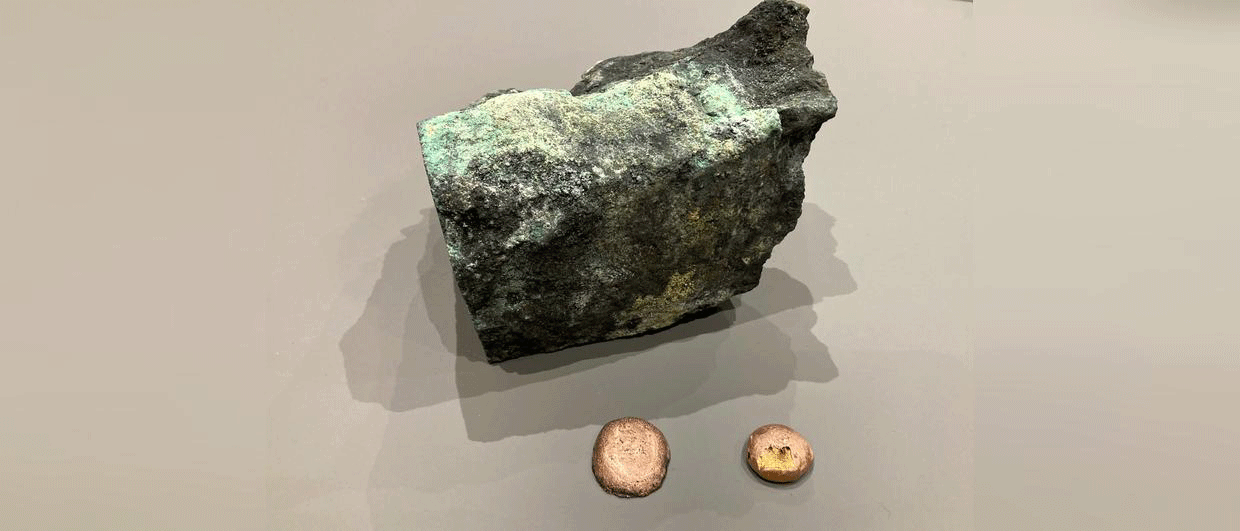
The first Norwegian copper of marine origin. The greenish rock is a sample of metal ore, taken from the Gygra sulfide deposit west of Svalbard. Photo: Ronny Setså.
First seabed copper from Norway
Research expeditions in the Norwegian Sea have shown that the Mid-Ocean Ridge has high prospectivity for metal ore. The list of known deposits is growing steadily, and for the deposits that have been sampled, the metal grades are often higher than what is typically seen in deposits mined on land

Over the past three years, academia and industry joined forces in the project EMINENT to increase knowledge of the deep sea and demonstrate a full value chain for sustainable extraction of seabed minerals. Now the results are on the table, and they include the first copper extracted from mineral deposits in Norwegian waters. It is tangible proof that the project has succeeded in demonstrating a complete value chain for the exploitation of seabed minerals.
Much of EMINENT’s research, environmental monitoring and technology testing concentrated on the Mohns Ridge. During the project’s first expedition, in May 2023, the project participants drilled directly and completely unintentionally into a previously unknown inactive sulfide deposit. They named the deposit after the expedition: Deep Insight.
The expedition’s purpose was to investigate water circulation in the subsurface by drilling into a fault, as well as to test FlexiCore – a cost-effective concept for core drilling in difficult deep-sea terrains. Further mapping has shown that Deep Insight, situated 8 km from the political border with Greenland, may be among the largest sulfide deposits so far discovered in the Norwegian Sea. The ore formed when boiling hot mineral-rich water percolated to the seabed and quickly cooled.
The EMINENT project was also involved in finding the Grøntua and Gygra inactive sulfide deposits. From a resource perspective, it is inactive, extinct fields that are of interest. Active deposits are protected by the Seabed Minerals Act because they form the basis for unique ecosystems. It is also more technically demanding to operate in the extreme temperature conditions that occur where boiling water flows out from the seabed.
Bioleaching
EMINENT has also investigated how copper, zinc and cobalt can be extracted from sulfide deposits under the seabed without breaking up the ore body. The method is based on principles from two established technologies: in-situ leaching and bioleaching.
In-situ leaching involves adding liquid, often acidic, directly to the deposit to dissolve the metals, while bioleaching uses bacteria to selectively break down the metals in the ore. The researchers believe this could be achieved by injecting a bacterial solution into the deposit through one well and retrieving metal-rich water via other wells.
Laboratory tests have shown that the method can provide high recovery rates. If in-situ bioleaching can be realised, it could significantly reduce energy consumption, environmental footprint and costs. In other words, a more sustainable alternative.
Given the promising results of project EMINENT, it is all the more surprising that the Norwegian government has put the first seabed mineral licence round on hold for at least the next four years.