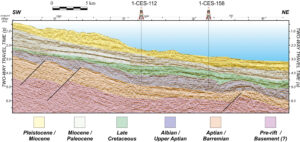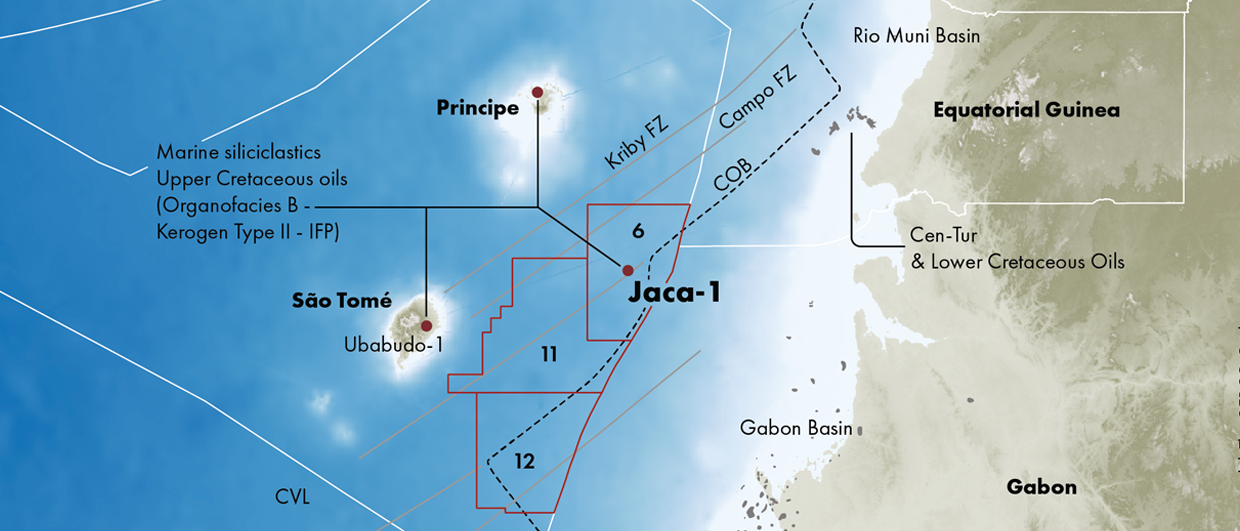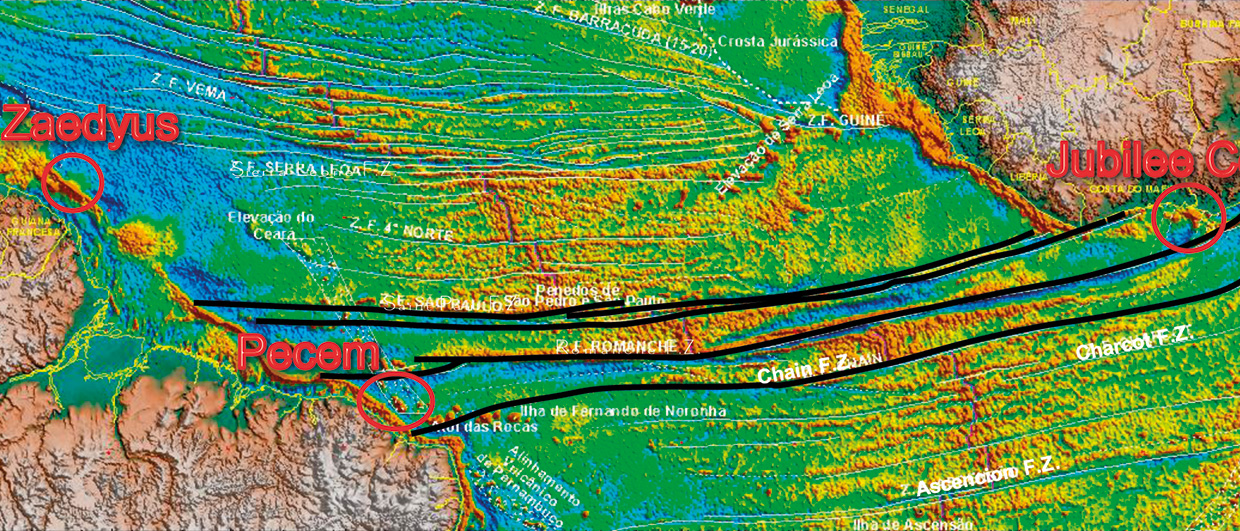
Topographical-bathymetric map of the South Atlantic Equatorial Transform Margin. The major transform fault zones that offset the oceanic spreading centers are shown in black. Recent deepwater discoveries include Jubilee in the Tano Basin offshore Ghana, Zaedyus in the Guyane Maritime Block offshore French Guiana, and Pecem in the Ceará Basin offshore Brazil.
New deepwater frontiers an ocean apart
Large oil finds in the African Equatorial Margin have led to recent oil discoveries along the South American Equatorial Margin. Similar geologic and geochemical characteristics suggest analogous petroleum systems with enormous potential in both conjugate margins.

The South Atlantic Equatorial Margin represents new, deepwater exploration frontiers. The 2007 Tullow Oil discovery of the Jubilee Field off the West African margin, located 60 km offshore Ghana in 1,100m of water, was the first for the region. The first oil was produced in December 2010 from recoverable reserves estimated to be over 600 MMbo. In the area that was once connected to the equatorial West African margin, but is now separated by the Atlantic Ocean, two discoveries have been recently announced. In 2011, Tullow Oil, drilling to test a ‘Jubilee play’ on the other side of the South Atlantic, announced that their Zaedyus well encountered 72m net oil pay in turbidite sandstones. Petrobras and BP announced the discovery of oil from the Ceará Basin Pecem well in 2012, which encountered 140m of net pay 76 km off Brazil’s coast in 2,129m water.
These three discoveries have characteristic tectono-stratigraphic evolution, source rock facies and oil types, suggesting that similar petroleum systems may occur across the conjugate margin. By applying, in a paleogeographic context, a unified model for this hydrocarbon province, new geologic details are revealed about these underexplored petroleum systems an ocean apart.
Plate tectonic reconstructions
The application of plate tectonics reconstructions aims to restore the basins, now separated by an ocean, to their previous pre-breakup and drift locations.
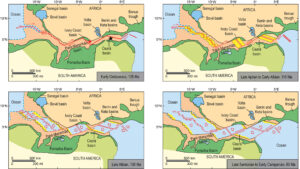
The Gondwana breakup in the Early Cretaceous (125 Ma), as the South American plate separated from the African plate, resulted in transtensional and transpressional rift basins in the South Atlantic Equatorial Margin. The rifted margins developed continental lakes and fluvial systems, which were infilled with siliciclastic and carbonate rocks. The initial rift phase was followed by a transitional phase of subsidence in the Late Aptian to Early Albian (110 Ma). This was associated with the early stages of oceanic crust formation and seawater ingression which allowed local accumulation of late Aptian evaporites in some basins, such as the Ceará Basin, and a rapid subsequent deepening of the depositional environment. After continental breakup and total separation of the plates by inception of oceanic crust in the Late Albian (100 Ma), the deepening of the sedimentary environment resulted in an oceanic basin influenced by worldwide sea level rises and falls. During the Late Albian to Turonian (Late Cretaceous), organic-rich shales and marls were deposited in maximum sea level-rising episodes that gave origin to the global Oceanic Anoxic Events. By Late Santonian to Early Campanian (85 Ma) the divergent margins were totally separated by the active spreading centers. Previous sedimentary successions were deformed by extensional and compressional forces.
Reservoir rocks
Erosion of the granites and gneisses from the cratons and from the uplifted rift flanks along the continental margin resulted in deposition of deltaic to shallow marine sands on the platform. Episodes of sea level falls gave rise to the development of erosional incisions of the deltaic and coastal sand deposits stored on the platform and in shallow marine environments. The steep continental slope favored the growth of canyons which acted as pathways for sand-rich turbidite currents and hyperpycnal flows into deepwater marine environments during sea level low-stands. These sands were deposited as amalgamated channel-lobe reservoirs as found in the Jubilee Complex. Similar deposits have also been identified near the French Guiana/Amazon Cone area, as testified by the Zaedyus discovery.
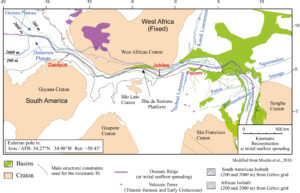
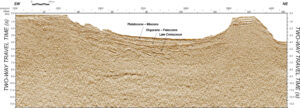
During the deposition of these turbidites, sea bottom topography played a significant role in creating important sedimentary facies variations. These are characterized by onlap and pinch-out seismic features, especially when associated with structural highs in the transition from distal rift border to oceanic crust. The facies variations of the sand-prone stratigraphic sequences resulted in stratigraphic plays which have been successfully tested in West Africa, particularly in the Tano Basin, Ghana, and more recently at the Zaedyus discovery off French Guiana.
Source rocks and oil types
Based on analysis and studies of oils recovered from exploratory boreholes offshore of the Brazilian Equatorial Margin undertaken by the Integrated Petroleum Expertise Company, (IPEX), Brazil, four separate petroleum systems have been identified using biological markers and high resolution geochemical technologies. This advanced geochemical approach aims to refine the play analysis based on geological and geophysical interpretation.
The oldest oil system is characterized by highly cracked, very mature oils and condensates sourced by a saline to alkaline, calcareous black shale deposited in a lacustrine brackish to saline anoxic environment. This Aptian/Barremian petroleum system is responsible for 90% of the oil generated offshore Brazil. Late Aptian salt plays an important role as well and has been identified in the most important producing basins on both sides of the Atlantic.
The second oil system is characterized by transitional environments, as found in the Ceará and Potiguar Basins, with the Late Aptian source rocks in the early to peak oil window stage. Most of the Equatorial Brazilian and West African transform continental margin basins are characterized by lack of massive salt in the transition from continental to marine environments. However, the exception may be Ceará Basin, where a few boreholes encountered evaporites in the Late Aptian stratigraphic interval, indicating a restricted depositional environment. Moreover, geochemical data from hydrocarbons recovered from oil fields in the Ceará and Potiguar Basins in northern Brazil indicate the presence of oil types similar to the ones that are present in the salt basins south of the equatorial transform fault zones. Consequently, the transform margin basins may share similar source rock systems.
The third petroleum system consists of Albian/Cenomanian/Turonian marine black shales, which are a major source for the oils in the West African salt basins, particularly in the deepwater settings of the Cabinda region, Angola. Similar oils have also been registered in the Amazonas Cone and Pará-Maranhão basins, and recently in five ultra-deep water discoveries in the Sergipe Basin. The oils in the Jubilee Complex are also sourced by the same marine black shales, deposited in deepwater settings. The origin of the marine hydrocarbons in these areas is related to Late Cretaceous global Oceanic Anoxic Events, which occurred when the two plates were totally separated and the basins were influenced by worldwide sea level rises and falls.
The fourth petroleum system consists of Tertiary source rocks that occur in deltaic environments in the Pará-Maranhão Basin. The 1-PAS-9 and 1-PAS-11 sub-commercial discoveries, as well as the gas accumulations in a number of wells drilled in the past decades, were sourced by these Tertiary source systems.
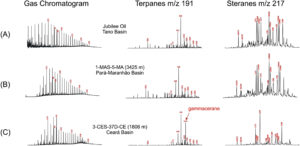
The geochemical components of the oils analyzed suggest that the lacustrine and marine source rocks which are extremely prolific in the Brazilian margin north of the Florianópolis Fracture Zone/Rio Grande Rise (Santos and Campos Basins) and north of the Walvis Ridge in West Africa (Namibe and Kwanza Basins), also occur in the South Atlantic Equatorial Transform Margin. The oil discovered in the Pecem well indicates a transitional environment source but could also include contribution from the same Albian-Cenomanian source rock system present in the equatorial margin of West Africa.
The implication is that simply matching recent discoveries in the conjugate margin basins, for example the Tano Basin offshore Ghana with the Ceará Basin in northern Brazil, does not necessarily yield the entire story. There is a great deal of contrasting sedimentary and structural development peculiarities from basin to basin and margin to margin. The application of detailed geochemical analyses and integration of geological and geophysical methods can lead to better exploration models for these basins and provide clues on the best strategy for drilling any new prospects identified in the South Atlantic Equatorial Margin.
Offshore equatorial Brazil
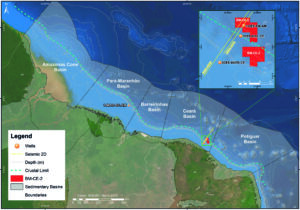
Five large sedimentary basins border the 2,200 km north-eastern Brazilian coastline. The westernmost, the Amazonas Cone Basin, is characterized by a thick Late Tertiary sequence with shale diapirs and thrust faults forming a deepwater gravitational foldbelt. Moving east, the Pará-Maranhão Basin has a thick carbonate platform and foldbelt in the transition from continental to oceanic crust. The Barreirinhas Basin is also characterized by a very thick sedimentary succession and deepwater foldbelts. The Ceará Basin is marked by a thinner Tertiary sedimentary succession but with a thicker syn-rift trough in the platform and deep water. Finally, the Potiguar Basin is characterized by several intrusive and extrusive igneous rocks affecting the sedimentary succession in the platform and in the deep basin. IPEX and Geohub reports indicate that these basins have several elements that point to the potential presence of large hydrocarbon accumulations in areas sourced by local syn-rift and by early post-rift source rock pods, as suggested by high-resolution geochemical evaluations of the margin.
Integrated approach and forecasts
Only a few deepwater exploratory wells have been drilled in the South American Equatorial Margin from the Amazonas Cone to the Potiguar Basin. Significant shallow water discoveries have been made in both the Ceará and Potiguar Basins, with the largest oil-producing region in Equatorial Brazil being the onshore portion of the Potiguar Basin. Production is from the syn-rift to transitional successions.
By contrast, the West African Equatorial Margin has been subjected to more intensive exploration activity. This resulted from insightful basin analysis projects conducted by companies such as Kosmos, Tullow and Anadarko, culminating in successful drilling in the deepwater province of the Tano Basin. Mahogany-1, drilled in 2007, was the first borehole to prove oil in the Turonian-age low-stand fans that form stacked reservoirs in the Jubilee Field Complex. Successful exploration concepts derived from these turbidite fans offshore Ghana have been applied to the western extension of the West African Transform Margin. The Late Cretaceous episodes of sea level falls that resulted in development of these reservoirs in the Jubilee Complex were also recognized in seismic profiles in other basins. Several prospects have been successfully tested by exploratory drilling, extending the oil trend from Ghana to the Ivory Coast and Sierra Leone.
The play concept developed in North West Africa was applied in a similar way to the conjugate margin in South America. By extrapolating their interpretations to the opposite side of the ocean, exploration geoscientists have developed prospects in ultra-deepwater settings offshore French Guiana and northern Brazil that shared similar stratigraphic and structural play characteristics with the Jubilee discovery. One of the first tests resulted in the discovery of Zaedyus, which found light oil in Late Cretaceous turbidite reservoirs, duplicating the success story obtained in the African Margin. This prospect successfully tested a genuine frontier region which had no deepwater wells, and confirmed the petroleum systems conjectures developed by the exploration teams.
New and better seismic imaging and 3D visualization software have enabled geoscientists to establish an unprecedented stock of leads and plays yet to be tested for this vast region. The recent successful tests in conjugate margin analogous plays provide the interpretation teams with calibrated results. The new geochemical data analysis and integrated modeling for the ultra-deep areas of the northern Brazilian margin have also resulted in a better evaluation of risks and exploratory criteria for the selection of viable prospects even in lightly explored and remote areas.
The next bid round in the Brazilian Equatorial Margin will be offered by the National Petroleum Agency in May 2013 and will mark a return to this frontier region. Diamondoid and biomarker analyses of oil from the Ceará Basin and from the Jubilee Complex prove that both the transitional and the marine source rocks may reach maturation levels for feeding giant turbidite fans in deepwater settings of the South Atlantic Equatorial Transform Margin. Over the next few years, drilling should test innovative approaches and hopefully extend production to the ultra-deepwater province of the Brazilian Equatorial Margin.