© Pablo Hidalgo/Dreamstime.com.
Whose responsibility?
A recent decision by the government of Ecuador to abandon a pioneering conservation plan designed to prevent drilling in the Amazon rainforest has thrown the spotlight on the many issues surrounding the search for hydrocarbons in this unique part of the world

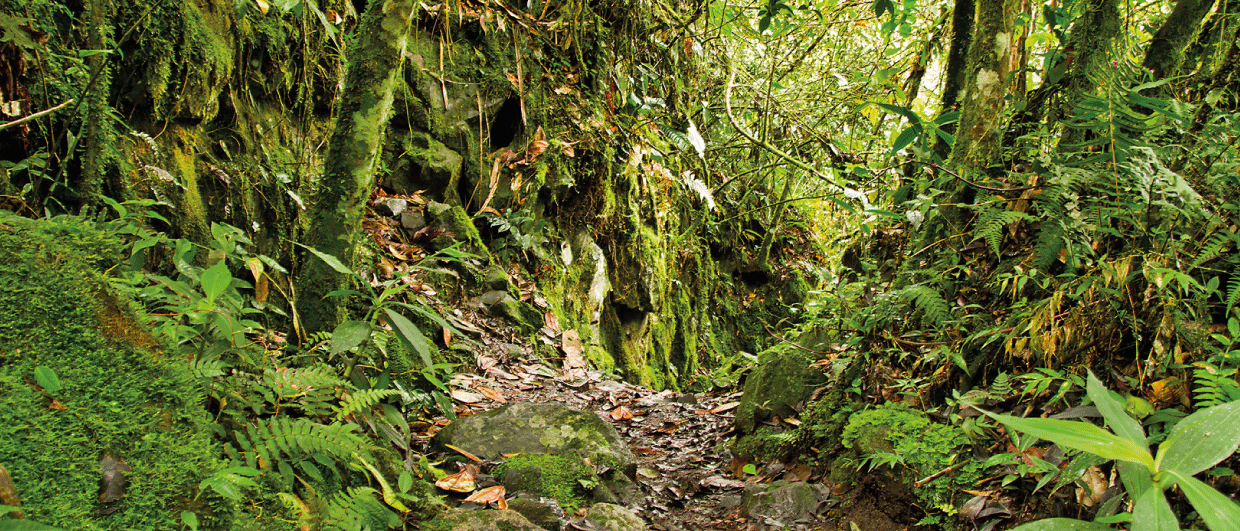
The Yasuni National Park, a UNESCO Biosphere Reserve in the far north eastern corner of Ecuador, about 250 km from the capital, Quito, is believed to be the most biologically diverse spot on the Earth, with more tree types in a hectare than in the whole of North America. There are 121 documented reptile species within the 10,000 km2 of the park, as well as 382 fish species and at least 596 types of bird, a third of the total found in the entire Amazon region. And about 10% of the known insect species of the whole world can be found here. It is also reportedly home to two isolated indigenous tribes which have resisted contact with the outside world.
But Yasuni National Park also holds an estimated 909 MMb of proven and probable oil, discovered in 2007 by state oil company Petroecuador – about 20% of the country’s known reserves. To somewhere as poor as Ecuador, where, according to the CIA World Fact Book, over a quarter of the population were living below the poverty line in 2012, this is a potential source of much needed wealth which could be used to improve housing, infra structure, education and health care facilities. Since 2007, oil pro duction has been near-stagnant in Ecuador at around 500,000 bpd, predominantly as a result of paucity of new developments.
Pioneering plan
Knowing the potential risks involved in drilling and exploiting reserves in the rainforest – Ecuador has had a protracted 20-year legal battle over alleged pollution and environmental damage from Texaco’s operations in the area to the north of Yasuni – the oil minister at the time of the discovery, Alberto Acosta, who himself worked in the oil industry for 20 years, came up with an unusual plan. He suggested that Ecuador would not permit exploration in the Yasuni, in perpetuity, if the rest of the world would agree to pay the country about US$3.6 billion – approximately half the estimated value of the oil. The money would be used to protect Yasuni and other Ecuadorian parks like the Galapagos, and in reforest ation programs.
However, six years later, despite contributions from high profile individuals like Leonardo DiCaprio and Al Gore, and pledges from a number of countries, only $13 million had been collected. President Correa pulled the plug on the initiative in August 2013, saying “the world has failed us.” From the start, he had insisted that the protection of the Yasuni area was the responsibility of all countries, particularly industrialized ones, rather than of Ecuador alone, stating: “It was not charity that we sought from the international community but co responsibility.” A number of countries and organizations, however, complained at the government’s heavy-handed approach to negotiations, while Correa himself in 2010 rejected a deal with the UNDP and several other countries, which would have secured about half the money required, saying that donors were attaching too many conditions to the contributions.
The companies which were initially awarded the block that was the subject of the moratorium, led by Petroamazonas (a subsidiary of Petroecuador) and Sinopec, are now free to start exploring. They insist that any exploitation will be done in a way to minimize the environmental impact, including not building roads and taking precautions to protect the indigenous species and population.
China the main beneficiary?
If it had been successful, this could have been an interesting model for future conservation. But there seems an inevitability about the outcome when one considers the economic pressures on Ecuador since the initiative was announced in 2007, including the global economic crisis and Ecuador’s default on sovereign debt in 2008–09. Ecuador has recently become increasingly dependent for financing on China, and in July the China Development Bank lent the Ecuadorians US$2 billion in exchange for nearly 40,000 bopd over two years.