
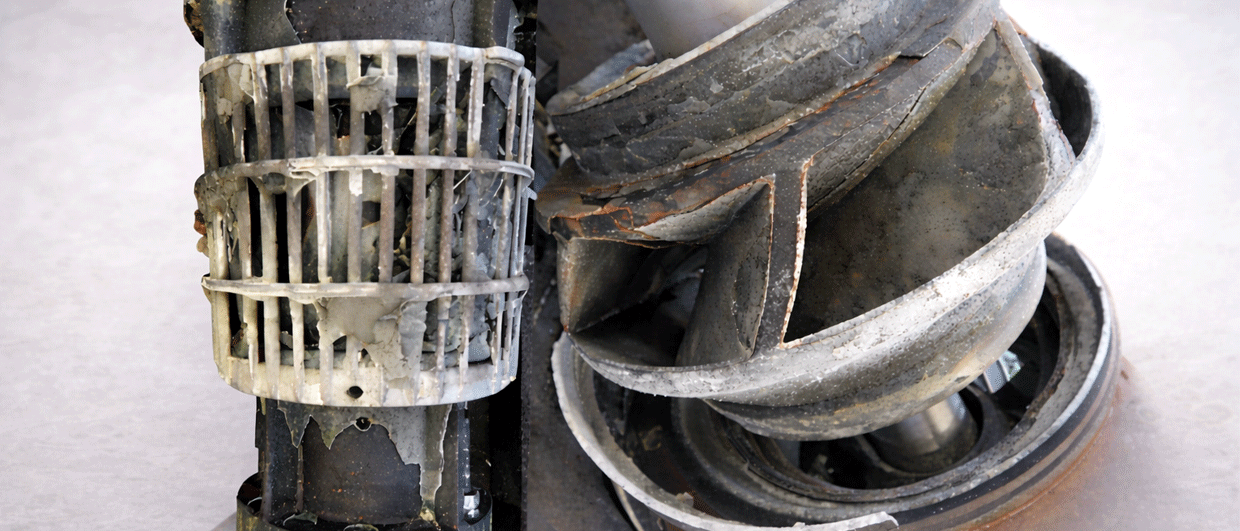
Example of scale development at an ESP in Southern Germany. Photo: Stadtwerke München.
When the reliability of your project depends on a single tool at hundreds of meters depth
Electric Submersible Pumps (ESPs) form the lifeline of many geothermal projects where there is no natural flow to surface. Especially in the case of single doublets, the risk of pump breakdown and a forced standstill is real and continues to be hard to predict. Therefore, technology is needed to better understand when ESPs might fail

An ESP can fail at any time, even before geothermal projects officially start. We recently reported on such a special case of ESP failure in the southwest of England, at the United Downs project. Even before the system started operating, the ESP broke down.
Ryan Law, the founder and CEO of the United Downs project, was quite vocal on LinkedIn about where to put the blame for the ESP failure: Baker Hughes. He has now put his hopes on technology from SLB: “Unfortunately, the deep Electrical Submersible Pump from Baker Hughes stopped working and is being replaced. (…) Hopefully, the new ESP from SLB will finally enable us to start producing electricity early next year.”
The ESPs that are running in geothermal wells in the Netherlands have an average run time between one and two years. However, there is a reported case of tool failure after nine days, as well as an exceptional lifetime of more than five years. It demonstrates the variation of tool performance.
It is quite rare to see an operator point fingers at hardware suppliers this way, but maybe he had a good reason to do so. Anyway, this example clearly shows how important ESPs are for the functioning of a geothermal system.
The critical nature of ESPs is not unique to the geothermal industry; they are also quite common in oil. But here, flow rates are often lower, there are fewer starts and stops, there is less variation in temperature, and corrosion and scaling are not as severe. In addition, many oil fields will have more than one producing well, which introduces contingency in case one needs to be shut in temporarily.
But what kind of technology is available to improve the reliability of ESPs? A workshop was held in the Netherlands to discuss what is happening in that domain.
Apart from better hardware, quality is a cost-reducer rather than a cost inflation – traditional monitoring of ESPs by looking at voltage and flow is now increasingly being supplemented by acoustic sensors and fibre-optic measurements to detect instability, wear or abnormal loads. This has enabled the prediction of failure days or weeks in advance, which allows the operator to prepare for an intervention while the ESP is still operational. This can minimise downtime significantly. Another aspect that was discussed in a presentation was the need for proper testing of new ESP prototypes under conditions that are representative of downhole conditions.
In the meantime, let’s hope that Ryan Law will soon be able to post about the successful startup of his geothermal project and that the SLB ESP will last longer than the one from the competitor.
Have a look at the presentations that were given during the ESP workshop in the Netherlands.