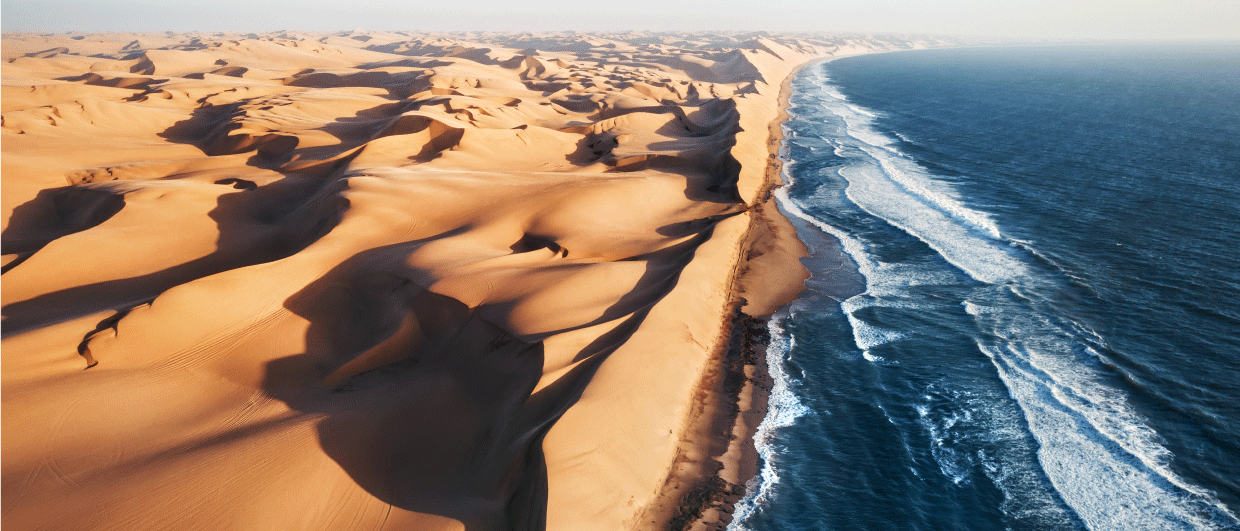
Place where Namib desert and the Atlantic ocean meets, Skeleton coast, Namibia. Photo: Smelov via Adobe Stock.
From hydraulic jumps to Goldilocks zones
New insights into the mechanisms behind deposition, compartmentalisation and reservoir quality of the Namibian deepwater reservoirs

There is a reason why talks delivered by operators are often well attended at conferences; there is always the chance that something new is being presented. That was not only the case during a talk by Aurélie Tassy from TotalEnergies at the recent IMAGE Conference in Houston in August, but also during a few talks delivered at the AAPG “Finding New Elephants” workshop in Windhoek in June. Here are some highlights.
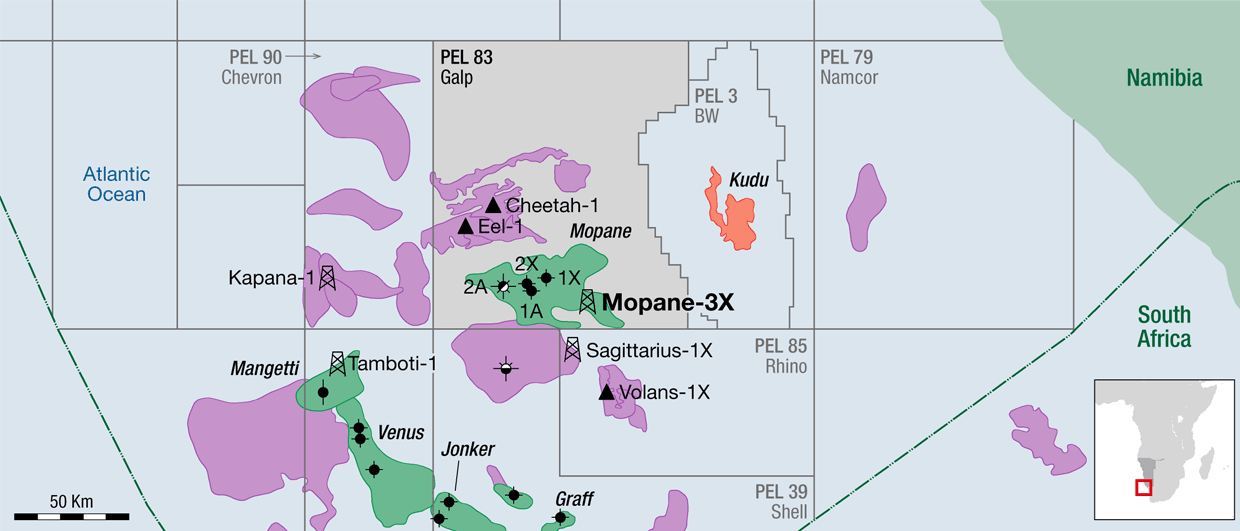
In contrast to the Lower Cretaceous Venus find, the Upper Cretaceous discoveries such as Graff and Mopane are often dissected by faults as a result of mass transport complexes that formed post-deposition. This is not a surprise if you look at the schematic cross-section shown here, which is based on high-quality seismic data, but it was still interesting to hear this so clearly expressed by an operator. This message also corresponds to what we published earlier regarding the Saturn Complex north of Mopane. Here, seismic time slices also suggest the presence of ridges that could be explained by internal slumps formed as a result of the shelf edge failing. In other words, the challenge for Mopane, Graff and any other Upper Cretaceous deepwater sand in the Orange Basin might be significantly compartmentalised and therefore more challenging to develop than the Venus discovery further outboard. Which is probably the very reason why Venus is likely to be the first development that is getting the go-ahead.
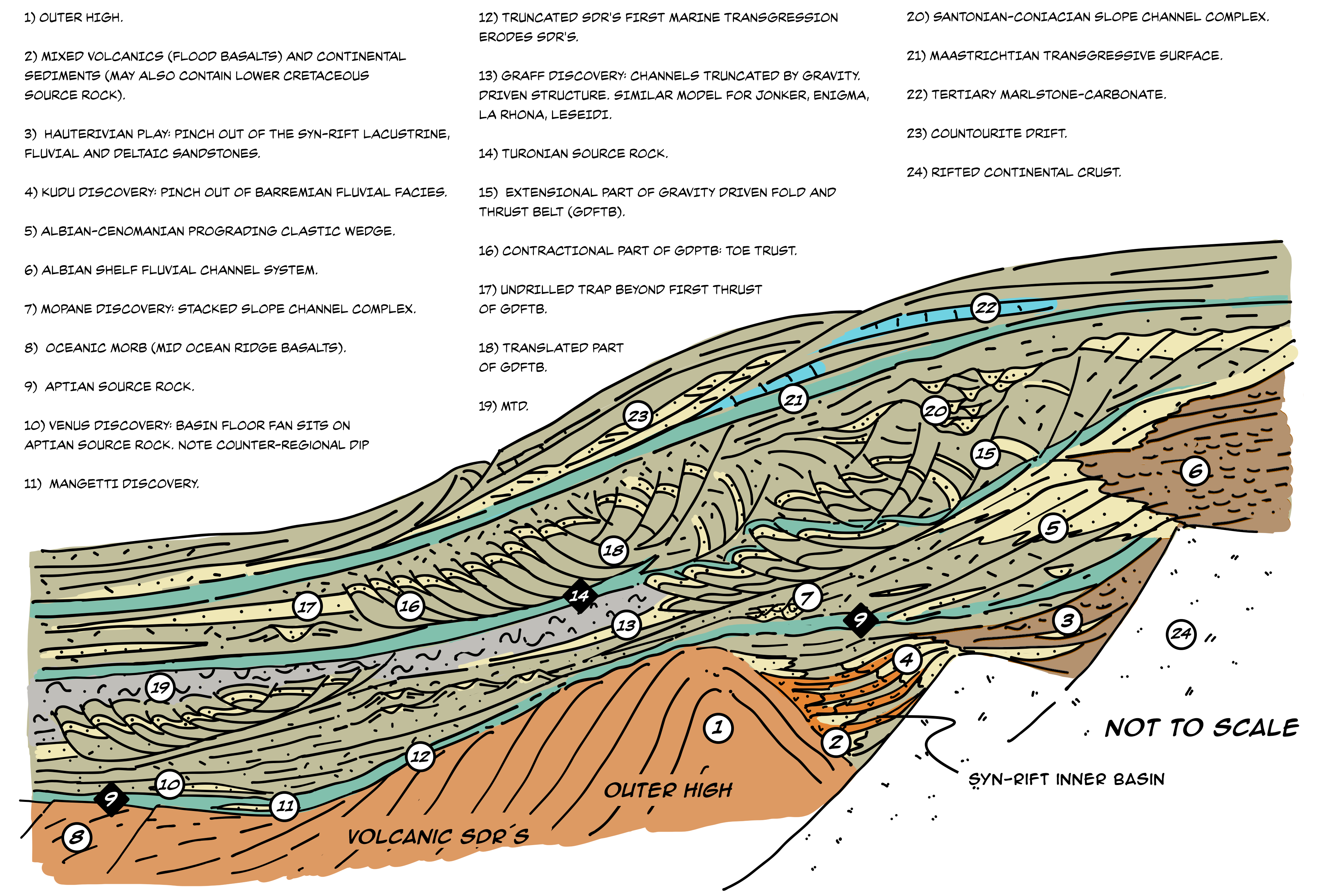
Another interesting view on how the Cretaceous reservoirs found in the Orange Basin were deposited relates to the suggested presence of a hydraulic jump. At the time the Venus-style sands were deposited during the Aptian, the idea is that a hydraulic jump existed across the Outer High. This hydraulic jump subsequently caused the deposition of sands basinward of the Outer High where Venus now is located. With ongoing sea-level rise, the hydraulic jump migrated further landward, and therefore sand deposition also shifted more landward, and in this case inboard of the Outer High where the Mopane and Graff discoveries are.
Then there is the reservoir quality issue that has been a concern for the deepwater Namibia discoveries. During the June conference mentioned above, an attendant shared information with us that was presented by Shell about the Jonker and Graff discoveries. Both discoveries apparently show thick and blocky sands in core logs and images, but overall permeability is poor, with some intercalated good permeability zones. Sandstones with reasonable 24 % porosity and pore-lining chlorite tend to be around 15 mD, whereas it drops to 15 % porosity and 1 mD where both pore-lining and filling chlorite are present. Sandstones where no pore-lining chlorite is present tend to be cemented up, leading to porosity values of around 9 % and less than 1 mD.
With TotalEnergies recently completing its entry into the Mopane discovery as an operator, it will be very interesting to see how the deepwater Namibia story unfolds, and how many snippets will be released during forthcoming talks. I keep my ears to the ground.