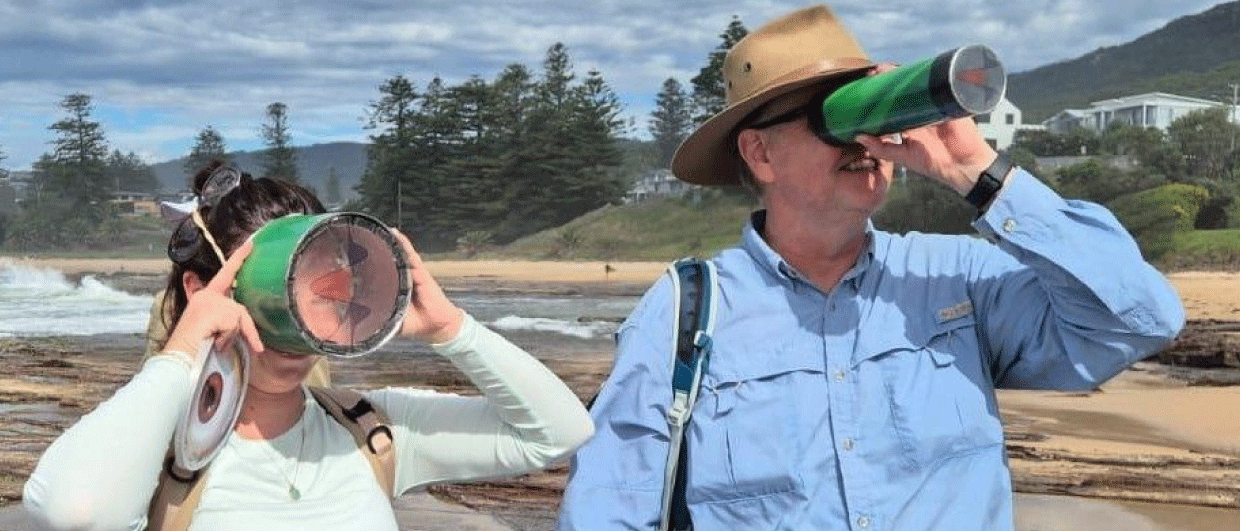
Seismic goggles. Photo: Lilly Walker.
Field trips and software don’t mix very well – or do they?
With a solid preparatory effort, a team of passionate geoscientists managed to provide an outdoor exercise that included a digital model-building element at the same time, allowing participants to implement and check the impact of their field observations directly

“It was a new thing to us,” says Lilly Walker from RFD when we meet on what is her Wednesday afternoon in Perth, Australia. Lilly is a geologist and joined RFD’s Australia team a little more than a year ago. “Combining a field-based exercise with hands-on digital model building is rarely attempted in the industry.”
“You have to lug laptops along, need data to start with, and you need software that does the job quickly, such that people are not sitting around waiting,” she says. “Given the mix of backgrounds amongst the participants, there was another reason why we needed short run times and some pre-loaded relevant data; we didn’t want reservoir engineers waiting till the end of the week for their dynamic model. We worked hard to get that right.”
“But we made it happen,” continues Lilly. Mark Bentley from Langdale23, who led the field exercise that was pulled together by Mark Reilly from Precipice Training, split up the group of participants – a diverse group of geophysicists, petrophysicists, geologists and reservoir engineers from Santos – into different fluids – one dedicated to oil, one to gas, and a heavy oil one. “That made us all look at the outcrops in different ways,” says Lilly.
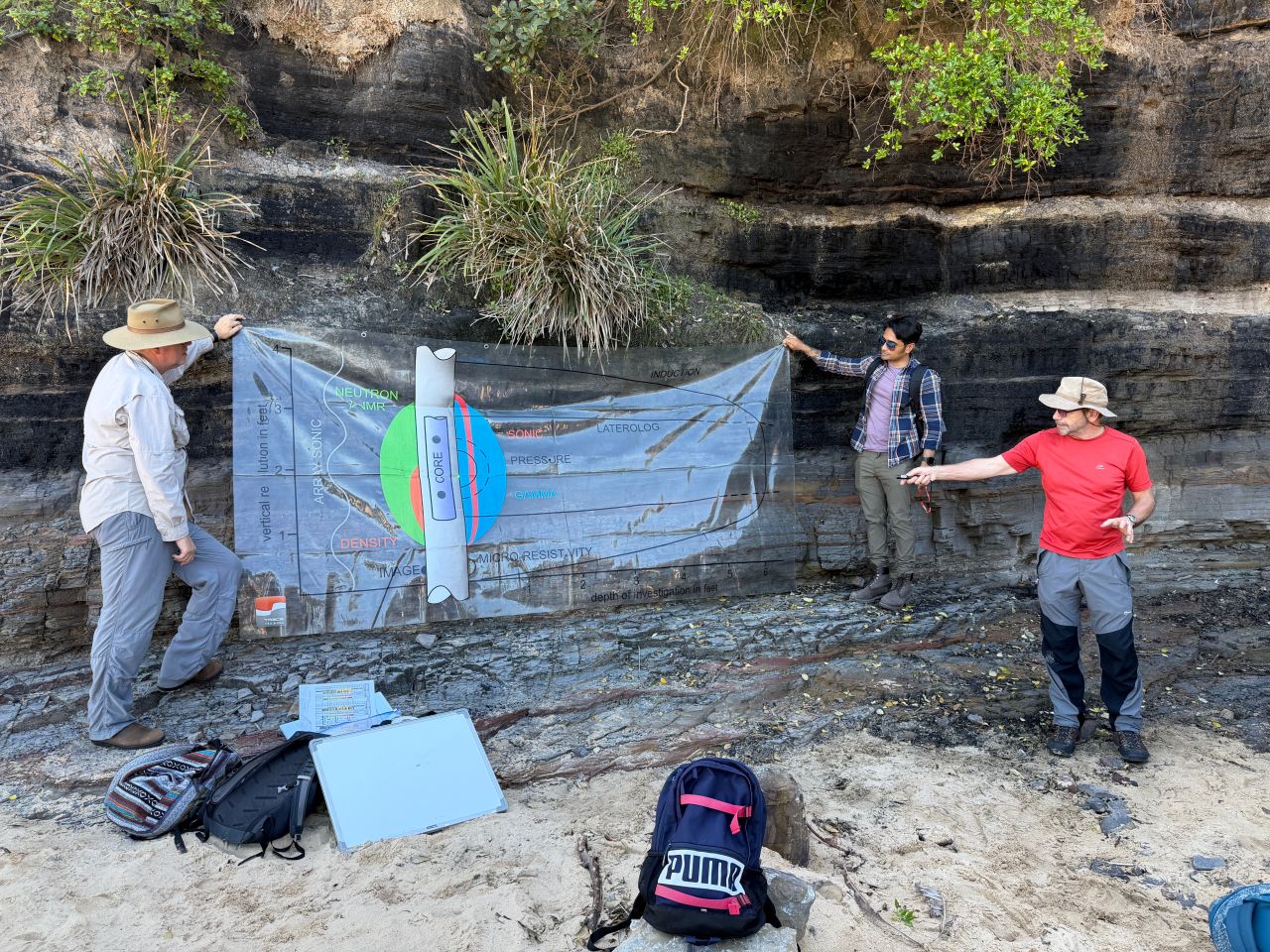
Mark Bentley always says that if you can sketch it, you can model and simulate it. “And that is exactly what we tried to do,” says Lilly. “With the help of props such as a shower curtain for petrophysical log responses, and seismic goggles to think about scale. In a way, the modelling exercises in the evenings made the group come together more: Leaning into their instincts, geologists went full steam ahead in the field with classifying a multitude of lithologies at the outcrop, whereas the engineers were thinking more about flow units. The best discussions began when we got into our groups to challenge that behaviour and start thinking like the fluid.”
“Immediately seeing the effects of the observations made in the field being reflected in how a reservoir model is built, how the sands are connected, and how the fluids are being produced from those was instrumental to better understanding the impact of the decisions we make in our daily routines,” adds Lilly.
“Spending time away from the office in a field setting really helped to encourage these discussions, and the software element builds the bridge to our “normal” jobs at the same time, making it all the more relevant. It also made people from one discipline use the software tools that they normally don’t use, which further stimulated understanding of each other’s expertise.” Maybe field trips and software exercises are a good mix after all.