
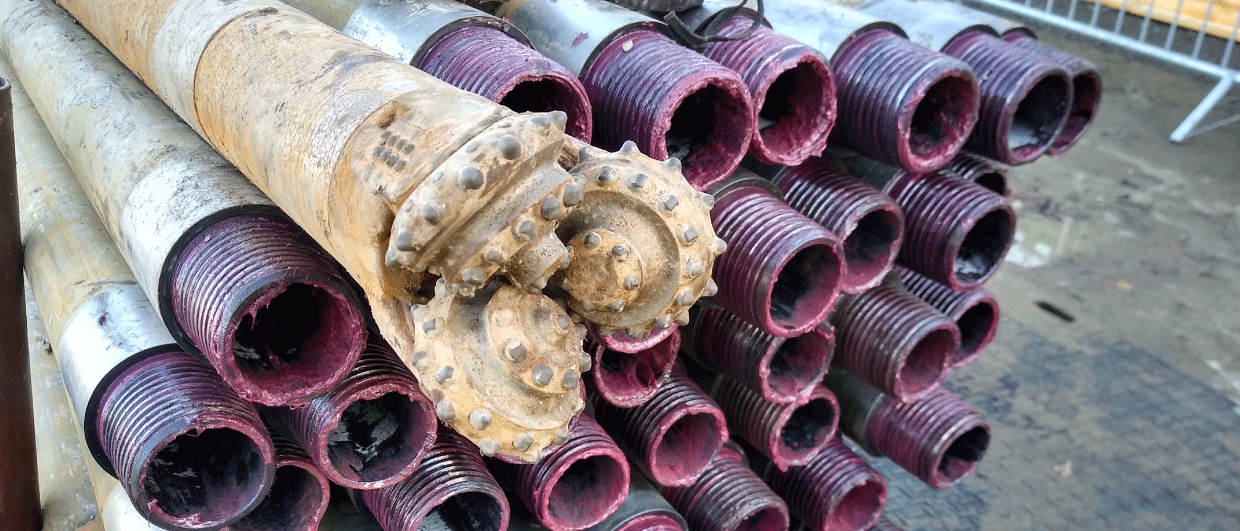
A bit and drill strings at a shallow geothermal project in Aberdeen, Scotland. Photo: Henk Kombrink.
The market challenges that force the shallow geothermal industry to continue innovating
If you want to stay in business in the shallow geothermal drilling industry, there is no other way than to embrace external cost pressure whilst trying to drive down installation costs

With a summer like the one Europe had this year, one would think that the shallow geothermal market is experiencing a busy time. At the end of the day, the loops can not only be used for heating, but for cooling too. The reality is a bit different, as I learned from talking to some industry insiders.
Escalating material costs are a serious burden for many operators, with both fuel and the cost of plastics used for the U-tubes having risen sharply in the last few months. This is also what Signhild Gehlin told us about the Swedish market earlier this year, when she attributed this to rising oil prices.
The high upfront investment that is required for a shallow borehole remains an issue too, especially when people can equally choose an air source heat pump. One way this upfront cost of drilling a borehole can be softened is to share a well amongst several households and create a mini heating network. It is something that seems to happen more often these days.
Increasing competition is another factor that drives prices down. The fact that there are more drilling companies can of course also be seen as an indication that there is more demand for their services, but at the moment it looks like market demand is not sufficiently buoyant.
Is it therefore a surprise that some companies have decided to throw in the towel? Celsius Energy announcing cessation of operations in France is probably the most visible decision in this space. Knowing that they are a spin-off from SLB, a company that is used to generating profit in the oil and gas industry, they must have been unimpressed with the margins that are being generated in shallow geothermal. As one insider told me: “These guys came in with an oil and gas mentality, thinking they were going to revolutionise the shallow geothermal industry because “they knew better…”. These two industries are completely different. The only similarity is tapping the ground for a resource.”
What remains is innovation in drilling to drive down installation costs further. The recent news from US company Dig is clearly aiming at that. They use a jet grouting technology to “drill” the hole, and only need to go one way because both the drill string and the nozzle stay behind in the borehole when the target depth has been reached. The borehole will then be used as a heat exchanger using a coaxial loop.
Someone with hands-on experience with this type of drilling told me that this approach makes sense, but that drilling into harder rocks and depths beyond 150 – 200 m may be a problem. The presence of fractures, gravel and thin aquifers may also pose a risk because it can lead to loss of water. However, a spokesperson from the company told me that they are capable of drilling into hard rock as well.


