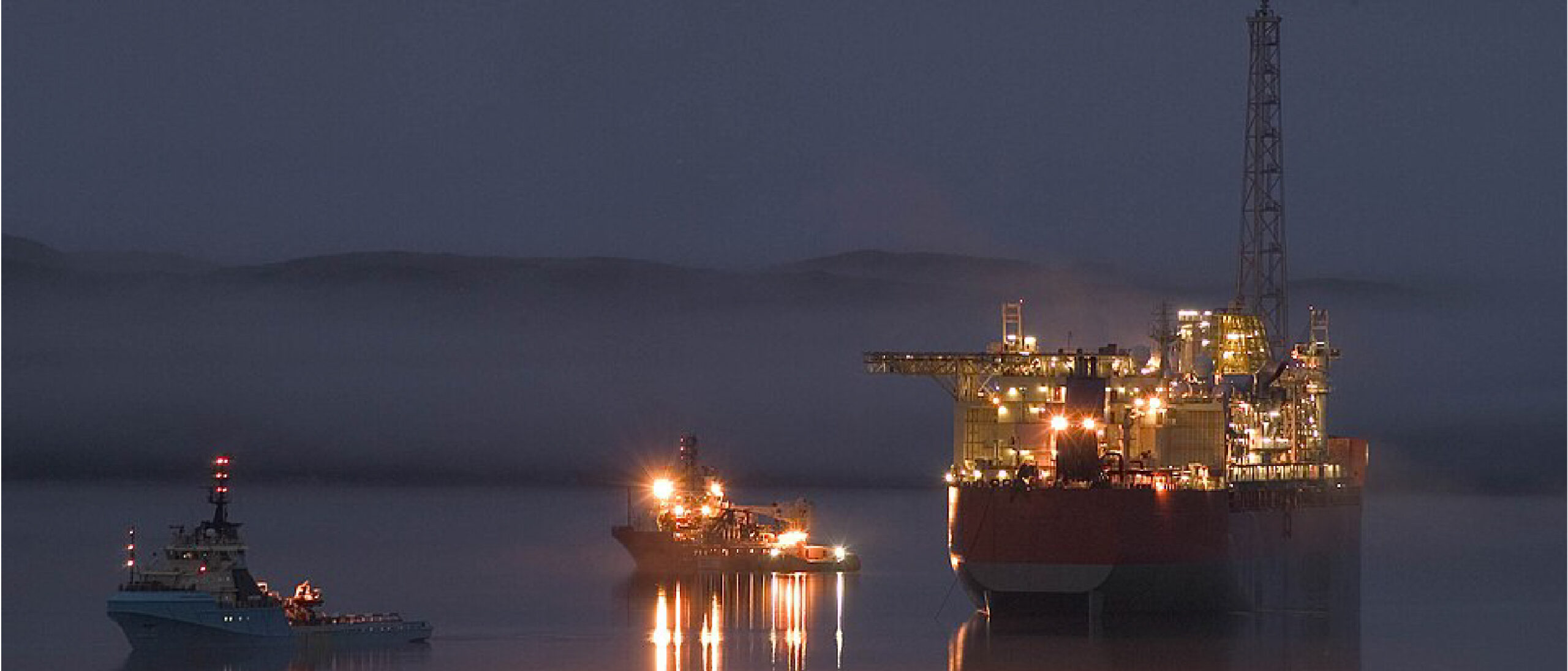
The SeaRose FPSO and offshore support vessels. Photo: Berardo62 via Wikimedia Commons.
Deepwater’s playbook for delivering growth
There are various ways to achieve the long-term attractiveness of deepwater projects

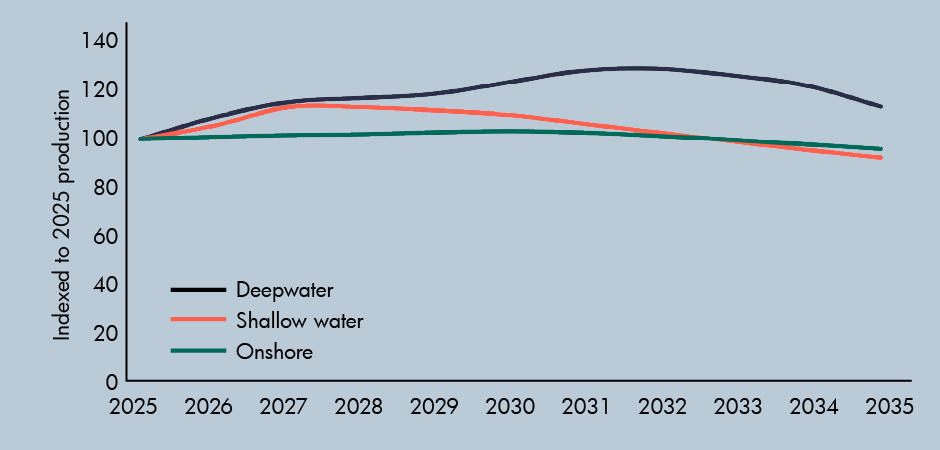
Deepwater production remains a core part of the long-term energy supply mix. While production from conventional onshore and shallow-water assets is expected to remain broadly flat under our base case, Welligence estimates that global deepwater oil production will grow from its current level of around 8 MMbbl/d to close to 10 MMbbl/d by the early 2030s.
However, post-2035, deepwater production is set to enter decline unless the hopper of pre-FID deepwater projects is replenished in the medium to long-term. But achieving this medium-term deepwater growth trajectory will require a tangible step up in investment. With IOCs maintaining a strong focus on capital discipline and applying strict criteria to new investment, only the most resilient and commercially attractive deepwater projects are progressing to FID.
As IOCs look to both existing and frontier opportunities, new developments are being assessed through a carbon lens as part of project screening, with emission reductions built in, not just bolted on. However, while deepwater production can offer some of the lowest-carbon barrels in an operator’s portfolio, commercial viability remains a challenge.
With FPSO topside costs estimated at between $50,000 and $60,000 per tonne, the incremental capital required can be in the hundreds of millions of dollars. One emerging technology that could ultimately reduce the operational footprint on FPSO topsides involves moving processing equipment subsea. This solution could lead to an overall reduction in emissions while also cutting the topside weight requirement for the FPSO. But the potential costs and system reliability will be critical to adoption.
There is, however, a growing comfort with new technology, especially digitisation and artificial intelligence (AI), where adoption of technologies like digital twins can be leveraged for real-time monitoring to enable early risk identification. With predictive analytics, operators can pre-emptively intervene rather than reactively fix. This new approach reduces process downtime by up to 30 % in some deployments. AI can also streamline and eliminate waste. Logistics, spares management, optimised maintenance and inspection routines, and reduced specialist interventions can significantly reduce opex. Savings of between 10 and 20 % have been projected. With early adoption by operators including bp and Shell in GoM, the industry will be watching closely.
As companies push the deepwater envelope and projects become increasingly more challenging, designing systems for remote operations not only reduces safety risk but can materially reduce the cost of crewed interventions over field life. While high initial costs have muted early implementation, with continual improvement in data processing and AI, tangible savings are likely and with that, a new addition to the deep-water playbook.