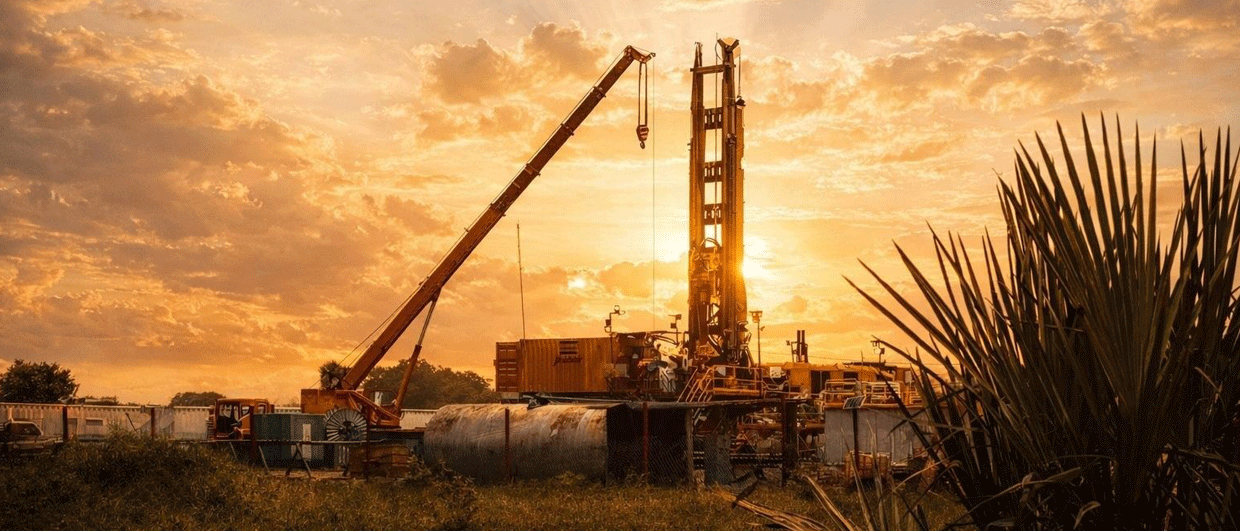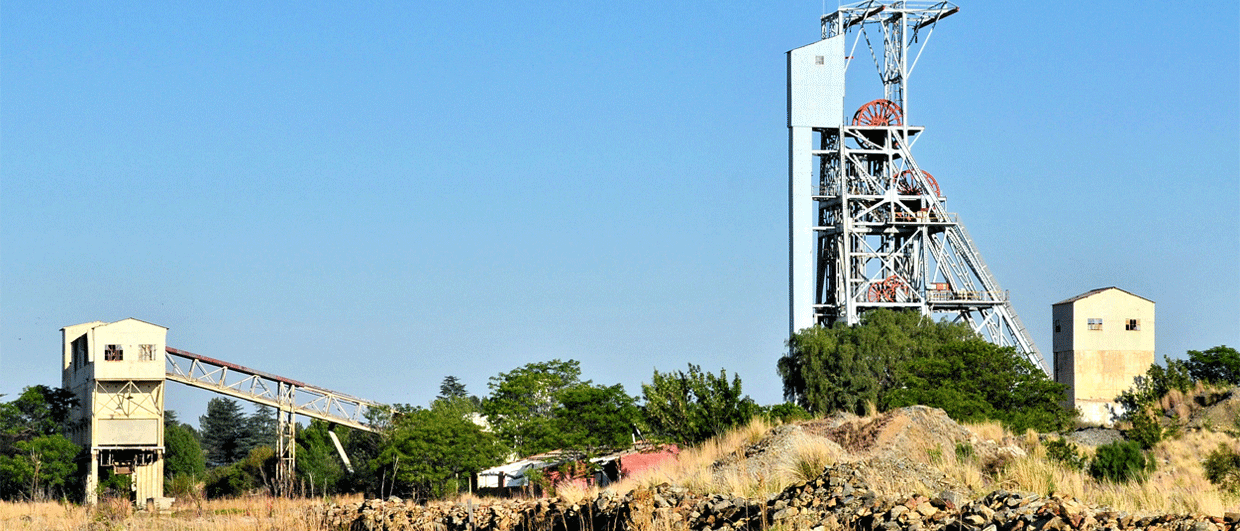
Gold mine in Welkom, South Africa. Photo: Ossewa via Wikicommons.
Revival of South Africa’s first commercial Helium project
Boreholes drilled during gold exploration in the Witwatersrand Basin often emit gas, and not a little bit. Some of these so-called ‘blowers’ have reportedly flowed for decades without any noticeable drop in pressure, and frequently need to be plugged to avoid hazardous situations

These observations prompted Renergen to apply for a natural gas exploration permit across Welkom, Virginia and Theunissen in Free State, South Africa. They soon discovered that apart from methane, the gas also contained high concentrations of helium, an opportunity that could potentially double their income stream.
LNG production for the local market came online in 2022, yet output was well below target, and commercial helium production never materialised at all. In May 2025, ASP Isotopes stepped in and agreed to buy Renergen. Even before the acquisition was finalised, ASP launched a new exploration and drilling campaign. Within a year, this resulted in a 60 % increase in LNG production and 18 new wells drilled.
The Witwatersrand is not a conventional hydrocarbon basin, so the origin of the gas is intriguing. The Archean metasediments of the Dominion and Witwatersrand groups are not only enriched in gold but also in uranium and thorium. The slow radioactive decay of the latter elements has, over time, generated a large volume of helium, along with various solid decay products.
In addition, the Witwatersrand Group contains carbonaceous layers, possibly the remnants of stromatolite mats. Microbes are currently feeding on this fossil organic material and are producing methane as a result. Both the helium and biogenic methane migrate through basement faults, mixing in varying proportions. This means that the gas composition differs from well to well, with some wells having as much as 12 % helium.
Because the basement has virtually no porosity, the gas is trapped in faults as well as in sill and dyke contact zones. To increase the chance of hitting these structures, Renergen drilled deviated wells. ASP Isotopes continued with this strategy but drilled deeper and used improved subsurface modelling to optimise well placement. As a result, 15 out of the 18 new wells intersected gas. They also identified a previously unrecognised sandstone reservoir at shallow depth (<400 m), which contains additional gas.
With the drilling campaign completed, ASP is preparing to tie back the wells to the processing facility. The biogenic nature of the methane means that virtually no heavier hydrocarbons are present, simplifying LNG production. During liquefaction, the gas is cooled to -162⁰ C and liquid methane is separated. The remaining helium-nitrogen mixture is then cooled further to -269⁰ C to liquify the helium.
After tentatively being listed as the eighth helium-producing country in the world for several years running, 2026 might finally be the year that South Africa secures its place, albeit with a humble 58 MCF per day.