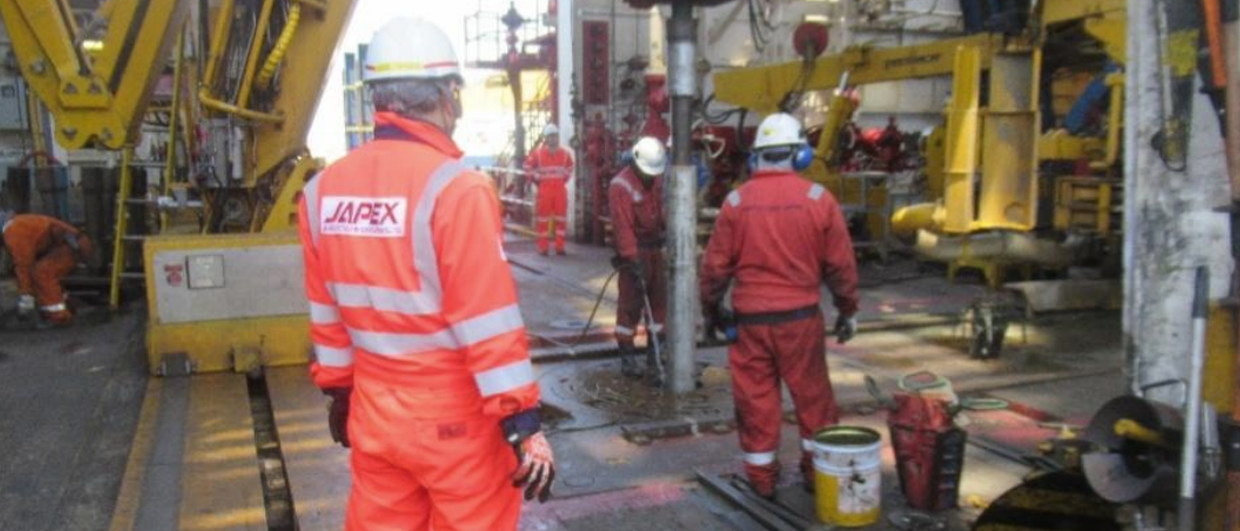
Drilling operations during the recently completed well in the Hidaka Trough. Source: Japex
Japex’ hopes to prove commercial gas offshore Japan down following completion of exploration well in Hidaka Trough
Sub-commercial gas found in what looks likely to be a series of mass transport deposits

Japex completed an offshore exploration campaign in the Hidaka Trough last week, a tectonically active foreland basin in the north of Japan. The well, drilled at a water depth of 1,900 m, has however failed to find commercial volumes of gas.
Seven years ago, the company also explored the region through drilling a well only a few kilometres away in shallower waters. At the time, it was concluded that potential exists, as a flow test achieved stable gas production even though a rate was not reported.
In this well, gas was found again, but the press release notes that it does not meet the criteria for being commercial at this stage.
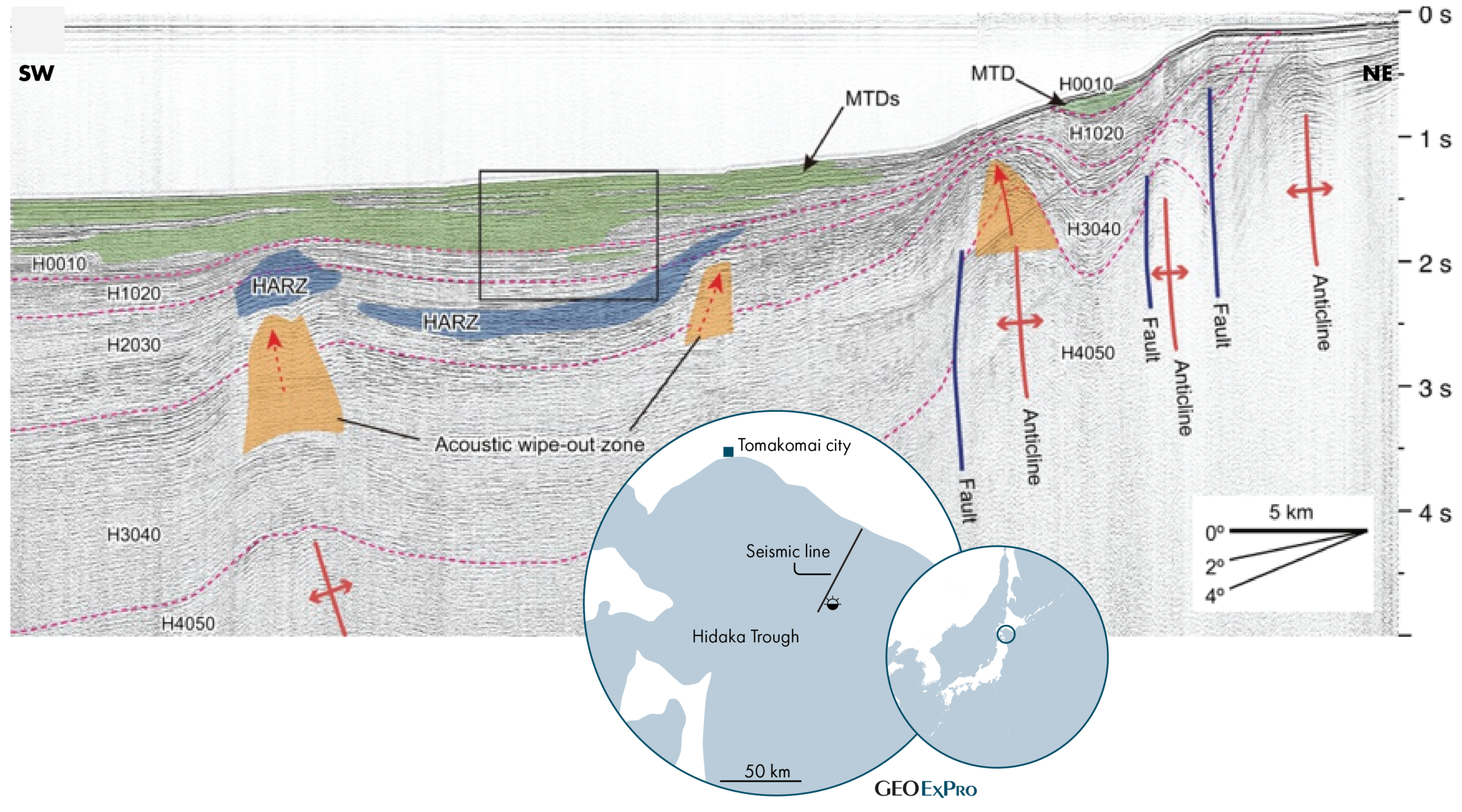
Even though the target of the well was not mentioned in the communication, we postulate that a complex of Mass Transport Deposits (MTDs), possibly of Quaternary age, was the primary drilling candidate for the well. An article published in 2013 contains a seismic line that runs very close to where the well was drilled, as shown in the illustration below. The authors mention the omnipresence of MTDs in the subsurface, which seems to be the main way of transporting sediments in the active foreland basin. No channel-levee systems have been observed in the basin at all.
The presence of gas in the shallow subsurface can be linked to acoustic wipe-out zones, in combination with high acoustic reflection zones above and lateral to these. In addition, pockmarks and gas chimneys have also been reported. The source of gas is speculated to be derived from a Cretaceous coal-prone source in the basin.
Looking at domestic oil and gas production, Japan has seen quite a sharp decline in recent years. Oil production has fallen from 3.9 million barrels per year in 2014 to 2.4 in 2023, and gas from 2,7 to 2.0 Bcm during the same time period. Many of the currently producing fields were found in the 1960’s to 1980’s and have been on stream for decades.
It must be against this backdrop of falling domestic production that the Japanese are trying to find new plays that could potentially be tapped into. The country is already known for its particular oil and gas reservoirs, with volcanic rocks being one of those. Whether the shallow subsurface will continue to remain on the radar following completion of this exploration well remains to be seen.