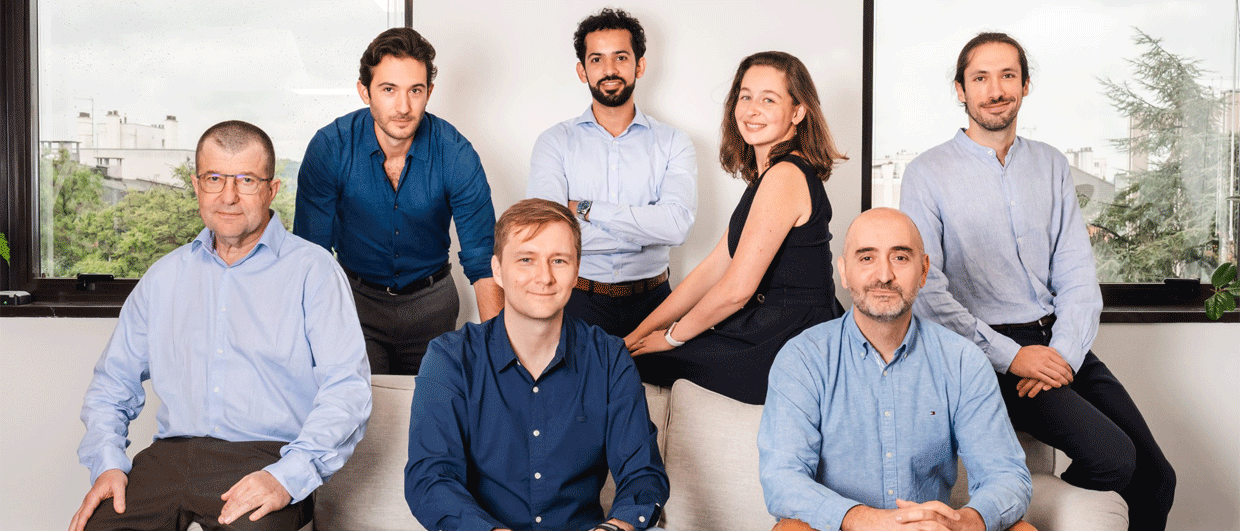
HyReveal’s team. From left: Frederic Schneider, Maximilien Verdier-Paoletti, Viacheslav Zgonnik, Théo Hamadé, Nolwenn Simonot, Jonathan Allard and Dan Lévy. Photo: HyReveal.
Until now, hydrogen exploration wells were drilled half-blind
Viacheslav Zgonnik and Jonathan Allard are putting an end to that as they developed software to model hydrogen generation, migration and trapping

There is often an element of coincidence associated with how companies form. That also applies to how Viacheslav Zgonnik and Jonathan Allard from French tech start-up HyReveal came together two years ago.
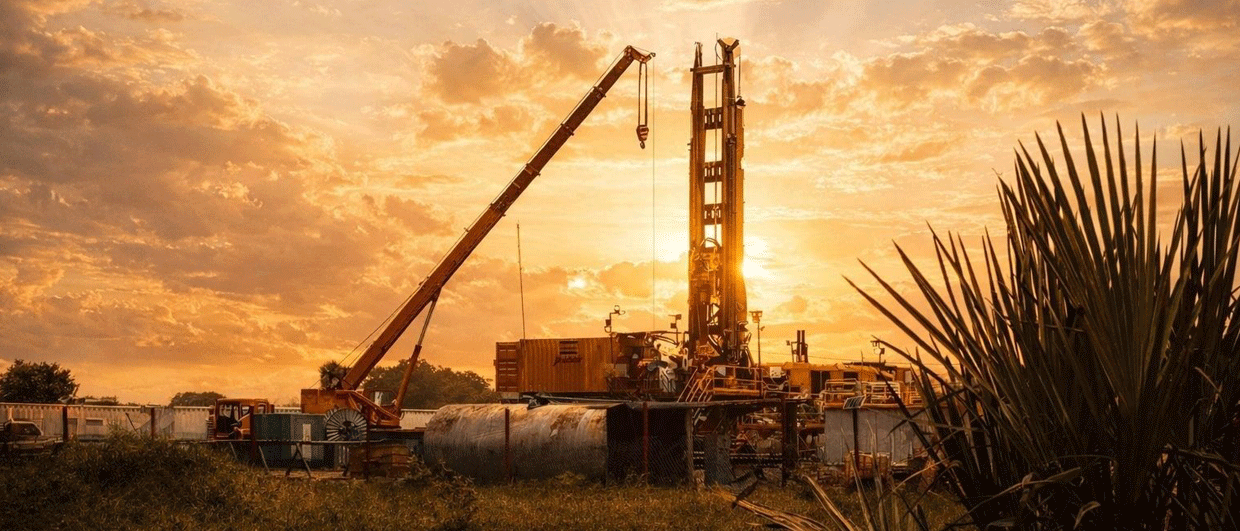
While Viacheslav was drilling the first dedicated hydrogen exploration well in the USA, Jonathan, who had a position in an oil and gas exploration consultancy firm, got more and more intrigued about hydrogen exploration.
Jonathan therefore decided to get in touch with the company that was drilling the well in Nebraska, to enquire about the project. He also reached out to Viacheslav via LinkedIn, and only then did they realise that they were only 3 km from each other, in the Paris region.
“We realised that there is a lot of material already available in the oil and gas industry that we could use, but that needs to be adapted for the hydrogen business,” explains Jonathan. “That was the main reason for us to form the company, to overcome the exploration pain points by smartly repurposing the concepts that are already out there for oil and gas.”
I’m quite sure that the main pain points for most hydrogen exploration wells drilled so far are in the source rocks and the charge risk – Jonathan Allard
“In short, our expert team is building a basin modelling toolbox for hydrogen exploration,” says Viacheslav. “Like in oil and gas, where you de-risk an area through modelling source rock maturity and charge, we are doing something similar for hydrogen.”
“Microbiology is a key factor that we needed to include,” says Jonathan, “because hydrogen is consumed in this way. If you don’t include it, you therefore underestimate the risk of drilling a hydrogen prospect.”
At the same time, some building block elements are very similar to what “conventional” basin modelling software uses, such as horizons and faults, and burial history. Moreover, the solution HyReveal developed, called IORIGIN, also models hydrocarbons, but can do even more gases like helium, nitrogen, hydrogen sulphide or carbon dioxide.
One of the things that HyReveal is developing the software for is to create a link between surface hydrogen measurements and what is happening in the subsurface. Because often, surface samples are used to prove that there is a promise of finding hydrogen deeper down, but how valid is that? “That’s the question we want to answer using a model that predicts how hydrogen is being sourced and how it migrates to surface,” says Jonathan.
But how to make sure that the model is actually reproducing results that make sense? “That’s a key aspect indeed,” says Jonathan. “We reproduced the digital twin of published lab experiments simulating the different ways natural hydrogen forms. That way, we have a tuned model that is calibrated against published experiments. We also used the gas data from the well Viacheslav drilled in Nebraska to use as a calibration of our model. More case studies are ongoing.”
“I am convinced that we are only in the very first phase of hydrogen exploration,” concludes Viacheslav. “Years ago, we wondered if natural hydrogen exists. Now, we are slowly getting better at finding it, with the right tools.”