
What are we risking and why is it important?
Some explorers believe that, when assessing the Probability of Success and volumes of an exploration prospect, it is best to risk the P90 or P50 volume. This is not correct; it confuses risk and uncertainty, and it leads to overprediction of prospect volumes

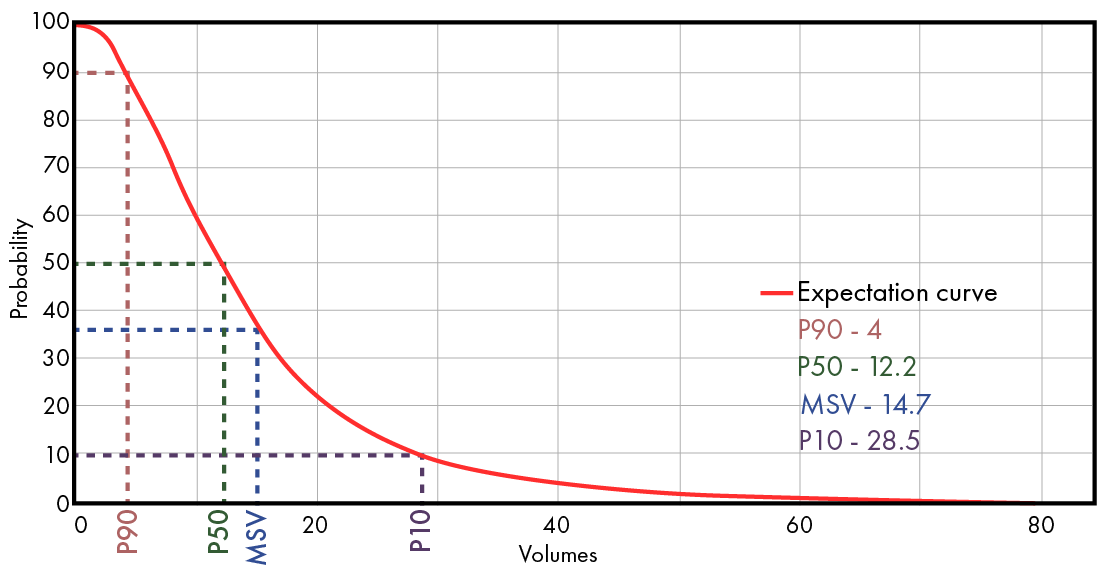
Risk is about the chance of finding producible hydrocarbons; uncertainty is about the volume of hydrocarbons that may be found in the case of success. The geological Probability of Success (POSg) of an exploration prospect is linked to the expectation curve, which shows the range of hydrocarbon volumes that may be found in the case of success.
From the expectation curve, we can simply read off the chance to find more than any specific volume in case of success. The chance to find more than the P90 volume is 90 % in case of success, so the a priori chance of finding the P90 volume or more is 90 % of the POSg (De Jager, 2021). It makes absolutely no sense to risk the P90 or P50 volume for estimating the POSg. The chance to find the P90 volume is 90 % of the POSg – it is not the POSg itself.
Likewise, for a Minimum Economic Field Size (MEFS or commercial cut-off volume), the chance to find at least that volume is the POSg multiplied by the P value that goes with the MEFS.
Risking a P90 volume also begs the question of whether we are actually able to differentiate between the chance of finding a P90, P80, P95 or any other P volume. Of course, we can’t. Only once the expectation curve and POSg have been established, can we read them off the chart of the expectation volume.
What this implies is that we need to be very clear about the definition of “technical success”. The most useful definition I know of exploration success is: “A discovery that finds producible hydrocarbons that could be produced at a sustainable rate of production” (after Otis and Schneiderman, 1997).
Now, why is all this important? In practice, and strangely enough, I don’t think that the estimated POSg is much affected by what we say or think we are risking: A technical success, the P90 or the P50 volume. What is affected is the predicted volume range. Risking the P90 is taken as an excuse to exclude small volumes from the predicted volume range. Those are then “in the risk”, which is, of course, confusing uncertainty for risk.
And when we have put these smaller volumes in the risk, the P90 of the resulting expectation curve will be too high a volume and also the mean success and the P50 volumes will end up being too high. It is yet another factor, together with a series of biases that we tend to suffer from, that leads to overprediction of volumes, which we all know is a major shortcoming of exploration geologists.