Image: Adobe Stock.
The tricky part of resource assessments within gas-dominated basins or petroleum systems
Two critical learnings to take into account

When conducting prospect resource assessments within gas-dominated basins, there is a low likelihood of oil or mixed-phase accumulations being filled to spill. If this is not properly considered, prospect resource assessments may overestimate predicted oil volumes, thereby creating unrealistic expectations for subsequent exploration programs. Let’s take a closer look at the factors influencing this.
The first critical learning relates to the controls on hydrocarbon phase in saturated, gas-prone petroleum systems and their relationship to the Sales trap classification scheme (Sales, 1997). Class 1 traps, or filled-to-spill traps, require strong seals that retain a gas column while, during the charge process, displacing the oil leg and any excess gas updip, ultimately leaving behind a gas-only accumulation. Class 2 traps are associated with intermediate seal capacity, where the gas cap leaks vertically and a dual-phase column is preserved. In these cases, the trapped oil volume depends on both the bulk charge volumes and the vertical relief of the structure. Class 3 traps are characterised by weak seals, where both oil and gas leak vertically, leaving behind an underfilled oil-only column. In general, oil columns are more likely to be encountered in structures with greater vertical relief, as the higher buoyancy pressures increase the likelihood of exceeding seal capacity.
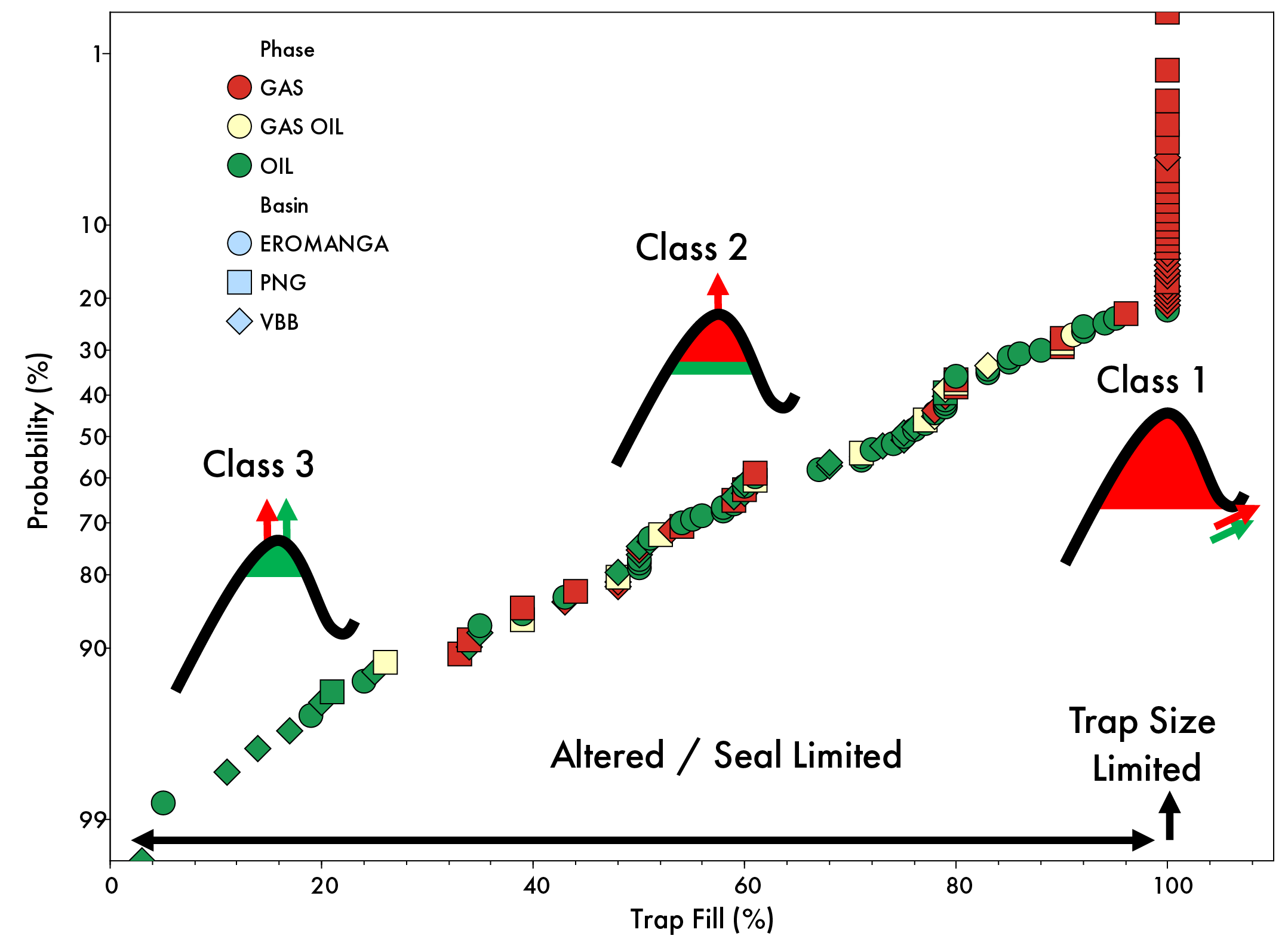
The trap classification scheme can be applied to the column height characteristics observed for a specific basin. Here, we show the column height distribution by hydrocarbon phase and trap fill percentage for the Australian Eromanga and Vulcan-Bonaparte basins and the fold and thrust belt of Papua New Guinea. It is evident that Class 1 traps are primarily trap-size limited, resulting in filled-to-spill, gas-only accumulations. In contrast, Class 2 and Class 3 traps commonly contain altered hydrocarbons or are seal-limited, resulting in underfilled oil-only or mixed-phase accumulations. The degree of underfilling reflects the balance between gas removal from the accumulation – which leads to overall volume shrinkage and a reduction in column height – and the charge characteristics, our second key point.
The charge volume and gas-liquids ratio (GLR) of the underlying petroleum system control the available volumes of fractionated oil. For a GLR of 20,000 scf/bbl, at least 8 Tcf of gas is needed to leave behind 220 mmbbl of oil at the depth and pressure of the Class 3 trap by migration fractionation, while still leaking oil still contained within the gas. If the charge is richer in liquids, less overall gas charge volume would be needed to fractionate 220 mmbbl of in-place volume out.
In contrast, for a higher GLR charge, significantly higher bulk charge volume would be needed for the same result. Overall, the less liquids dissolved in the charging gas, the more needs to transit through the leaky trap to fractionate sufficient amounts of oil. This highlights the challenge of fractionating significant oil volumes in petroleum systems characterised by higher GLR.