Photo: Photocreo Bednarek via Adobe Stock.
Conjugate margins in the Indian Ocean
Exploration activities in the area oceanward of the Strait of Hormuz choke-point

The concept of conjugate margins as a geological model on which to base exploration strategy is well established in the Atlantic, where the extensional plate boundaries and geomorphology are clear and definitive. But other oceans also have conjugate margins, and it is worth looking at the Indian Ocean in this context.
Many of the countries surrounding the ocean, including Mozambique, India, Indonesia and Australia, are established offshore hydrocarbon producers, while in others, the industry is nascent. This applies to Somalia, for instance. In other places, the E&P business has traditionally focused onshore, such as in Oman and Pakistan.
Extensional, transform and compressional boundaries
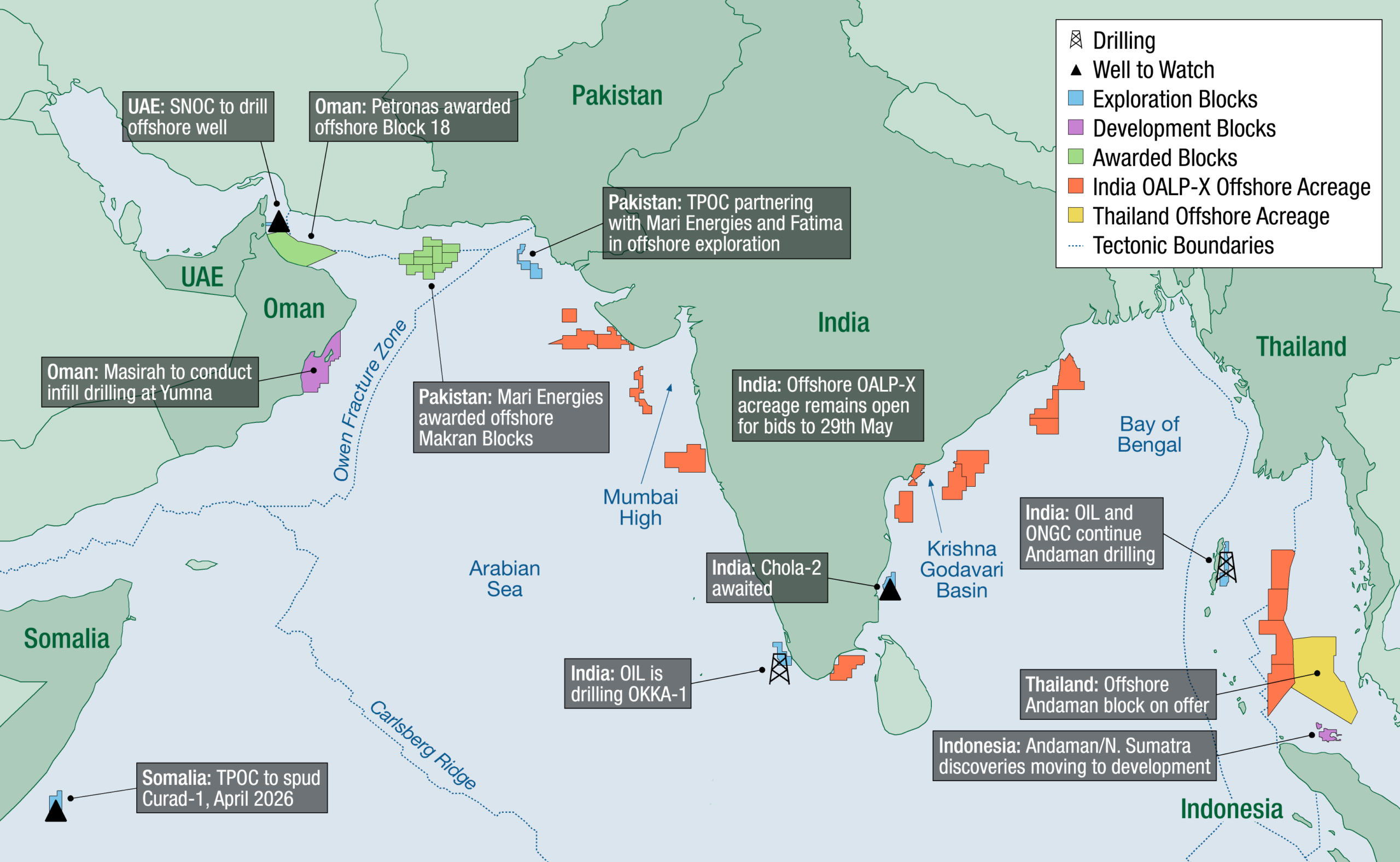
The Indian Ocean’s crustal architecture is defined by extensional, transform and compressional boundaries. The conjugate margin in the Arabian Sea, associated with the Owen Fracture Zone, places southern Arabia and parts of east Africa against south-west Asian coastlines, in which India’s Mumbai High carbonate platform is the significant petroleum province. Clastic plays remain lightly explored, while historically, exploration activity has been on a nation-specific basis, and it is not obvious whether a pan-regional approach to exploration has been considered or progressed.
However, recent activity levels in the western part of the ocean suggest that things are changing.
TPOC (a subsidiary of TPAO), fresh from E&P success in Türkiye’s Black Sea, reportedly acquired 15,000 km2 of 3D seismic around Blocks 152 and 153 in Somalia. Now, the company plans to drill the first offshore exploration well in over 40 years, Curad-1, beginning in April 2026.
TPAO also entered Pakistan as a result of the 2025 offshore licensing round, partnering with domestic companies Mari Energies and Fatima Petroleum to explore the area around the 1985 stranded gas discovery Pakcan-1. Play types in both situations appear to be classic ‘passive’ margin plays, characterised by stratigraphic traps, marine channel and fan systems and gravity-driven anticlinal folds. On modern or reprocessed seismic data, leads in these plays are often associated with DHI’s, supported by surface seeps.
Mari Energies has also taken a key position in the underexplored Makran Basin, offshore western Pakistan. This accretionary wedge has long been overlooked due to remoteness and perceived limited prospectivity. Its counterpart is the Batinah coast of NW Oman, where Petronas, partnering OQEP, has recently been awarded offshore Block 18, as part of the 2025 licensing round. This is a vastly underexplored frontier, despite Oman’s status as a mature hydrocarbon-producing nation onshore. With the exception of the shallow water Yumna field, which has a Cretaceous clastic reservoir, previous drilling offshore Oman, including Eni’s two deepwater wells, has not been successful. However, the density of drilling is exceptionally low.
In the UAE emirate of Sharjah, one of the few with an Indian Ocean coastline, SNOC is planning to play-test an offshore exploration well in the near future. If successful, this will undoubtedly help to de-risk Block 18 Oman and, perhaps by association, its conjugate margin.
Meanwhile, further along the Oman coast, Masirah Oil is planning infill and development wells at the Yumna oil field and has some exploration targets for interested joint venture companies.
Moving east
Moving east, the conjugate margin model is more ambiguous as transform and convergent margins dominate. In the Kerala-Konkan basin in India’s far south-west, seen as a conjugate to Madagascar across the Carlsberg Ridge, OIL is drilling the OKKA-1 exploration well, with results expected in June 2026. Madagascar itself is expected to open up for explorers this year as well.
The long-running OALP X bid round in India, now due to close on 29th May 2026 after numerous extensions and relaunches, offers potential in most of India’s key offshore basins, including the Andaman basin, associated with a convergent margin, which has been the focus of recent drilling campaigns by OIL and ONGC. These campaigns have so far yielded only one discovery announcement, OIL’s Vijaya Puram-2 in September 2025, which flowed gas on test. While gas was reported as being 87 % methane, the test flare, as seen on social media, was described at best as ”intermittent”, and media speculation that the basin represents “the next Guyana” seems unlikely. This has not, however, deterred Thailand from offering one large offshore Andaman block in a planned licensing round, spanning most of the Mergui Basin.
Meanwhile, Zawtika in Myanmar has been onstream since 2014, and at the southern end of the Andaman Basin in Indonesia, exploration successes such as Tangkulo and Timpan are moving into the development stage. This complex convergent margin region merits a multi-national approach.
ONGC is also expecting to spud appraisal well Chola-2 in the offshore Cauvery Basin, which will de-risk this 2024 gas condensate discovery. At the same time, Cairn has a drilling campaign planned in the deepwater Krishna Godavari Basin, where it has de-risked leads through the integration of CSEM technology and seismic data. These basins are essentially passive margins formed during the break-up of Gondwanaland, and their conjugate pairs are considered to be in eastern Antarctica.
Proximity to global markets
Taking a pan-regional strategic approach to the Indian Ocean reveals a variety of potentially play-opening activities and opportunities, and a growing diversity of active companies keen to take advantage of them. Notwithstanding geopolitical instabilities, proximity to growing markets in Africa and Asia, oceanward of the Strait of Hormuz choke-point, is an added benefit.