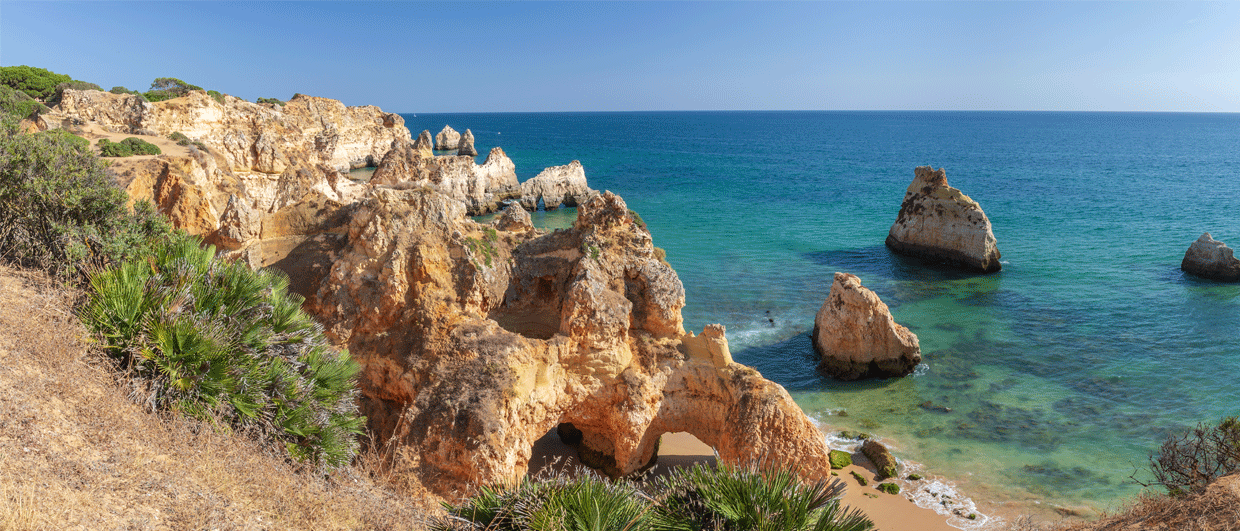
Along the south Portugal coastline. Photo: mmuenzl via Adobe Stock.
Offshore Algarve Basin geological carbon storage potential
Portugal emits roughly 40 Mt of CO₂ each year (APA, 2025), with about a quarter (10 Mt) coming from the country’s ten largest industrial point sources, including refineries, gas‑fired power plants, and cement production. This study evaluates the geological carbon storage (GCS) potential of the offshore Algarve Basin, highlighting its capacity to support the decarbonization of Portugal’s hard‑to‑abate industries and strengthen the national climate strategy

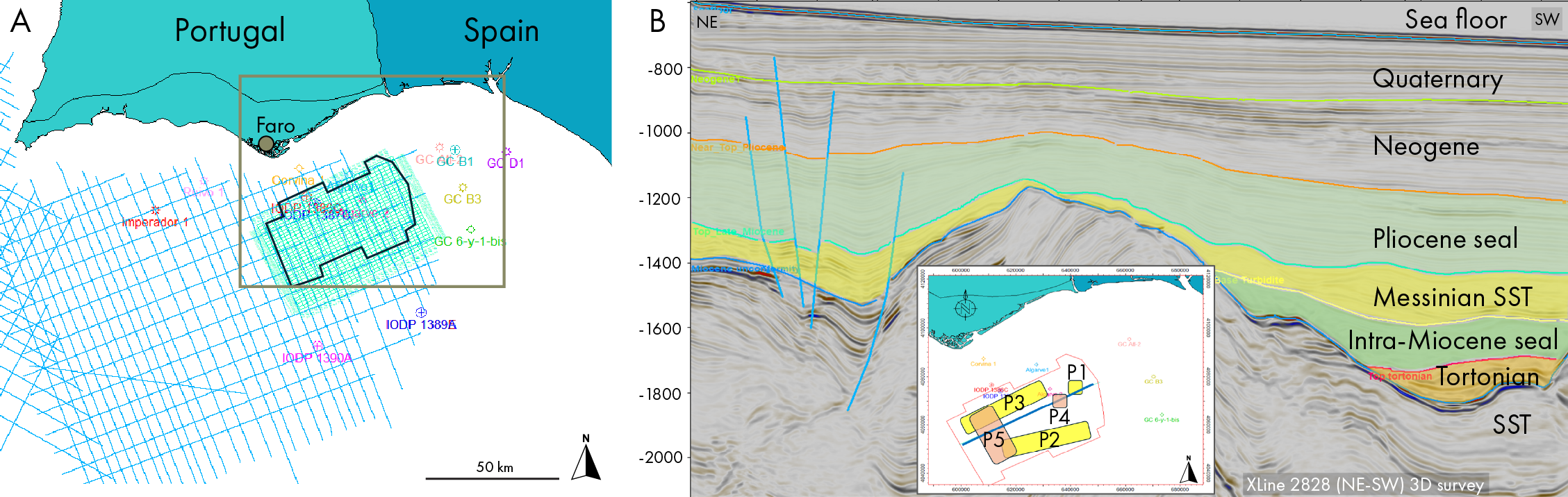
In the Algarve Basin, two late Miocene plays have been identified southeast of the Faro Peninsula using high-quality seismic and borehole data (Figure 1). These comprise of high-porosity turbiditic sands of Tortonian and upper Messinian age, overlain by regionally extensive, shale-dominated seals (Ng et al., 2022).
Their GCS potential reflects the interplay of stratigraphic architecture and structural closures. The stratigraphic features were recognised along sedimentary fairways interpreted from the morphology of the late Messinian and top Tortonian surfaces. The structural traps are predominantly salt-related, including reservoir pinch-outs against diapir flanks and four-way anticlines above diapirs (Matias, 2007). Five prospects have been identified, based on the lateral continuity of the Messinian (Prospects 1, 2 and 3) and Tortonian (Prospects 4 and 5) reservoirs.
Prospect analysis
Figure 2 illustrates the workflow for Prospect 5, showing the parameterisation of key Monte Carlo simulator inputs and predicted outputs. The analysis focuses on the theoretical storage resources, based on net pore volumes (NPV), which are dependent on the size of the trap and the proportion of reservoir rock and the porosity (Figure 2A). The thermal model uses a mean geo-thermal gradient of ~31° C km-1, consistent with regional constraints (Muñoz-Cemillán et al., 2025), and a surface temperature of 11.8° C, averaged from the CTD data within the study area (EMODNet). Hydrostatic pressures at the crest of the prospects vary between 9 and 14 MPa. To account for potential overpressure fracturing, a fracture gradient is applied (Figure 2B). Figure 2C shows that Prospect 5 carries some risk of liquid CO₂ under lower than average geothermal gradients, a very small risk of top seal leakage, and substantial theoretical resources (p50 of ca. 2.3 Gt of CO2).
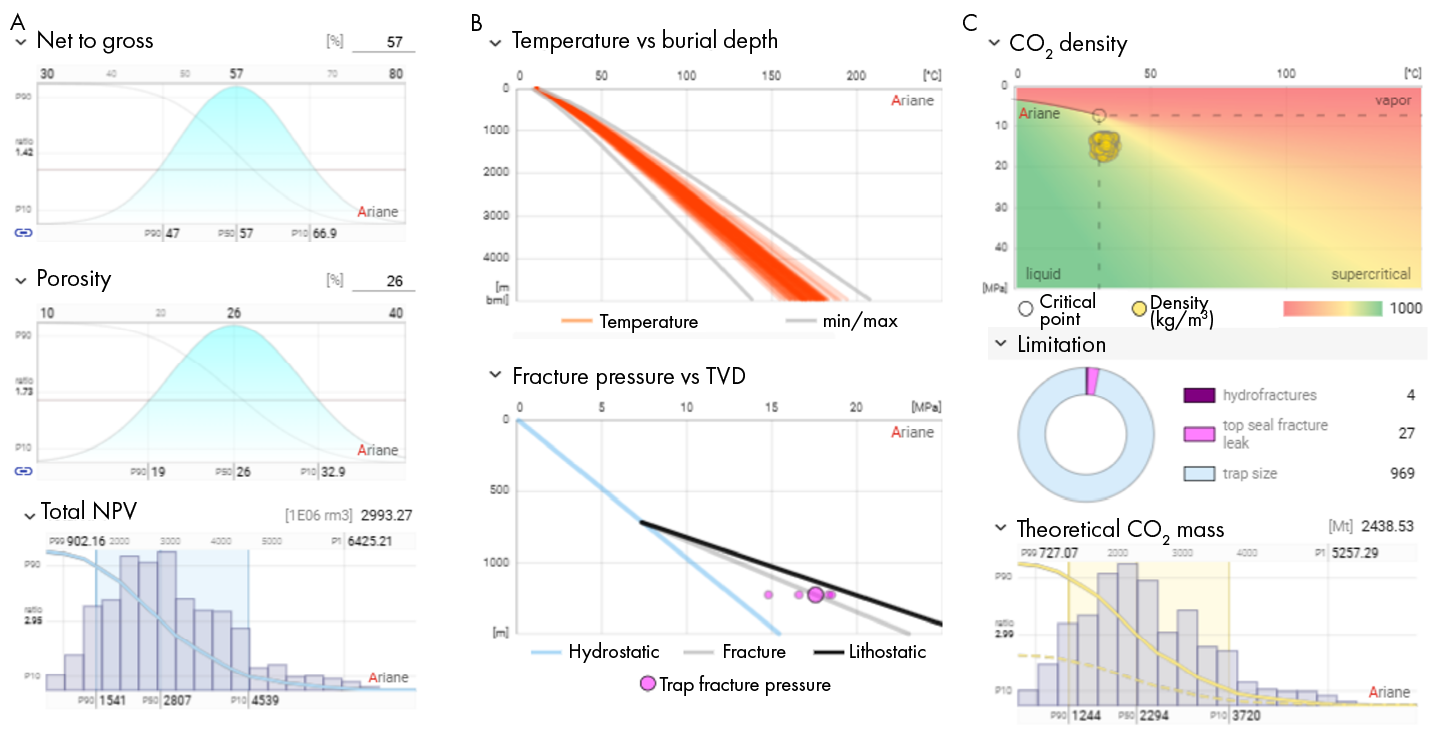
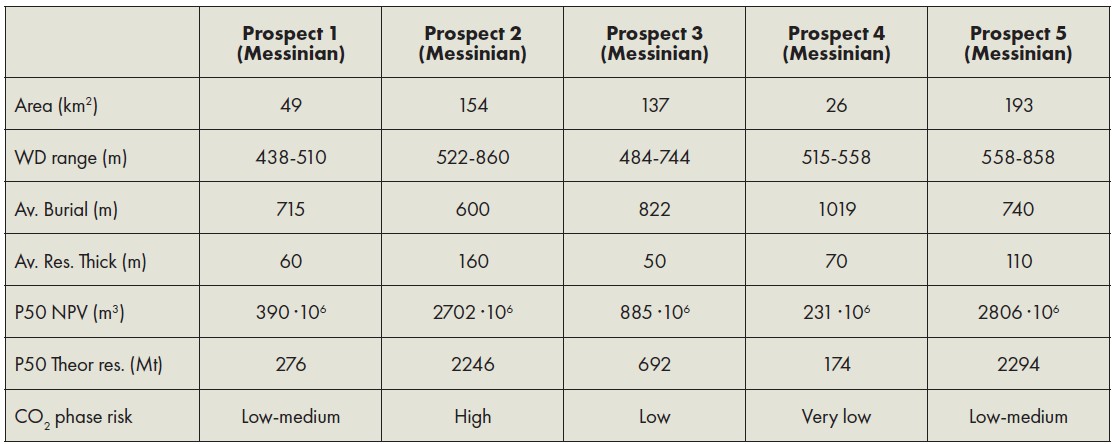
Table 1 summarises the key aspects controlling the variations in NPV, theoretical resources and phase in the modelled prospects. Prospect 2 holds significant NPV, but a high risk of liquid CO₂ , as a result of shallower burial, and will not be considered in the overall estimation of resources. Prospects 1, 3 and 4 show low to medium risk of liquid CO₂ and may also contribute to the GCS potential of the area.
GCS resources
Prospects 1, 3, 4 and 5 have been combined to estimate the range of possible theoretical resources for the entire block. A probabilistic aggregation of multiple prospects consists of calculating both risk and success case CO₂ masses as part of an interdependent co-simulation of all individual prospects. These prospects can be related to each other via risk dependencies: If one prospect succeeds, other dependent prospects are also likely to succeed, and volume parameter correlation (e.g. porosity, NTG).
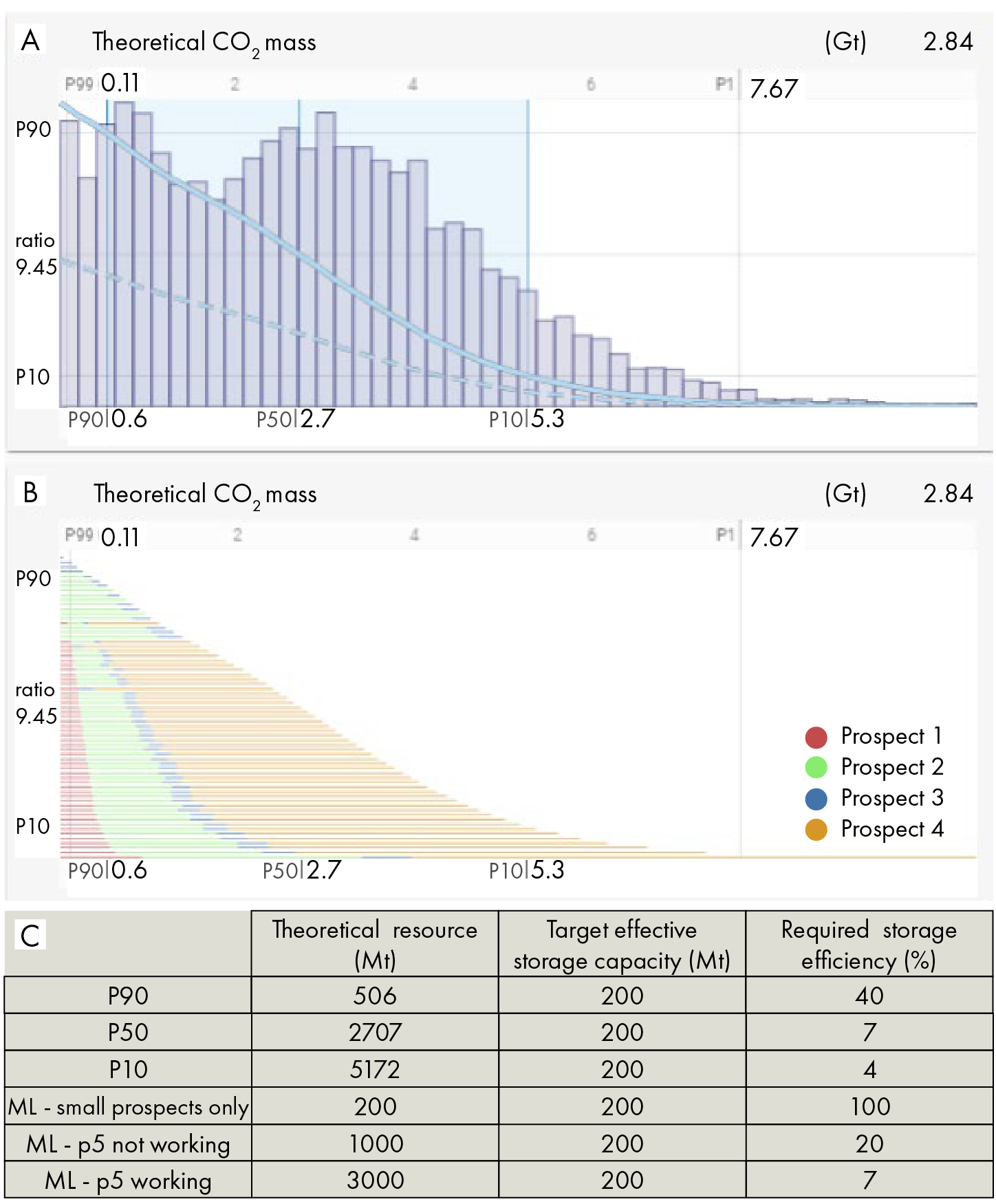
The likelihood that at least one prospect succeeds is 48 % (prospect cluster chance of success). In case of success, the theoretical resource range (Figure 3A) is very large – 116 Mt (p99) to 7.6 Gt (p01) – reflecting early exploration uncertainty. A more realistic conservative-to-optimistic range is 0.6 Gt (p90) to 5.3 Gt (p10). The mean theoretical resource is 2.8 Mt, with a median of 2.7 Mt (p50).
The most likely outcome is represented by the peaks in the resource distribution (either <200 Mt, 1 Gt or 3 Gt), dependent on the possible combinations of successful prospects. There are a few possible cases where either Prospect 3 or Prospect 4 are the only ones to succeed (<200 Mt scenarios). The 1Gt scenarios exclude Prospect 5, whereas Prospect 5 (chance of success 35 %) is needed for the cluster to exceed 2 Gt with a most likely of 3 Gt.
Discussion
Meeting a 200 Mt storage target over 20 years requires converting theoretical resources into effective capacity, which depends on storage efficiency. This is still uncertain for the Algarve margin. Even so, the results indicate that conservative scenarios or those excluding Prospect 5 would require unrealistically high efficiencies (Figure 3c). Prospect 5 should therefore be the focus of further work, including pore volume refinement, dynamic simulation, and risk assessment, with other prospects providing supplementary capacity.
We acknowledge the funding program 01/C05-i02/2022, financed by PRR (Next Generation EU). The authors would like to thank DGEG (Portugal) for providing the data for this study.