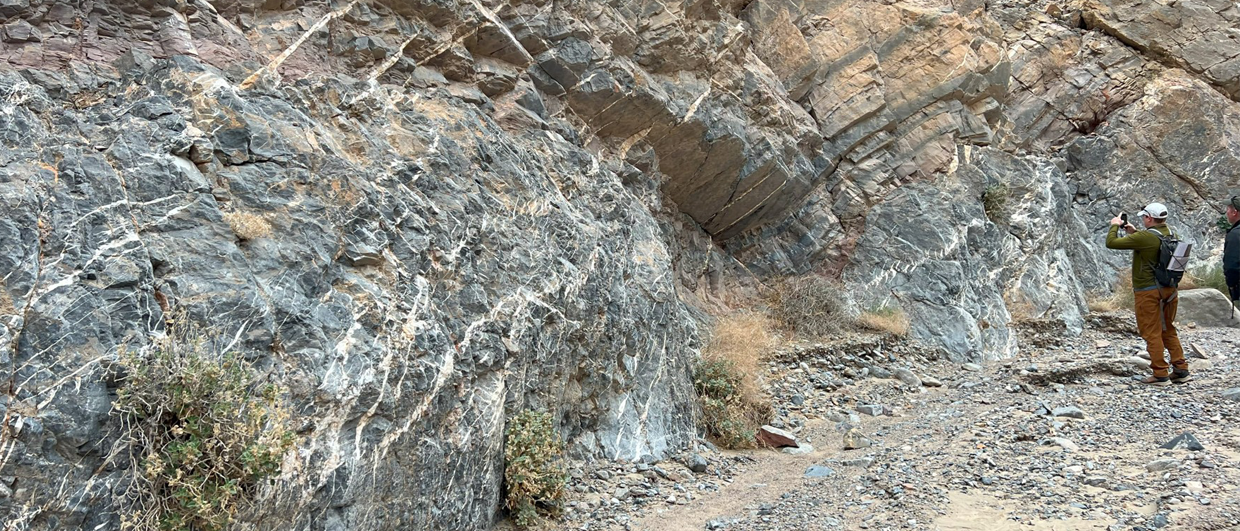
Molly Turko near the Tablelands of Bishop California Photo: private archive.
Recognising structural inversion
Three key rules serve as powerful and practical tools that every structural interpreter should keep readily available in their interpretation workflow

In structural geology, inversion describes a situation where a fault or structure is reactivated with the opposite sense of movement from its original displacement. The most common type is positive inversion, in which a normal fault is later reactivated as a reverse fault, although negative inversion, from reverse to normal, can also occur. Three practical rules help geoscientists recognise structural inversion when interpreting seismic sections or outcrop data.
The first rule involves looking for syn-tectonic thickness changes across faults. During an extensional phase, sedimentary packages typically thicken into the “down-dropped” hanging wall of a normal fault as syn-rift growth occurs (label 1a in the figure). Later, under compression, younger packages may thin toward the structure or onlap onto the crest of an anticline that has developed over the same fault (label 1b in the figure). This pattern of initial thickening followed by thinning or onlap strongly indicates that the fault first accommodated extension and then switched to contraction, which is the hallmark of classic positive inversion.

The second rule focuses on the presence of folding above an older normal fault. An anticline that forms directly above the offset of a deeper normal fault serves as a reliable indicator of positive inversion (label 2 in the figure). At shallow levels, the structure might appear to be a simple reverse fault cutting through a fold, but deeper imaging often reveals the underlying normal fault geometry, confirming the earlier extensional history.
The third rule relies on deviations from the “return to regional” or “near-regional” datum line. By projecting an undeformed regional horizon across the section, interpreters can observe that older, deeper units lie below this datum, which is consistent with extension and subsidence, while younger, shallower units sit above it, indicating contraction and uplift. Finding both patterns along the same structure provides strong evidence of positive inversion (label 3 in the figure).
Finally, before drawing any conclusions, it is always essential to review the regional tectonic history. Understanding whether a basin has undergone multiple phases of extension and compression helps set realistic expectations and allows interpreters to either support or confidently rule out an inversion interpretation. Together, these three rules serve as powerful and practical tools that every structural interpreter should keep readily available in their interpretive toolkit.