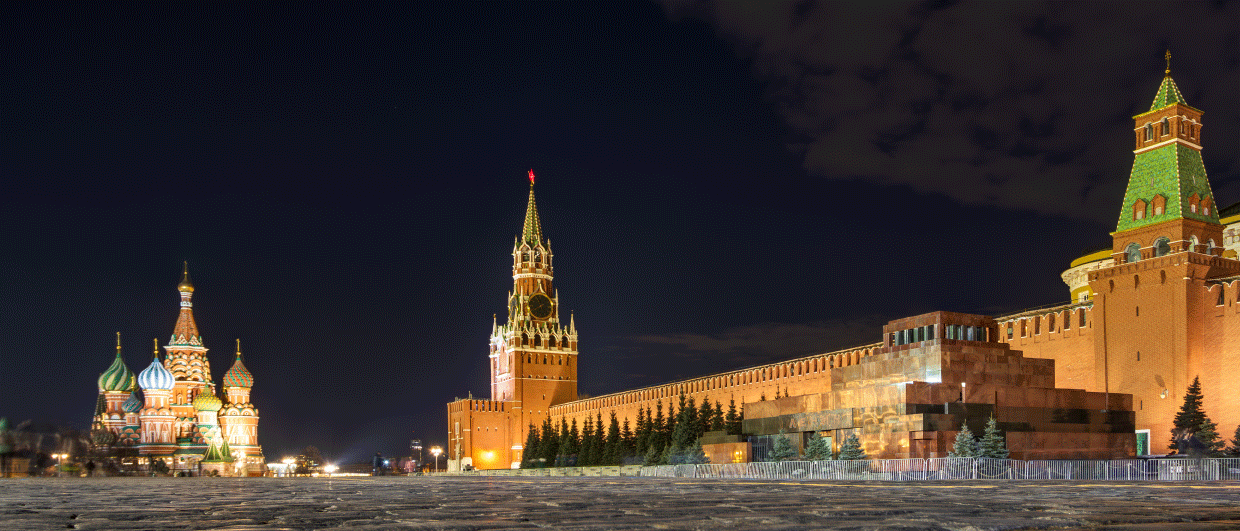
Red Square, Moscow, Russia. Photo: Andrei Stepanov via Adobe Stock.
An impression of the state of the industry in Russia
Based on a conversation with someone with knowledge of the matter, we provide some high-level observations from the country that does not feature in the oil and gas news frequently, but is an important exporter nonetheless

Following the onset of the war in Ukraine, news about the E&P business in Russia seems to have become even more scarce than it already was. For this article, I spoke to someone from Russia who was willing to provide me with a few interesting insights that are worth sharing. In that sense, this article does not claim to be the result of an exhaustive piece of research, but rather forms an impression from someone with direct exposure to what is happening in the country.
First of all, it is worth noting that the dynamics of the exploration business are different in Russia compared to other places. That is because during Soviet Union times, before the 1990s, a lot of drilling took place that proved up many discoveries, of which many have not made it to development yet. That’s not to say that all of these will ultimately progress, but there may be more of a backlog than in other hydrocarbon provinces.
As an example, there is a 500 MMboe discovery now being developed in the High North that was found in the 1980s already. Drilling technology had to advance further to make it worthwhile. All of this doesn’t mean the quality of the reserve base is declining, but there seem to be many smaller satellites out there waiting for development. Based on this observation, it is likely that Russia will be able to maintain its current production level for some years to come.
Export of oil and gas is key. As my contact expressed it, “there is no internal market for all the hydrocarbons we produce.” That is a very different scenario in places like the Permian Basin, where large cities and an existing pipeline network provide at least an important customer base.
As much as Russia was benefiting from high oil prices before 2014, the subsequent crash has put the brakes on further spending. Rosneft has seen a 30 % reduction in drilling, for example. Western sanctions have also put pressure on access to technology, but that is now being replaced by products from China. It is an interesting question whether Western companies will ever be able to regain market share should the country open up again in the future.
As the Welligence article points out, the area that holds most promise in Russia is Western Siberia. But will unconventionals be part of that? My contact is not convinced and mentions that he has not seen any meaningful production results as of yet. He also mentions that one company has tried it, but that high water cuts were observed and that the whole exercise was uneconomic. On that basis, he thinks unconventionals will not become an important part of the Russian energy mix for some time to come.