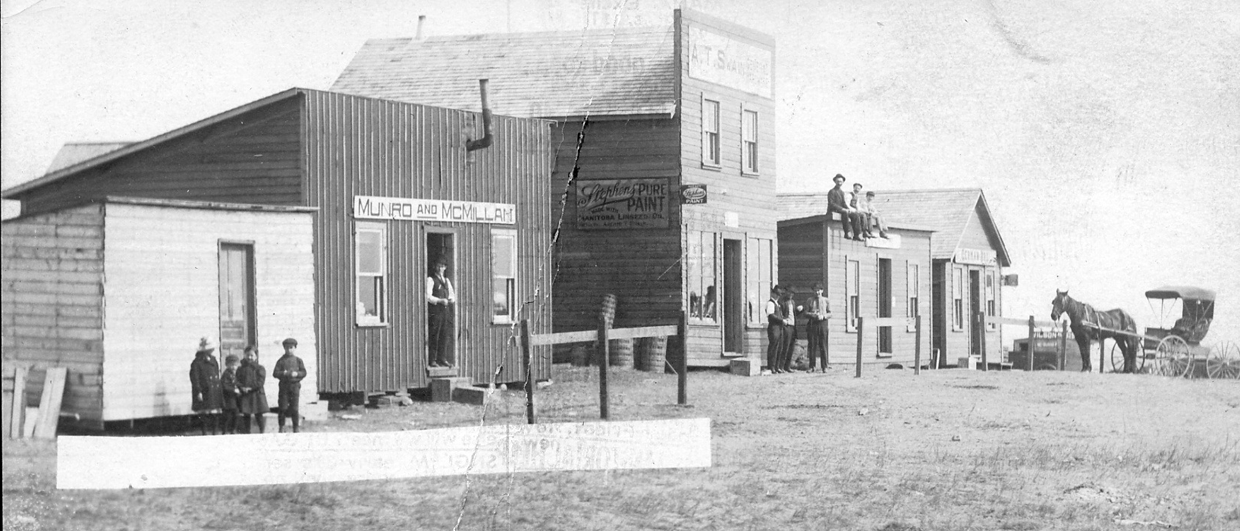
Did the people from Central Butte realise that a century after this photo was taken in 1914, their village would be the place of the first hydrogen exploration well in Canada? Photography: prairie-towns.com.
Canada’s first hydrogen exploration well
Mining companies are entering natural hydrogen territory by force

In certain coal mines, it is already common practice to use vented mine gas, predominantly methane, to power operations. The same principle can be applied to ore mines where hydrogen makes up a good proportion of the mine gas. Mining is very energy-intensive, and mines are often situated in remote locations, so readily available gas as a free energy source is a win-win. In addition, it also reduces the operations’ carbon footprint.
Canada-based Max Power Mining Corp is one of the companies that adds hydrogen to its repertoire. Originally a critical mineral explorer, mainly focused on lithium, it has now drilled Canada’s first-ever natural hydrogen well. The 2,278 m deep Lawson well was drilled in November 2025, near Central Butte, Saskatchewan.
Members of the Max Power team got their first lead in 2022 when they provided geological and operational support for a non-hydrogen exploration well. The company has since identified a multitude of early prospects based on aeromagnetic basement anomalies and legacy seismic data. Most of these are located along the so called ‘Genesis Trend’: A 475 km basement structure extending northwest-southeast through Saskatchewan and into the USA. The eastern boundary of the Genesis Trend is nestled against the Prairie Evaporite, which functions as a regional barrier and potentially acts as a seal that traps hydrogen.
The Lawson well targeted a Precambrian basement structural high. Natural hydrogen shows were detected in multiple horizons ranging from the shallow Cretaceous strata to the basement complex. An inflow test was performed on an 8 m thick, fractured interval within the uppermost portion of the basement complex. After casing perforation, the well quickly achieved free gas flow to surface before being overtaken by a powerful influx of formation brine. The initial gas flow is due to the pressure differential between the borehole and the formation. Like opening a fizzy drink, excess gas escapes first. In other words, this is an aqueous hydrogen reservoir, not a worthwhile free gas reservoir. Yet, Max Power holds out hope that free gas might be encountered at the apex of the structure.
The hydrogen concentrations from the flow test range from 16.8 % to 19.1 %, with the remainder of the gas being predominantly nitrogen. In the basal Cambrian, immediately above the basement, helium concentrations up to 8.7 % were extracted from core samples.
Max Power has three more high-level prospects; Lucky Lake and Radville, both situated on the Genesis Trend, and Bracken, part of its Grasslands acreage. The Grasslands project is situated along the Saskatchewan-Montana border and is surrounded on the Canadian site by producing helium wells owned by North American Helium. Max Power hopes to spud the Bracken well in February 2026.
It does make one wonder why the company is so set on finding hydrogen when helium is a much more lucrative business.