
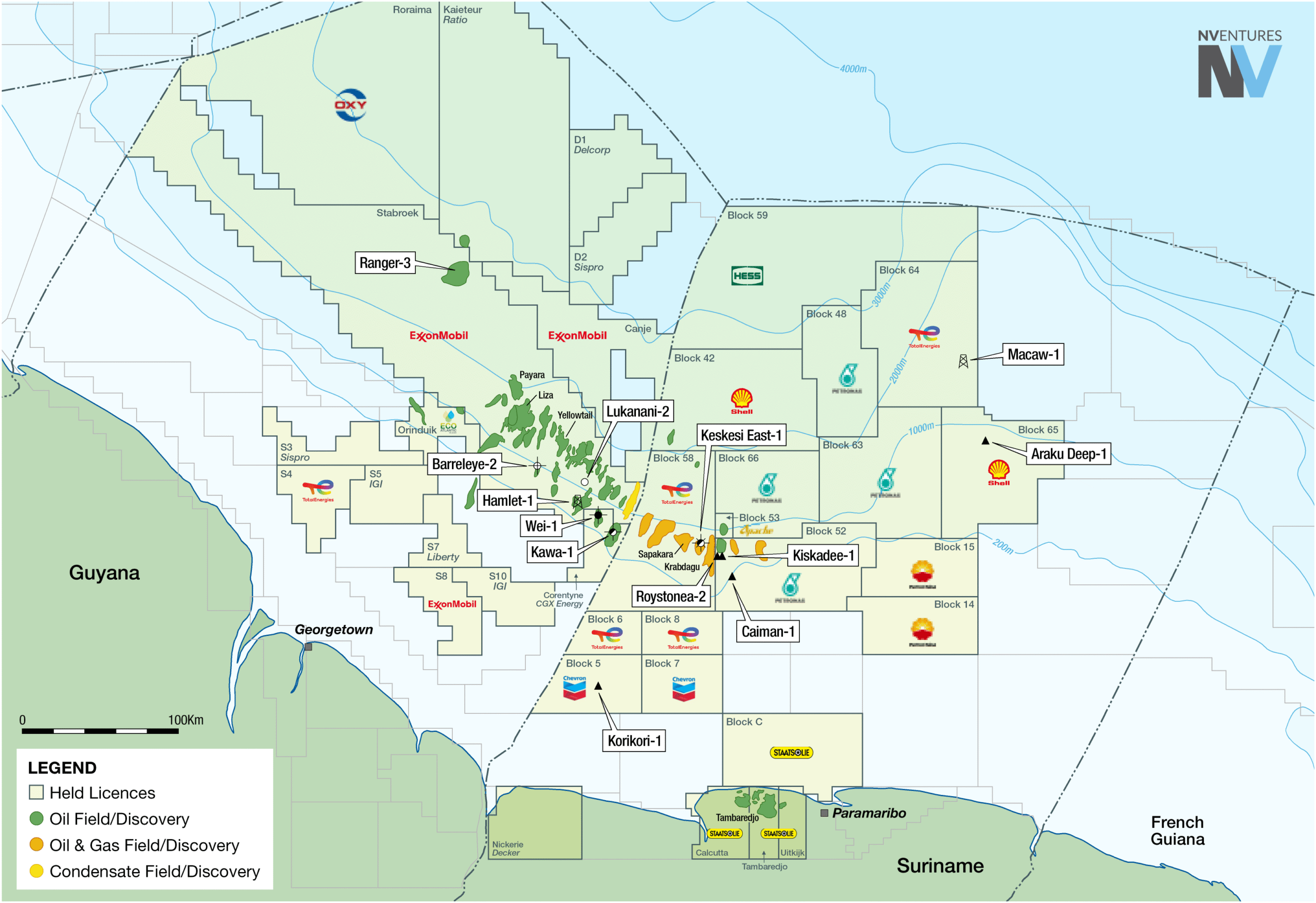
All eyes are on the Stabroek Block, where ExxonMobil and its partners have embarked on a significant three-well drilling program. The campaign, which commenced in April 2025, includes the Hamlet-1, Barreleye-2, and Lukanani-2 wells. These targets are strategically positioned updip of the prolific “Golden Lane” trend, that is close to reaching 900 mbopd from 4 FPSOs. ExxonMobil appear to have started an appraisal campaign on Ranger, the deep-water Lower Cretaceous carbonate reservoir discovered in 2018.
The Lukanani and Barreleye discoveries, announced in 2022, found 35 and 70 m of oil-bearing Maastrichtian sandstone, respectively, proving the presence of hydrocarbons in this structural position. The market awaits further data from the two appraisals, with no official information yet released, to gauge the full commercial potential of these updip accumulations. Ranger-1 reported 70 m net oil pay in Cretaceous carbonates, an ambitious target in these water depths (2,735 m).
This theme of commercial uncertainty in the structurally higher play did not go well for CGX’s operations on the Corentyne Block. The company’s Kawa-1 (2022) and Wei-1 (2023) wells encountered 61 m and a combined 99 m of oil-bearing Upper Cretaceous sandstones, respectively. Despite these technically successful discoveries, CGX faced challenges in securing a development partner, with the market perceiving risks regarding its commercial viability. Both the government and the operator are vigorously pursuing further plans for this acreage in Q3 2025.
Suriname: Extension and new play openers
Exploration activity in Suriname waters is equally dynamic, characterised by a mix of appraisal drilling and bold frontier tests. Following the November 2023 Roystonea-1 discovery in Block 52, which encountered pay in Campanian sandstones, operator PETRONAS is set to appraise it with the Roystonea-2 well in a campaign that has now started and will go until 2026 with two additional wildcat wells. One of those, Caiman-1, will be crucially drilled approximately 25 km to the south of Roystonea, targeting the updip extension of the Upper Cretaceous play.
Meanwhile, a highly anticipated frontier test is underway in deepwater on the Demerara high. The TotalEnergies-operated Macaw-1 well in Block 58, alongside Shell’s Araku Deep-1 well, are targeting a new play concept for the region: Aptian carbonates on the Demerara Plateau. This daring move aims to test a northern migration pathway from the main kitchen, which would untap a whole new region to explore. Whilst the Lower Cretaceous has proven hydrocarbon bearing at the Keskesi East 1 well (APA, 2020), these targets are deep and challenging, and the Demerara carbonate play is a major new play test. Success may draw the explorer’s eye across the Atlantic to the Guinea Plateau, once conjugate with this play.
Brazilian pre-salt: Discoveries and lingering challenges
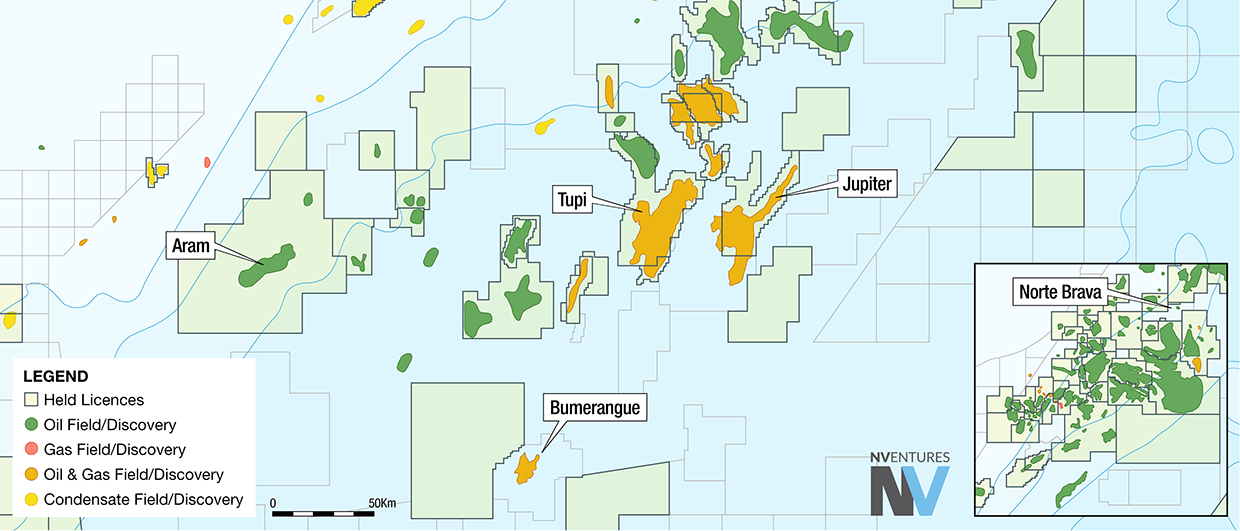
Shifting focus south, the Brazilian pre-salt continues to yield significant discoveries, though not without its challenges. bp announced a major find at the Bumerangue prospect in the Santos Basin, approximately 25 km south of the giant Tupi field (Petrobras). The well encountered an impressive column of around 500 m of oil-bearing carbonate reservoirs, with estimates suggesting an in-place volume of approximately 2.5 bboe.
However, the commerciality of such discoveries in this region of the basin remains a key question. The area is known for significant CO₂ content, which can complicate development and increase costs. The giant Jupiter field (Petrobras and Galp), holding an estimated 1.6 bboe and 17 TCF of gas, has remained undeveloped for precisely this reason. bp’s assessment on the content of CO₂ will be crucial to unlocking the value of Bumerangue.
In other announcements, Petrobras reported discoveries at Norte Brava (1-BRSA-1394-SPS) in the Campos Basin and Aram (1-BRSA-1395-SPS) block in the Santos Basin. While both affirm the continued potential of the pre-salt, the state-owned operator has yet to release details on net pay or resource estimates.
A region for the future
The Latin America Atlantic Margin remains a powerhouse of global exploration. From the meticulous updip appraisal in Guyana to the play-opening gambits in Suriname and the ongoing, complex evaluation of Brazil’s pre-salt, the results from these campaigns will set the tone for investment and strategy in the region for years to come.