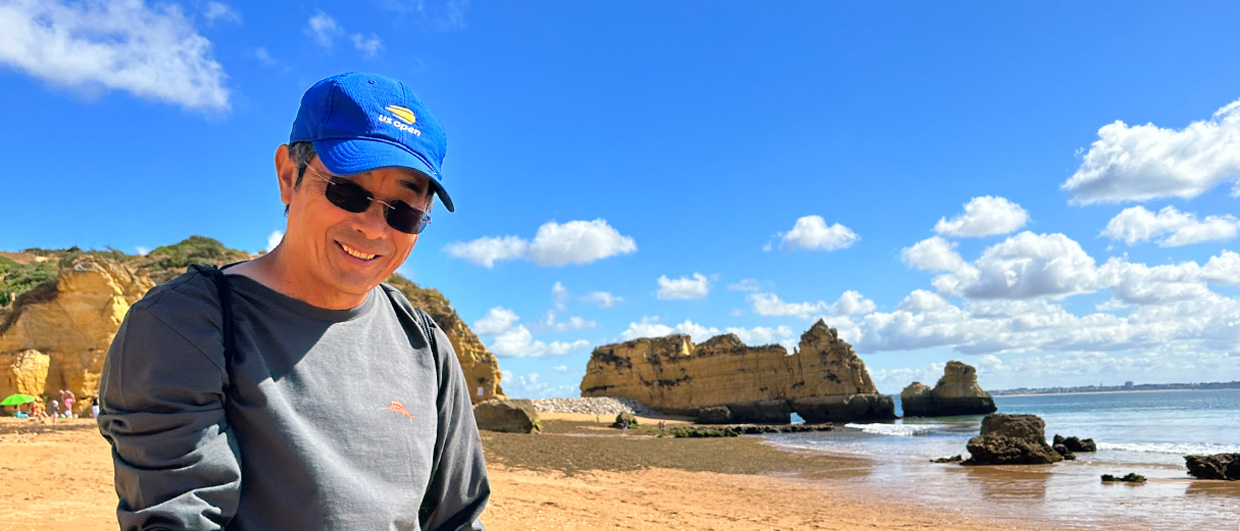

Geology? Going to university? It was not on his mind at all when he finished high school. Yet, he has become a world-renowned expert in petroleum systems and basin modelling, Zhiyong He. For this interview, I spoke for more than two hours with the founder of ZetaWare, the company Zhiyong started after he left ARCO in 1999. Ever since, a “pragmatic” approach has been his mantra, as he does not believe that more advanced 3D modelling software does a better job. Instead, he keeps on emphasising during the conversation how important it is to “model” a basin in your mind instead. But before we get to that, let’s take a look at his earlier years.
“I was born and raised in a small town in the Gobi Desert near the Mongolia border in western China,” says Zhiyong at the start of our conversation. “Life as a kid was very simple; we played outside until bedtime, no matter the high temperatures during summer or the cold in wintertime. School was not hard at all either; we had everything we needed.”
Double stick shifts
Then, after high school, I assumed that Zhiyong went to university straight away, like most people I interviewed for this series. But that did not apply to him. “Colleges were suspended during the Cultural Revolution, so after high school we were sent to rural villages to be re-educated”, Zhiyong says.
So, he moved to the countryside about 30 km away from his home, to a small village with seventeen farming families. “We cleared large tracks of land to grow wheat, and we even had tractors and combines. It was a great time,” he says. “You always learn so many things you don’t learn at school. For instance, how to drive a tractor with a double stick shift and a double clutch. I can still do it today.”
After two years working on the farm, Zhiyong moved further away from the area he grew up in; in fact, it was a 10-hour bus ride away, and closer to industrial activity. He joined a steel factory where he worked on trains. “We had five locomotives to shift things around; bring coal and ore in, and ship the finished steel out,” Zhiyong explains. “I worked as a switchman, hooking / unhooking cars, and hanging on the side of the leading car to signal to the engineer when the trains needed to be backed into loading docks. I often had to hop on and off while the train was moving. It was a dangerous job, but a great way to learn about trains and the railroads.”
Geology, what is that?
After four years, universities opened up again, and Zhiyong took his chance to embark on an academic career. However, with many kids wanting to go, competition was immense. He wasn’t selected the first time he tried, but a year later, in 1978, he was offered a place to study geology. “My preference was engineering,” Zhiyong says, “but it is likely that the geology departments did not have that much interest, and so I was offered a place there, at one of the top-tier universities. As competition was so rife, it would have been foolish to say no, so I went, without really knowing what I was about to get myself into!”
Zhiyong went to the “Northwestern University” in the city of Xi’an. “I was surprised to see so many trees about,” he says, “and it was a lot more humid as well.” His class of thirty students consisted of a wide range of people, as universities had been practically closed for so long. Some came straight out of high school, others had worked as Zhiyong, or spent time in the military. Some people had kids already.
After a four-year undergraduate programme in petroleum geology in Xi’an, Zhiyong applied to graduate school in Beijing at the urging of his English teacher in college. Following the master’s program that focused on basin modelling, he stayed at the university for two more years as an assistant professor. And there he made a difference, during a workshop.
Why not?
The workshop was presented by Ian Lerche from the University of South Carolina, a genius astrophysicist from the UK who had made his way into geology. “The theme of the workshop was about basin modelling, and involved biomarker kinetics,” Zhiyong says. “It was an odd topic, so most of the audience either tuned out or had no idea what he was talking about.”
To make matters worse, the translator had difficulties with many of the specialised terminologies. Zhiyong, one of the few who understood the narrative, helped with the translation. It made an impression, which led Ian to invite Zhiyong to do a PhD with him in the US. “Why not?” Zhiyong responded.
At the University of South Carolina, Ian came up with the equations to model vitrinite reflectance, apatite fission tracks, and biomarkers. Zhiyong, together with other students, helped translate that into a software application. “This all happened as part of a big joint industry project in which multiple oil companies participated,” Zhiyong explains.
During the second year of his PhD, Zhiyong landed a summer job at ARCO, basically doing the same he was doing at the university: Writing code to perform basin modelling with. And as if it was all destined to happen, he was subsequently offered a position at ARCO once he had defended his thesis. But not as a normal employee, but as a postdoc instead. “I was in the USA on a student visa,” says Zhiyong, “and in order to stay in the country, it was easier to extend that. So I became a ‘student’ in ARCO, starting in their research department in 1989.”
Putting a foot on the break
The basin modelling landscape at the time of Zhiyong joining ARCO was still in a fairly early stage. “Most of the majors were developing their own modelling software,” he explains, “and were also licensing the commercially available systems just to see how these were functioning and to learn from them.”
As part of ARCO’s research team, Zhiyong continued working on developing code himself as well, moving from 1D to 2D modelling over time. But when 3D came around in the mid 1990s, Zhiyong put his foot on the brake.
“I didn’t believe it was practical at the time because we did not have the data necessary to calibrate a 3D model,” he says. “In fact, I am still of the same opinion today. The physical principles involved are fine, but there are just too many uncertainties involved, especially when it comes to the presence and distribution of carrier beds and source rocks, and their quantity and quality.”
ARCO management did not challenge Zhiyong in his belief that it was a waste of time to go the 3D route. Instead, he started working on a 2D map-based tool, the precursor to Trinity, which was much more in line with what geologists were doing in the new ventures departments. “You have to think about the practicalities of how geologists worked at the time,” Zhiyong says. “They often only had paper maps and had to draw prospects, kitchens, and migration pathways with pencils. They commonly had ZMAP surfaces, and we built the software to use those surfaces to create maturity maps, migration pathways and fill and spill scenarios, to help evaluate prospects.”
“As such, there was a real synergy between what the geologists were producing and what we could deliver on top of that,” Zhiyong continues. “By visually presenting prospects and kitchens, and interactively drawing migration pathways and fill and spill patterns, explorationists had a new tool to sell their prospects to management.”
The wrong question
Zhiyong worked at ARCO for eleven years, so I am intrigued by how often the software he developed proved critical in the decision to drill a well, or not. It turns out to be the wrong question. “The software is not a crystal ball to get an answer from,” emphasises Zhiyong, “but a set of tools to help prospect evaluation and test different scenarios. It is highly experienced explorationists with the right focus and workflow who found Jubilee, Mangala, Johan Sverdrup, Liza, and Venus,” he adds.
That’s not to say that people always take the best approach.
“I knew it was going to be a dry well”
“Once upon a time, I had lunch with a very well-known petroleum systems expert in a big oil company,” says Zhiyong. “This person told me that his company just drilled a dry hole, even when he had written an internal report condemning the prospect two years before spud.”
Zhiyong did not tell him what he thought of this kind of “I was right” boasting. “First of all,” he says, “it is not possible to predict the outcome of an exploration well deterministically. If you predict an exploration well to be a dry hole, you would be right most of the time, especially in a more frontier domain. It is nothing to brag about. Secondly, if you are THE expert of petroleum systems, and your company ignored your advice, it wouldn’t be something I would be proud of either. I would rather the company listen to my advice even if I was wrong in the end.”
“I believe our job as petroleum systems experts is to integrate all the relevant information, test all scenarios of outcomes with our models, and provide a probabilistic chance of success to the decision maker, not a deterministic answer. This requires the software to be able to model the key aspects very quickly. We cannot afford to take several weeks to build a model, and then several days to run and get a single scenario that’s most likely wrong.”
Another interesting observation about this story is that the well was drilled regardless of the negative advice from the expert. “Exploration managers probably have seen enough dry holes to know how to deal with uncertainties, while experts tend to be overly confident about what they know,” says Zhiyong, “and therefore I understand that managers don’t always listen to their own experts, especially when their judgment is very black or white.”
Then there is the observation that experts do not always agree, and the Jubilee field offshore Ghana is a good example of that. “In the farm out discussions, one company claimed that the Cretaceous source rock could not be mature because the kitchen is sitting on oceanic crust,” explains Zhiyong, “whilst another company’s model predicted that it was overmature instead, also because the kitchen is sitting on oceanic crust!” At the same time, both ignored the fact that there was already an oil discovery updip of the Jubilee stratigraphic trap, clearly suggesting that there was a working petroleum system regardless. People put too much emphasis on modelling sometimes, and do not pay much attention to observations,” Zhiyong says. “All models are wrong, and some are useful”.
Why are we still drilling dry holes in established basins?
Zhiyong prefers to make observations, which are powerful clues to how hydrocarbons migrate in sedimentary basins. One of these observations is that dry holes are still being drilled in basins where a mature source rock is proven. “I think there are two things to consider when it comes to explaining that,” says Zhiyong.
“First, there are carrier beds,” he continues. “These intervals are often obscure and hard to map, but they are the ones that cause lateral migration. If carrier beds exist above a source rock, the shallow prospect sitting directly above them may not have access to charge, as the hydrocarbons follow the carrier beds laterally. Observations in many basins confirm this principle, and therefore, shallower prospects further up above the carrier beds often have a low chance of success.”
“Success rates are much higher if the reservoirs are adjacent to (directly above or below) the source rock,” Zhiyong continues. “Vertical migration requires that the deeper carrier bed leak at structure locations, and that typically means the structure relief needs to be high enough allow buoyancy to work against the seals above the deeper carrier beds. That gives us some criteria to high-grade shallow prospects above such high relief structures.”
“I worked with a small company that explored the Miocene reservoirs in the GOM,” says Zhiyong. “Their criteria in farming in a prospect is whether the Cretaceous below had significant structural relief. This company had a very high success rate! In the North Sea, the same principle can be seen at work. Big fields like Montrose, Forties or Ekofisk sit on large basement highs, and that made it more likely for hydrocarbons to migrate into Cretaceous or Tertiary reservoirs. Yet in general, younger targets are much higher risk than the middle Jurassic reservoirs that sit directly below the Kimmeridge Clay source rock.”
Secondly, the source rock may be mature, but is it generating enough to fill the deeper carrier beds and have enough left to migrate to updip structures, or leak up to shallow prospects? “The further away you get from the source rock, laterally or vertically,” explains Zhiyong, “the more important that question becomes.
In the northwest Java basin of Indonesia, the Eocene source rock is mature, but has not generated large volumes due to limited potential. As a result of that, and mainly driven by migration models predicting a higher extent of lateral migration than what was actually the case, many dry holes were drilled into surrounding reefal structures. Only when drilling started next to or inside the kitchen area, discoveries were made,” says Zhiyong.
“Being aware of these concepts,” concludes Zhiyong, “and being aware of the large uncertainties, makes a strong case for not using a deterministic model in exploration. Instead, basin models should account for a probabilistic outcome, taking into consideration main controls such as presence and extent of carrier beds and source rocks, the seal quality above them, and the source rock potential and maturity.”
Timing does not matter
We continue our conversation about the intricacies of hydrocarbon generation. “People have spent a lot of time on modelling the paleo heat flow and kinetics of source rock maturation,” Zhiyong says, “and describing the source rock in minute details. All with the aim to predict the timing of hydrocarbon generation and the type of hydrocarbon they will find in the trap. At some point in time, there were five industry consortia working on kinetic models. But does it all matter at the end of the day? Is it very much required for a trap to be ready once a source rock enters the kitchen? “No. it rarely does,” Zhiyong says firmly.
“We have multiple examples of discoveries where the oil was generated tens of millions of years before the reservoir was even deposited,” he explains. “And this concept is not new; the idea of hotelling the oil was already proposed in the 1970s. The difference between what people thought back then and what I, together with some of my peers, think these days is that this concept is much more common than we ever anticipated. In fact, I think it is the norm. The source rock itself is a large hotel, and so are the carrier beds.”
Let’s go and dive a little bit deeper into this and use the Gulf of Mexico as an example. “When the Tithonian source rock started expelling during the Oligocene,” Zhiyong says, “the Middle Miocene to Pleistocene reservoirs had not even been deposited yet. But the oil made its way into carrier beds and stayed there. Then, five more kilometres of sediments were dumped on top of this, with the result that the source rock and the deeper carrier beds enter the gas window.”
Timing-wise, this was actually a good thing,” Zhiyong continues. “Cracking oil to gas expands volume quickly and pushes the oil at the front into the shallower Miocene reservoirs. So, even after the source rock has expelled all its hydrocarbons, oil continues to migrate into new reservoirs simply due to increasing burial.
And that immediately exposes another phenomenon that is often misunderstood. “Many people think that a good reservoir with Darcy permeability is all we need to make sure that hydrocarbons migrate into a trap. But that is neglecting a critical factor,” says Zhiyong. “If you just generate one barrel, do you think that this single barrel will move all the way up to a closure? Of course not. What we need is the generation of a volume of hydrocarbons that is big enough for all the small traps along the carrier beds to be filled along the way to the trap that we ultimately want to drill. It’s that volume that is key, and not so much the timing of generation.”
“Seismic and our models don’t capture the fine granularity of the storage and carrier system that exists in a kitchen area and therefore fill the big traps further away much more easily than reality suggests,” stresses Zhiyong. “If the source rock generates less than that volume, there is no oil in our prospect. And that volume is unknown but often many times larger than the trap can hold. This unknown volume is one of the most important parameters to account for probabilistically.”
The value of 3D and drilling close to the kitchen
Although 3D seismic may not have high enough resolution to map those carrier beds and the subtle traps, it is very useful in better delineating structures and, hence, drilling targets. “A great example is the Western Desert in Egypt,” says Zhiyong, “where Apache was the only company shooting 3D over the horst blocks separating the grabens.”
“It paid off to do that,” he says. “Through this approach, the company was able to demonstrate that an individual horst structure consists of multiple sub-blocks. In turn, this allowed them to pinpoint the fault blocks closest to the kitchen, and voila, success followed. The Jurassic source rock in the Western Desert is not as productive as the North Sea, so it is key to drill as close to the kitchen as possible.”
Funny models
We already know that Zhiyong is not a great fan of 3D models. Yet, we get to talk about them a bit more. “The sizes of grid cells are often totally unfit for purpose,” Zhiyong says. “When a whole reservoir unit is captured by the thickness of one grid cell, it is impossible to have pressure gradients in there that drive how the hydrocarbons will move throughout the volume of rock. This alone is a reason not to rely on these models too much.”
“Another thing I observed frequently, and actually still observe today at times,” he says, “is that models often predict accumulations where there is no trap at all, in a completely flat area. It is an artefact, because these models only rely on buoyancy for upward migration, rather than a combination with saturation-induced capillary pressure that pushes oil to lower saturations, which can also be downwards.”
“All in all, there are so many details in a volume of rock that we cannot see and map. Rather than building a complicated 3D model in a piece of software, people should build a 3D model in their heads instead, and be aware of the uncertainty,” Zhiyong concludes.
Luck, pure luck
We have been talking about technical insights for quite some time now, even when Zhiyong says that he is happy to continue talking for two more weeks. However, it is time to return to where we left his career timeline, when he was still at ARCO. At some point during the interview, Zhiyong tells me that he actually got much more exposure to the exploration game once he left ARCO after eleven years. It was the time he became independent and set up his own software and consultancy business. I am intrigued as to how this went and how he managed to grow from that point onwards.
Rather than building a complicated 3D model in a piece of software, people should build a 3D model in their heads instead, and be aware of the uncertainty
“I was very lucky,” he emphasises firmly.
Usually, companies don’t allow departing employees to take software they have developed with them; it is seen as corporate IP. However, as bp did not have the tradition of developing software in-house, the situation was a bit different in this case. Because they were still interested in Zhiyong’s approach and wanted to test the software for a few things, they decided to offer him the code, under the premise that he would support the company for six months.
“It meant I had something to market straight away,” says Zhiyong. “And even better, my former ARCO colleagues who found positions elsewhere at other oil companies happened to be keen users, so I immediately had some customers as well.”
And rather unexpectedly, bp came back after a few months, asking Zhiyong if they could join the consortium of companies that he had already pulled together, to the point where they wanted to have the most influence in deciding which direction the software should be developed. “I was in a great position to have generated an income straight away,” Zhiyong says. “Can you now see how lucky I was?”
“I have always been a very practical guy,” Zhiyong continues at the end of our conversation. “I understand the physics behind modelling, and have spent a lot of time on integrating things in code, but at the end of the day, when we see that it is the unobserved subsurface details that make any model too much of a generalisation for migration modelling, I think we have to admit that a 3D model is something we need to build in our minds. Only in this way is it possible to match your observations.”
Someone who works with Zhiyong frequently calls him a legend. I’m sure that he will not use that word himself, modest as I think he is, but the conversation I had with him did confirm that I was talking to a man with vision and an infectious curiosity. What a delight to pen this article down.