
The region took a huge leap forward in 2020 when the Turkish state energy company Türkiye Petrolleri Anonim Ortaklığı (TPAO) announced the giant Tuna-1 gas discovery in the western basin deepwater. The field was subsequently named Sakarya, and further drilling on the structure confirmed it as the biggest field in the Black Sea. Phase 1 of gas production started in 2023 and is forecast to peak in 2028. More good news was announced in April 2025 with a second deepwater gas discovery at Göktepe-3 in the same area as Sakarya. TPAO is moving quickly to appraise the discovery and has deployed three drillships. TPAO is also reported to be drilling up to six exploration wells in the Black Sea basins in 2026.
In March 2025, OMV Petrom and partner Romgaz started development drilling on the shallower water Pelican South and deeper water Domino gas fields in the Neptun Deep Block in Romania. First gas from the project is expected in 2027 from a range of water depths between 120 m and 1,000 m. The strategic implications for the development of the fields are significant, marking a structural shift from Romania as a net importer to a net exporter of natural gas.
In Bulgaria, the first of two highly anticipated frontier exploration wells, Vinekh-1, has unfortunately come up dry. Operator OMV (45%) and partners NewMed Energy (45 %) and state-owned Bulgarian Energy Holding (10 %) will now move on to the second well that will be drilled in the Khan Asparuh licence.
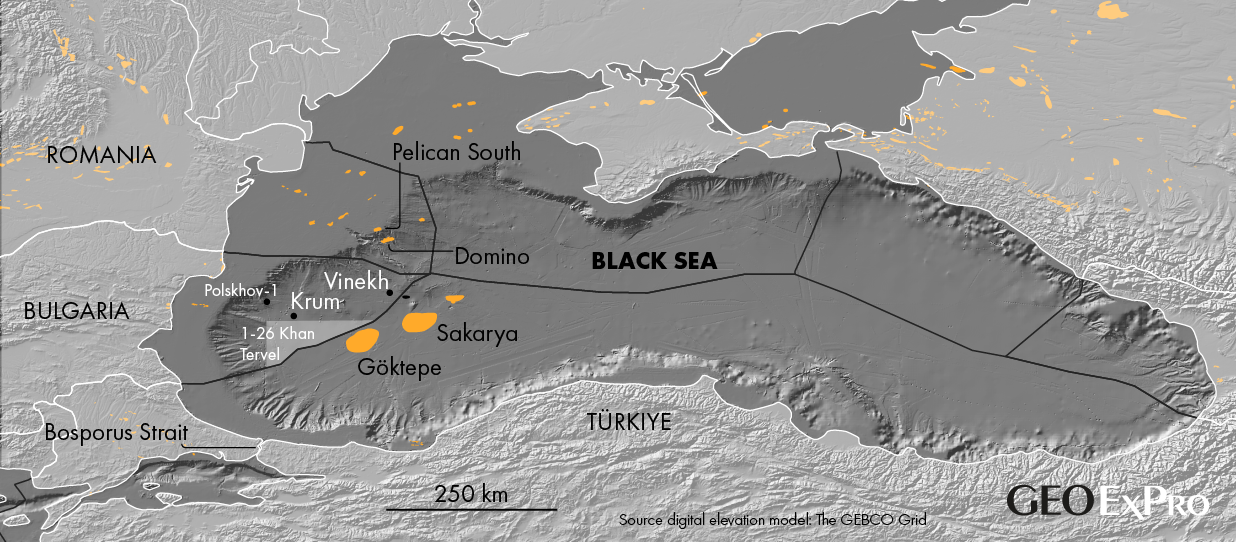
Adding to the interest in the Bulgaria offshore, Shell signed an agreement for deepwater Block 1-26 Khan Tervel in April 2025. This represents a return to offshore Bulgaria for Shell who exited the country in 2021. The initial work programme will likely focus on acquiring seismic in the area adjacent to the TPAO Göktepe discovery.
The Black Sea hydrocarbons are important for regional energy security, with the recent successes in the deepwater offering Europe alternative sources of gas. This was again reinforced in January 2026 when ExxonMobil and TPAO signed a Memorandum of Understanding (MOU) covering exploration and development opportunities in the Black Sea.
The post-rift basins offer much running room for exploration with the current focus on the Pliocene-Miocene biogenic gas plays, and in the future, we may see follow-up exploration on the Bulgarian Oligocene to Miocene clastic oil play opened up by Polskhov-1. Further romance exists in under-explored oil exploration targets in the syn-rift and pre-rift plays. In the coming years, the industry may shift more investment from the North West Europe offshore to this growing regional gas hub, where currently state-backed companies tend to dominate.