
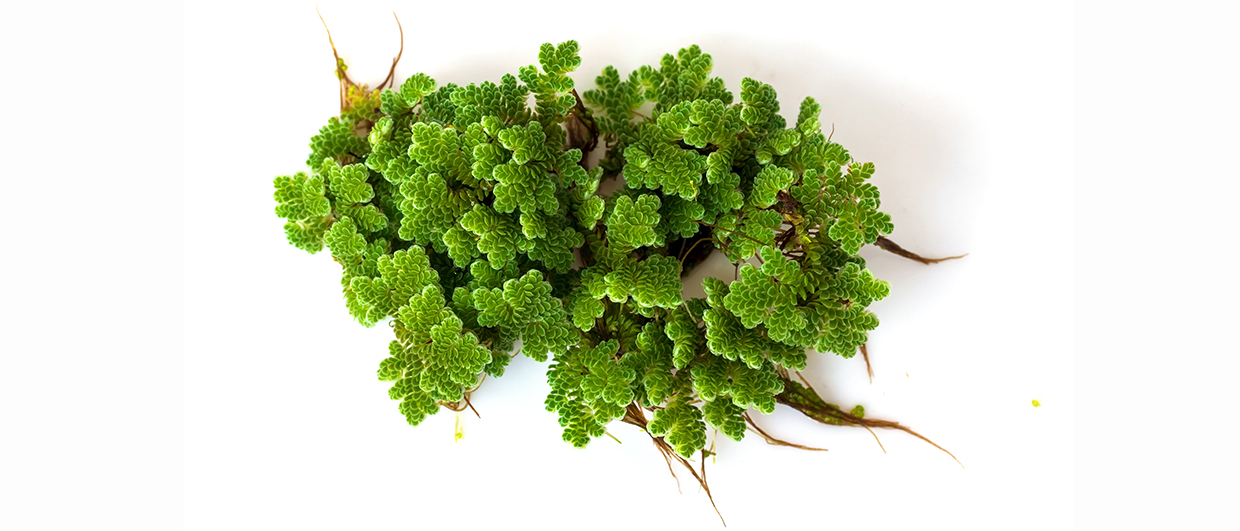
Green Azolla microphylla. via Adobe Stock.
The Azolla Biosystem
The amazing Azolla plant could provide a gateway to the future.

The past
2004 was a landmark year in our understanding of past climate change. Reduced ice cover allowed the Arctic Coring Expedition (ACEX) drillship Vidar Viking to core a deep hole in sediments close to the North Pole, opening a window into a greenhouse world completely unlike today’s, when turtles and alligators inhabited lush forests a few hundred miles from the North Pole. Then, 50 million years ago, the free-floating freshwater fern Azolla repeatedly spread across the Arctic Ocean surface, sequestering enormous quantities of atmospheric CO₂ and triggering the shift from a greenhouse climate to our modern icehouse world with its year-round snow and ice at both poles.
Azolla was able to accomplish this because of its symbiosis with the cyanobacterium Anabaena. Azolla’s leaf vacuoles provide an oxygen-free home for Anabaena, which draws down atmospheric nitrogen. This fertilizes Azolla, making it one of the fastest growing plants on the planet, doubling its biomass every two to three days even though its only requirements are air, light, freshwater and small quantities of nutrients. Azolla-Anabaena is the only known symbiosis in which the cyanobacterial partner is maintained throughout the plant’s reproductive cycle, resulting in their co-evolution and the extreme efficiency of the Azolla-Anabaena superorganism. This amazing plant, and its effect on CO₂ and climate, was discussed previously in GEO ExPro Vol. 4, No. 4.
The Present
Could this unique plant help us weather the perfect storm that threatens humans and many other species today: the related threats of imminent climate change and shortages of land, food, freshwater and energy as our population passes seven billion? Alexandra and Jonathan Bujak have designed a natural biological system – the Azolla Biosystem – to do this.
The biosystem can be used outdoors, or as an indoor modular system, which facilitates control and automation. The Sequestration Module converts atmospheric CO₂ directly into Azolla plants that can be grown in containers, ponds or stacked trays of shallow water. The resulting biomass is then transferred to the other modules: the Carbon Capture Module removes selected amounts of Azolla from the biological cycle by converting it into dense carbon products, and the remaining biomass produces biofertilizer, livestock feed, food and biofuel in the other modules. The biosystem is highly flexible because the size of each module can be adjusted for local needs, and processes such as algoil generation and hydroponics (growing plants in water with nutrients, rather than soil) can be integrated into the biosystem, providing food and renewable bio-oil and gas anywhere in the world, irrespective of the local climate.
Azolla can remove impurities from our waste water including harmful chemicals from industrial discharge and also extract radioactive material from water used in nuclear facilities.
The Future
The biosystem resolves the main problem that plagued the 2009 and 2012 Copenhagen and Doha Summits on Climate Change: why should developing countries forego their opportunities in the 21st century in order to help resolve the problems created by developed countries in the 20th? The billions of pledged ‘climate change dollars’ can help developing countries to progress using the biosystem’s synergy, thus turning the perfect storm into a perfect opportunity, for example by replenishing soils and providing livestock feed and food in regions such as East Africa that experience repeated famines. And the biosystem could also be a catalyst for other essential changes in the 21st century – greening of the growing megacities, or re-establishment of families and communities through urban agriculture.
The Azolla Biosystem is an incredibly efficient nano-assembler that has evolved for millions of years and it is ready to use now. It is a gateway to the future that only needs our determination to make it work and attain its full potential.
Alexandra and Jonathan Bujak’s book ‘The Azolla Story’ will be published in 2014.