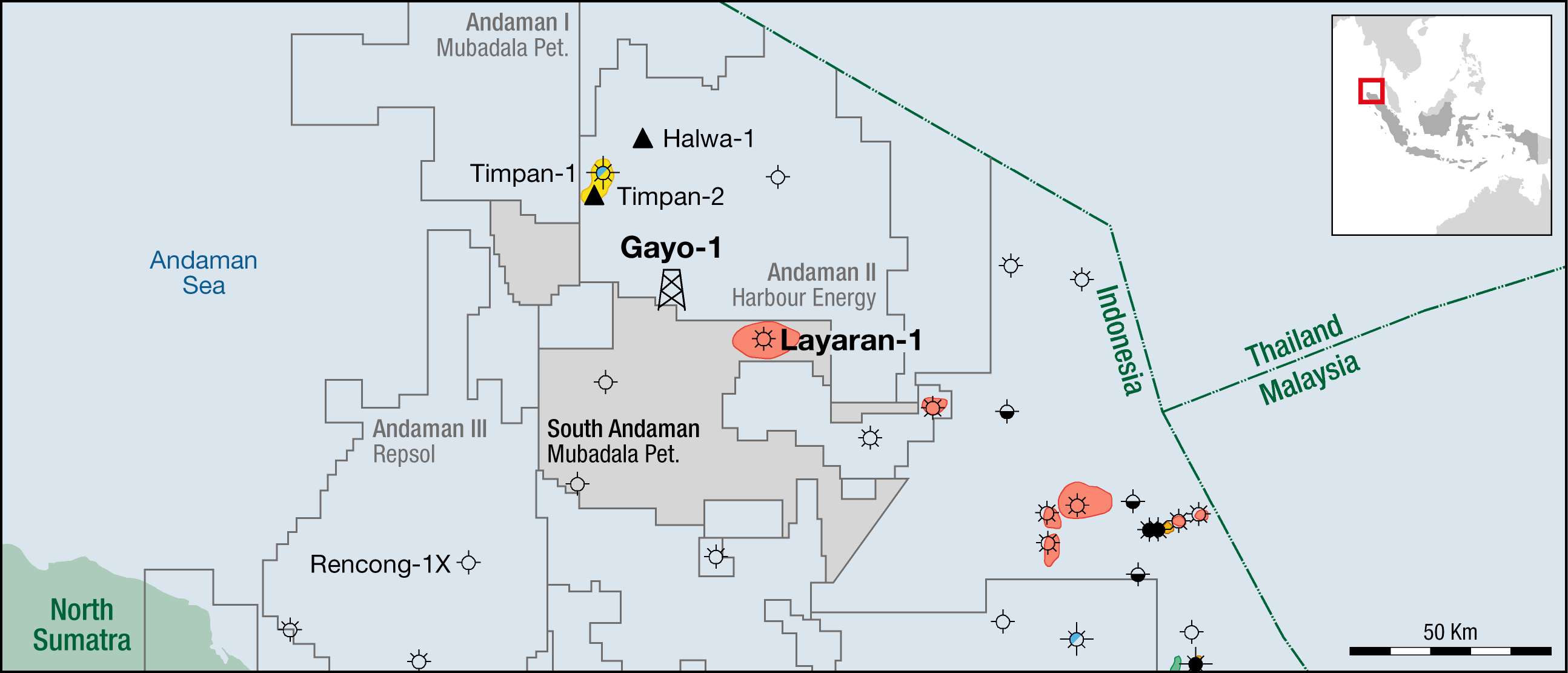

The Thailand Department of Mineral Fuels has just announced a licence round in the Mergui Basin, Andaman Sea. Interestingly, they have decided to license the area as a single massive block covering 60,288 km2 in water depths that range from 400 m to around 2000 m. The block encompasses all nineteen of the exploration wells drilled to date. Three of these wells were drilled in water depths of around 1000 m, four in 750-1000 m and the remaining 11 in 400-750 m of water. This is largely a frontier region, and its licensing has been much anticipated following the recent large gas discoveries at Timpan, Layaran & Tangkulo to the south in deep-water offshore North Sumatra.
A successful licensee would secure a large tract of acreage covering an entire basin in a country where gas discoveries would have a significant value to help counteract the need for increasing LNG imports and declining domestic gas production. Work commitments and commercial terms have yet to be announced, and it will be interesting to see how they differ from the terms previously applied to the Gulf of Thailand, where water is much shallower and there is existing infrastructure.
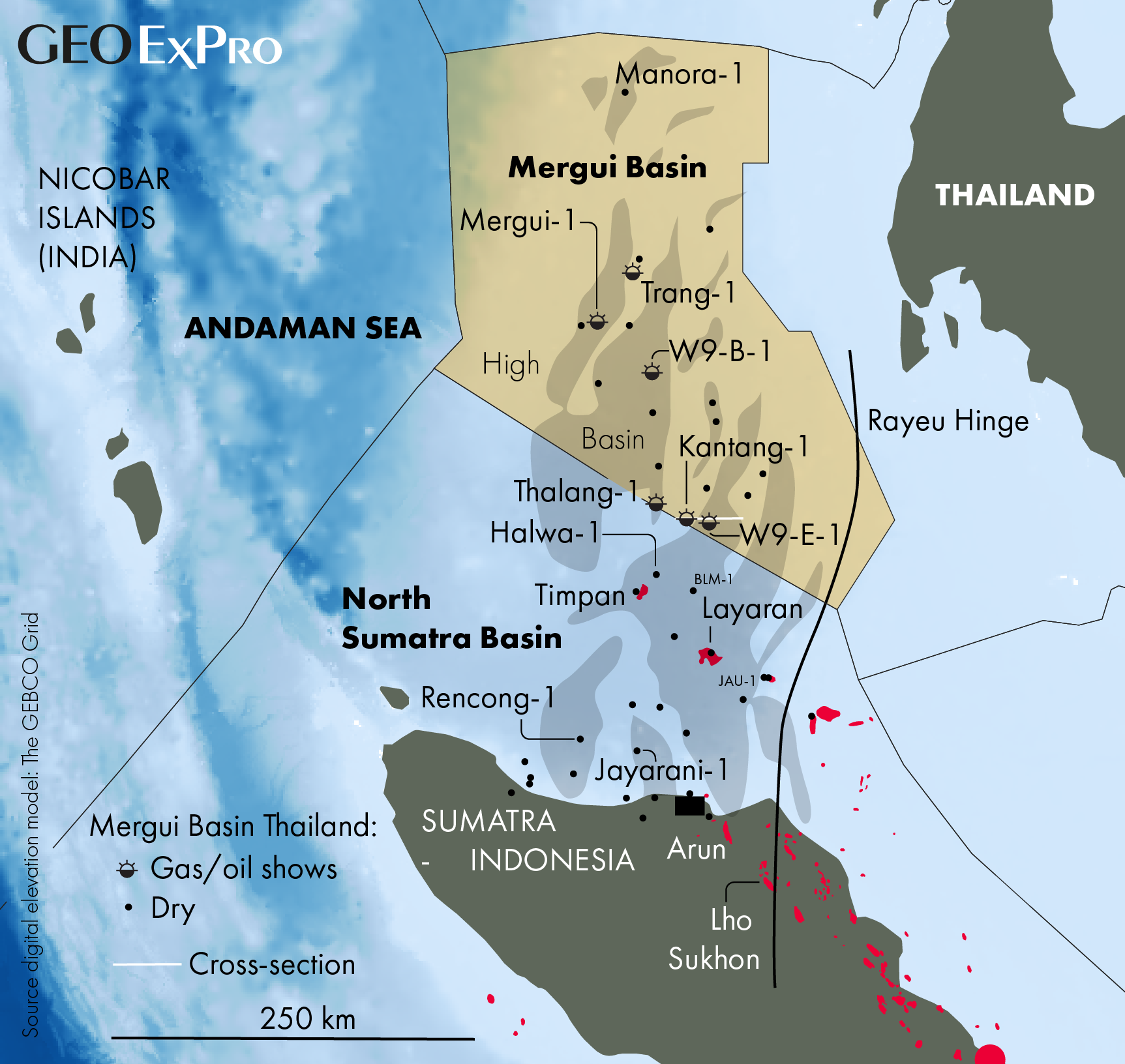
Exploration in the Mergui Basin has been intermittent, starting in 1976 when 12 wells were drilled. This was followed by a second phase of drilling in 1997, during which a further five wells were completed. A single well was drilled in 1987, and the last well drilled was 25 years ago and it was in the far north of the basin close to Myanmar border. The basin is currently covered by around 45,000 km of 2D seismic.
Four of the nineteen Mergui wells had significant untested gas columns; three in Upper Oligocene sandstones (W9-B1, W9-E1 and Mergui-1) and one in Lower Miocene carbonates (Kantang-1). These were all drilled in 1976 during the first phase of exploration when the main focus was finding oil. These are the same ages as the North Sumatra discoveries further south in Upper Oligocene turbidites in Timpan, Layaran and Tangkulo in the deep-water offshore and Lower Miocene carbonates in the Arun and Lho Sukhon fields onshore.
Oil and gas shows were also recorded in the Middle Miocene and Oligocene in the Thalang-1 well and possible oil shows in the Oligocene in the Trang-1 well. None of the Mergui Basin wells reported any CO2 or H2S associated with the gas. Many of the dry wells were drilled to target Lower Miocene carbonate build-ups of similar age to those of the large Arun and Lho Sukhon fields, discovered in 1971 and 1972 respectively, onshore North Sumatra.
The deeper water western areas in Thai territory are therefore unexplored and hold potential to test the successful plays recently drilled to the south in Indonesia.