
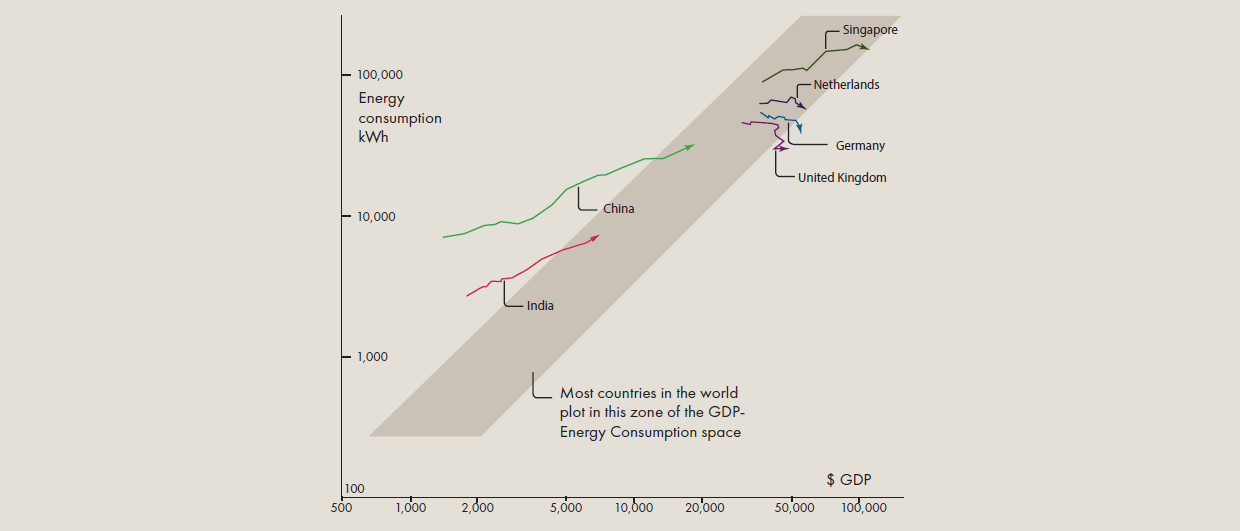
Even though some of the richest countries in the world have in recent years bucked the trend of increasing energy consumption as GDP rises, many countries are not at the stage yet - see China and India. Higher income means more energy consumption, and therefore means a need of a much higher baseload that is available 24 / 7 to run these advanced economies. Source: ourworldindata.com
Let’s not play Russian roulette with our energy system
The risk of an industry exodus increases as long as no new large-scale baseload or storage option arises for a continent that is running out of hydrocarbons

I am not a pessimist, and I don’t like using terms like “energy crisis”, but if we do not start to take our energy system seriously, many industries will leave much of Europe in the next 10 – 15 years, at a huge socio-economic cost. The problem stems from the fact that we have forgotten what energy poverty means, with many of the last two generations not having experienced it in their lifetimes.
The theme of my columns is that modern societies are completely dependent on reliable energy production. And this dependency was and has been accommodated by hydrocarbons from the start of the 19th century onwards. However, the oil crises in the 1970s caused a big rethink. Therefore, from the mid – 70s to the mid – 80s Europe, embarked on the world’s most extensive nuclear power build-out, which led to affordable fossil-free energy and resulted in accelerated industrial growth.
A reliable energy system depends on baseload energy sources. These currently consist of the three fossil sources coal, gas, and oil as well as hydro and nuclear power. Geothermal energy is another potential baseload energy source but has not yet been built at scale. Baseload energy sources help stabilize the electricity grid. Electricity must be consumed at the time of production; no current technology enables storage at grid scale.
Currently, there is a lot of discussion on how to generate electricity but hardly anything on how the electricity should get from the producer to the user. That part of the energy transition discussion has largely been missed.
The very reason for today’s high electricity prices in Europe was the choice of gas as a baseload energy, without sufficient internal supply. This causes high prices because the energy market is priced where the demand is. If Germany, with eighty million people and a large industrial base has too little baseload electricity production and is prepared to import electricity, this impacts other European consumers.
Today’s situation was a choice of gas over nuclear. Partly through the closure of fully functioning nuclear reactors and a reluctance for new investments with high upfront costs. For example, prior to Fukushima, Germany received 30 % of its electricity from nuclear energy. If Germany had invested in nuclear energy to phase out coal and avoid gas dependence, that construction would be online today. Instead, Germany has one of the dirtiest electricity productions in Europe.
In the end, what matters most for a sustainable energy system going forward is the ability to have baseload options at the core to provide reliable, affordable power for households and industry, which is then complemented by wind and solar at the periphery.