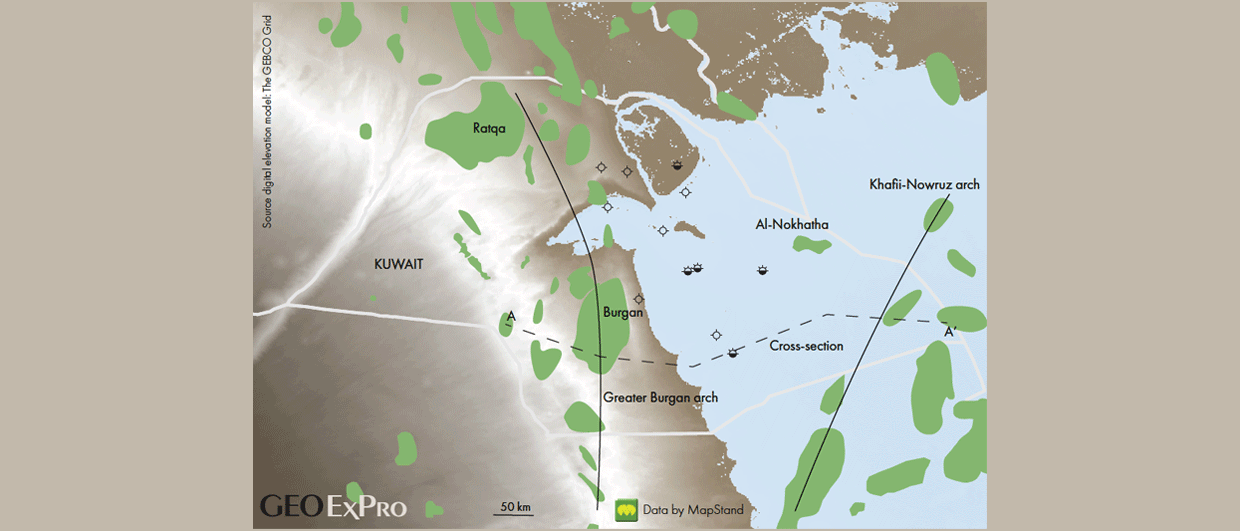

A bit more than a year ago, KOC announced the discovery of oil and gas in the Al-Nokhatha structure offshore Kuwait. Based on regional data and the location of the discovery, I concluded that a stratigraphic trapping element may be a key factor in the field, given that it was found in the large monoclinal structure between the so-called Burgan and Khaffji-Nowruz Arches. These arches represent the two uplifted and folded zones that still form the nucleus of where most of Kuwait’s oil and gas have been found and produced, as the map illustrates.
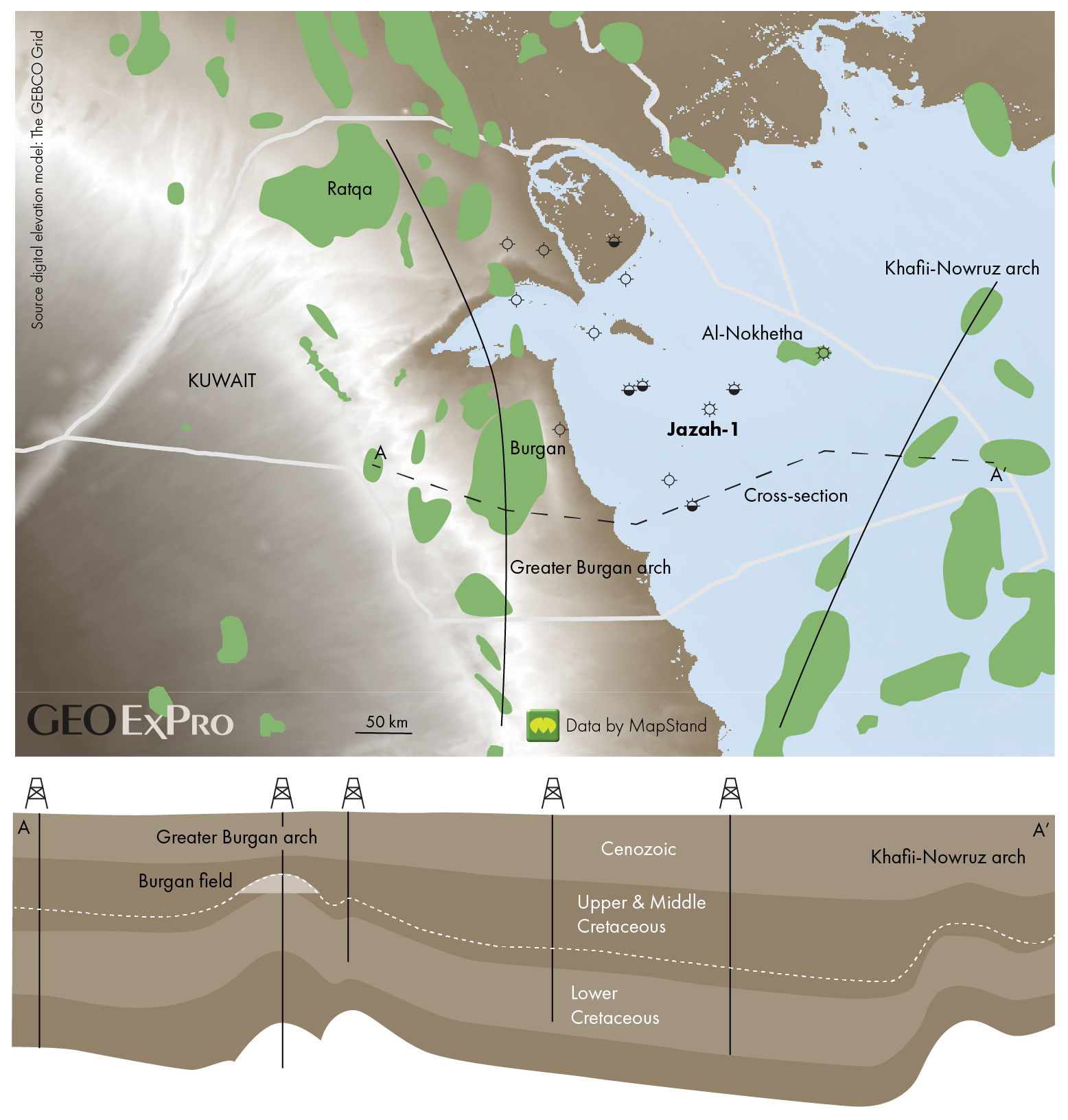
This is not the first time exploration is taking place in the area of the monocline. In the 1960s, Shell drilled three wells at locations where very low-relief closures were mapped. As Abdul Aziz Al-Fares and co-authors explain in a paper they published in GeoArabia in 1998, the well that performed best fizzled out to 103 bopd after five days of testing. In the 1980s, KOC started another campaign offshore. One of those was to further test the area of the best-performing Shell well, but the results disappointed, with oil shows at best. The second well in the KOC campaign tested 420 bopd from the Minagish Formation. That is not a great amount, but still important in the light of what follows.
I am not entirely sure how much drilling followed after the 1980s KOC campaign, but it is unlikely that many wells were completed, given the information at hand. It may therefore be tentatively concluded that the current drilling operation KOC has embarked on in the area of the monocline is a third proper attempt to prove resources in this less “conventional” part of Kuwait’s territory.
The drive to find additional resources may be more significant now. S&P published a study in 2022 concluding that Kuwait needs additional swing production capacity. In addition, similar to what Saudi Arabia is doing with the Jafurah project, Kuwait may also be interested in using gas for local electricity production whilst keeping more oil for export.
Regardless, the Jazah-1 discovery that was announced the other day is yet another exciting one, given the background information provided. Again, located in the heart of the monocline where structural closures are small or absent, it seems that KOC is now able to successfully target stratigraphically trapped resources that were missed in earlier attempts. The reported resource for Jazah-1 stands at about 1 Tcf or 29 Bcm, which is not major, but an encouraging result nonetheless. And similar to one of KOC’s 1980s wells, the reservoir is reported to be the Lower Cretaceous Minagish Formation that produced 420 bbls / day on test 45 years ago. Are synclines the way to go?