
Most commonly, Petroleum Systems Analysis (PSA) studies tend to focus on source rock distribution, its quality, and the thermal regime of the basin to then model migration pathways and the associated hydrocarbon phase. This is also sometimes referred to as ‘’Bottom-up’’ PSA, which predominantly depends on large uncertainties in the basin centres, away from well and data control.
However, this methodology can fall short when it comes to predicting the hydrocarbon phase of prospects. As demonstrated by Zhiyong He, the variations in hydrocarbon properties such as phase, API and gas-to-liquids ratio (GLR) across a migration pathway are not necessarily related to maturity or local variations in source rock properties, but can be entirely explained by seal capacity.
In the example shown here, all the hydrocarbons of very different composition have originated from the same expelled gas condensate. As the gas condensate reaches saturation pressure, oil begins to fractionate out. If the seal is compromised, excess gas leaks off vertically, leaving behind an underfilled oil accumulation.
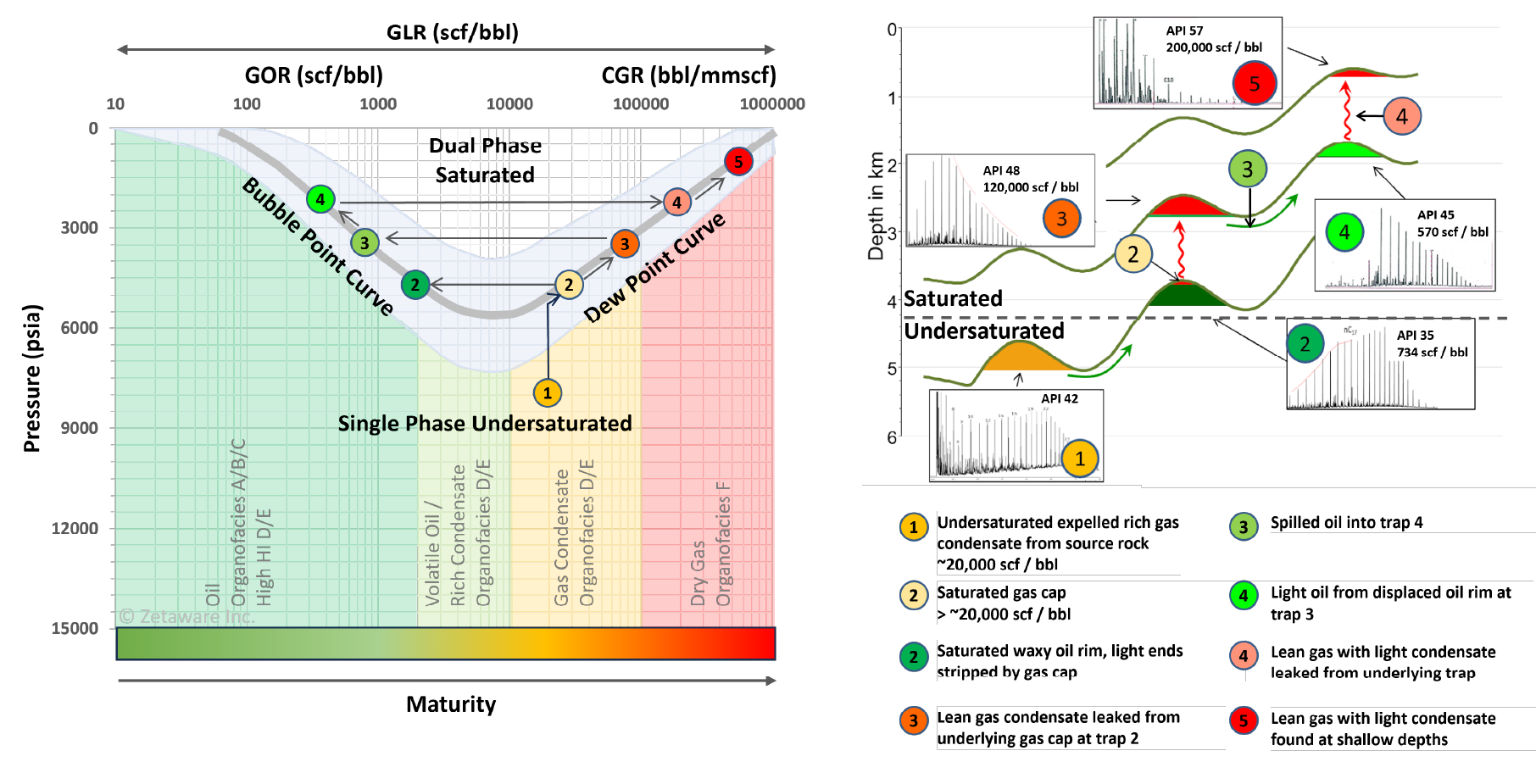
On the other hand, a competent seal allows for a gas column to accumulate, which displaces the oil leg updip, leaving behind a fill to spill gas accumulation. As such, the occurrence of a filled-to-spill oil field only or a mixed phase accumulation is very unlikely. At the same time, it is those overoptimistic scenarios that are often assumed in prospect assessments.
As this example shows, it is the hydrocarbon properties or PVT (pressure, volume, temperature) data from already drilled exploration wells in a basin that form the critical piece of the puzzle. This type of data tends to be neglected in “Bottom-up” studies, and we therefore make a case for what we call a “Top Down” approach to be applied in PSA at the same time as the study of source rock generation over time.
Both the “Bottom-up” as well as the “Top Down” approaches enrich the understanding from opposite directions, and ideally result in consistent predictions of the exploration risk. ‘’Top-down’’ thinking must not only be integrated into any regional PSA study, but also into the prospect resource assessment, where a proper evaluation of the relationship between the PVT data and seal properties at the trap allows making probabilistic assumptions about the hydrocarbon phase and resource volume uncertainty ranges.