
Australia’s NW Shelf is characterised by a gas-dominated petroleum system, where Middle Jurassic deltaic coals of the Plover Formation make up the main source rocks. That is why oil occurrences along the NW Shelf tend to be the result of secondary alteration processes, ranging from water washing in the Bonaparte Basin, phase fractionation in the Vulcan Sub-Basin to biodegradation in the Carnarvon and Browse basins. In rare circumstances, oil accumulations are sourced from oil-prone Upper Jurassic marine source rocks and require shielding from the dominant Middle Jurassic gas source.
The Vulcan Sub-Basin is characterised by a whole-system gas-to-liquids ratio of approximately 20,000 scf/bbl (~50 bbl/MMscf). Early oil discoveries in the 1970s and 1980s, including the Jabiru and Challis fields, led to the interpretation of an oil-prone petroleum system sourced from Upper Jurassic marine source rocks, largely based on geochemical interpretations. However, subsequent exploration delivered underwhelming results, with discoveries commonly deemed sub-commercial due to limited oil volumes or the presence of significant gas phases, as observed in the multi-Tcf accumulations of the Cash / Maple and Bratwurst discoveries.
Integration of bulk fluid properties with modern geochemical analysis indicates that the discovered oils are best interpreted as products of phase fractionation from an originally gas-condensate-dominated charge. Consequently, the interaction between phase fractionation processes and seal integrity emerges as the primary control on hydrocarbon phase distribution and preserved oil volumes.
The Jabiru oil field was subjected to a charge–fill analysis to evaluate the impact of the relationship between phase fractionation and seal integrity. The image on the far right shows the Jabiru field outline and hydrocarbon phase at discovery. At that time, the oil–water contact (OWC) was interpreted at 1,630 m below sea level and the lowest closing contour (LCC) at 1,720 m, indicating an underfilled trap of approximately 90 m. Prior to production, Jabiru was estimated to contain approximately 220 MMbbl of oil originally in place (OOIP).
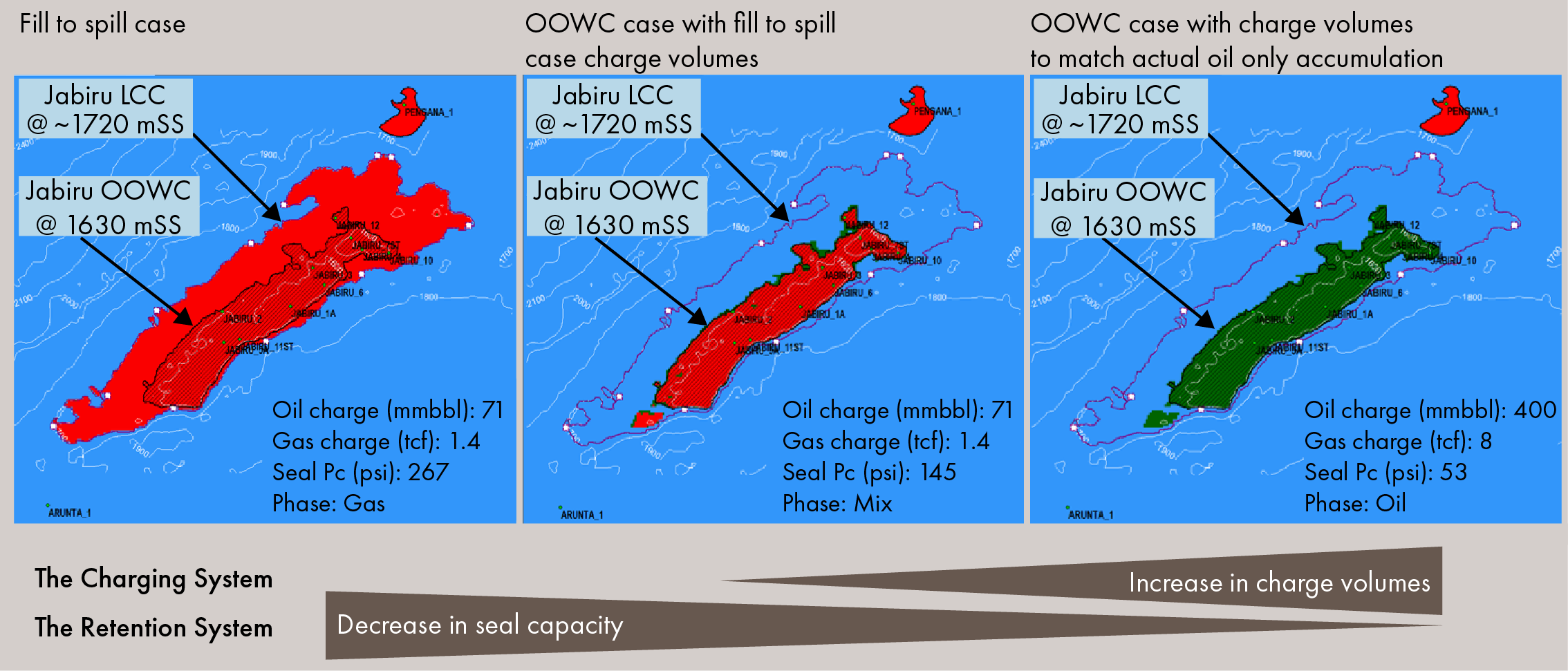
Fractionating 220 MMbbl of oil from a charge with a 20,000 scf/bbl GLR requires in the order of 8 Tcf of gas to transit through the trap, coupled with limited seal capacity to allow excess gas to leak.
If the seal at Jabiru had been robust, consistent with the underlying petroleum system, the accumulation would most likely have been a filled-to-spill gas accumulation of approximately 1.4 Tcf, as illustrated on the far left of the slide. Conversion of such an accumulation into an oil-only field requires both a reduction in seal capacity and an increase in charge volume, enabling continued phase fractionation of oil while excess gas is progressively leaked from the trap.
Hence, any prospect assessment requires integrating the underlying petroleum system to assess whether its fetch cell captures sufficient expelled gas volumes to fractionate the necessary commercial volumes of oil.