
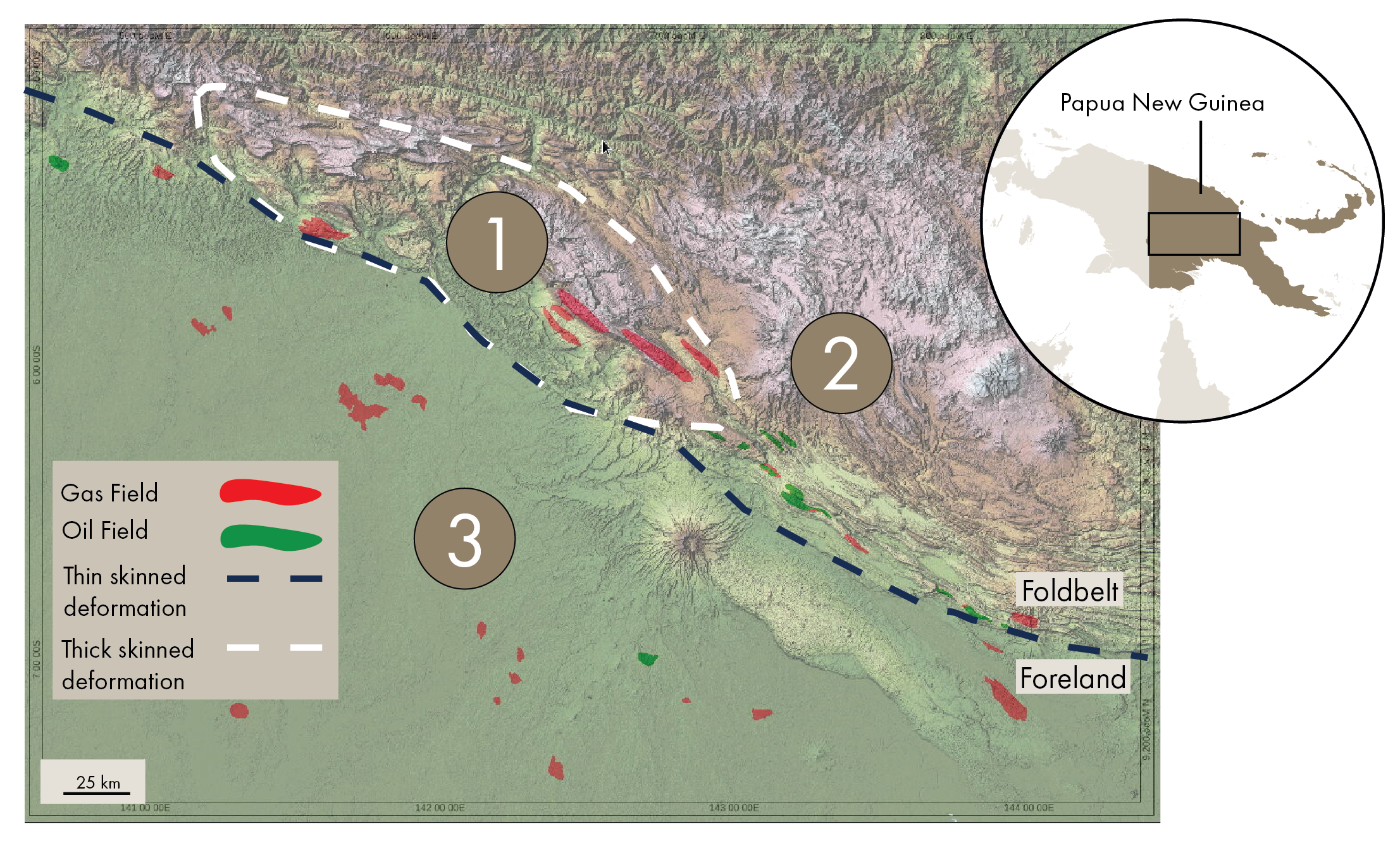
The Papuan Basin is located across a tectonically active area and is dominated by a gas-prone Jurassic petroleum system with a whole-of-system Gas-Liquid Ratio of 30,000 scf/bbl. The complex geology, coupled with a steep and karstified surface terrain, results in poor data coverage with even poorer quality, making attempts at standard bottom-up basin modelling to predict hydrocarbon distributions and phases almost futile.
Therefore, the understanding of the petroleum system is driven by a top-down analysis integrating the existing accumulation trends and hydrocarbon bulk properties into the context of their structural setting.
Hydrocarbon column heights distribution analysis across the Papuan Basin shows that larger column heights are associated with gas-only accumulations, whereas none of the traps containing either an oil-only or a mixed phase are filled to spill.
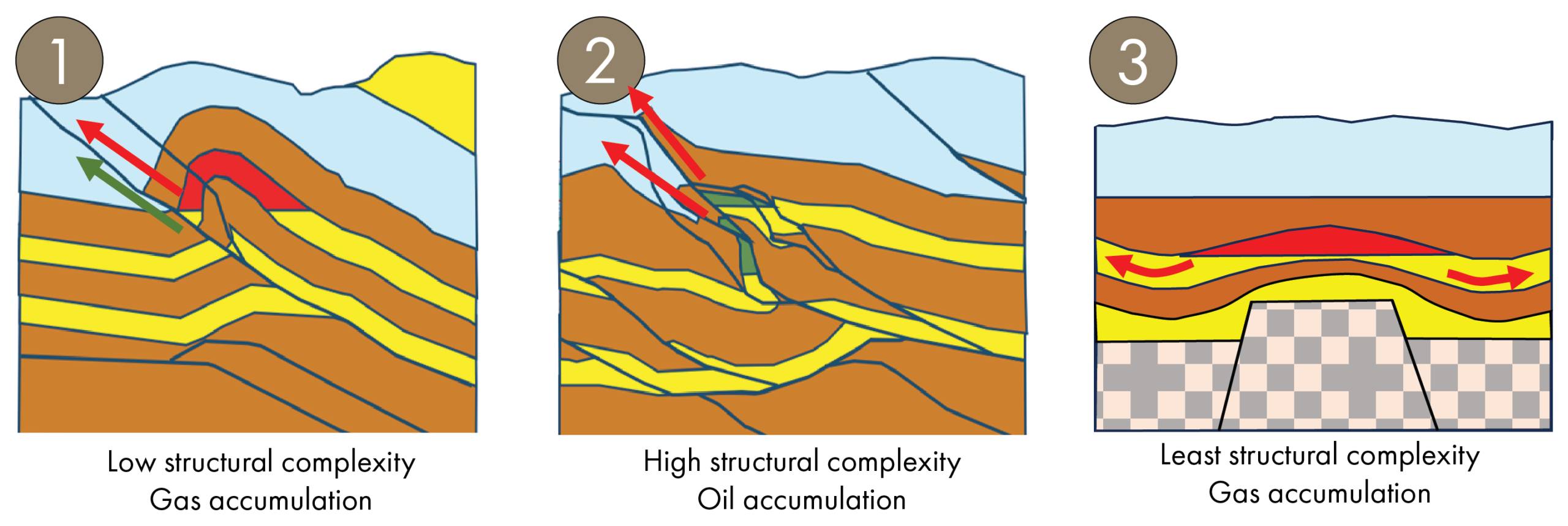
Based on the existing PVT and geochemistry data, all the sampled Papuan Basin hydrocarbons are saturated and have the same origin. As the originally undersaturated condensates are expelled from the Middle Jurassic deltaic coals at greater depths, liquids drop out once they reach the dew point pressure on the upwards migration pathway. The preservation of the liquids in the traps is dependent on the structural setting and indirectly related to seal integrity. The greater the degree of structural complexity, the greater the likelihood of vertical gas leakage leaving behind oil accumulations.
Therefore, areas of lesser complexity, such as the thick-skinned deformed part of the Papuan Basin foldbelt (1), tend to be prone to gas-only accumulations with the oil having been displaced. The more structurally complex thin-skinned deformed part of the foldbelt (2) tends to also host oil accumulations, as some or all of the gas leaks through the faults, creating space for the oil. The foreland part of the basin (3), which is the least structurally complex setting, contains only gas accumulations of relatively low column heights that do not favour the accumulation of oil.
Despite the lack of data and the incomplete knowledge of the subsurface, the accumulation trends and related fluid properties can be used for a solid probabilistic prediction of prospect phase and column height. This requires prospect assessment workflows to include quantitative assumptions for PVT, charge and seal, so that oil and gas fluids are put in competition for pore and pressure space, obeying the mechanism as described above.