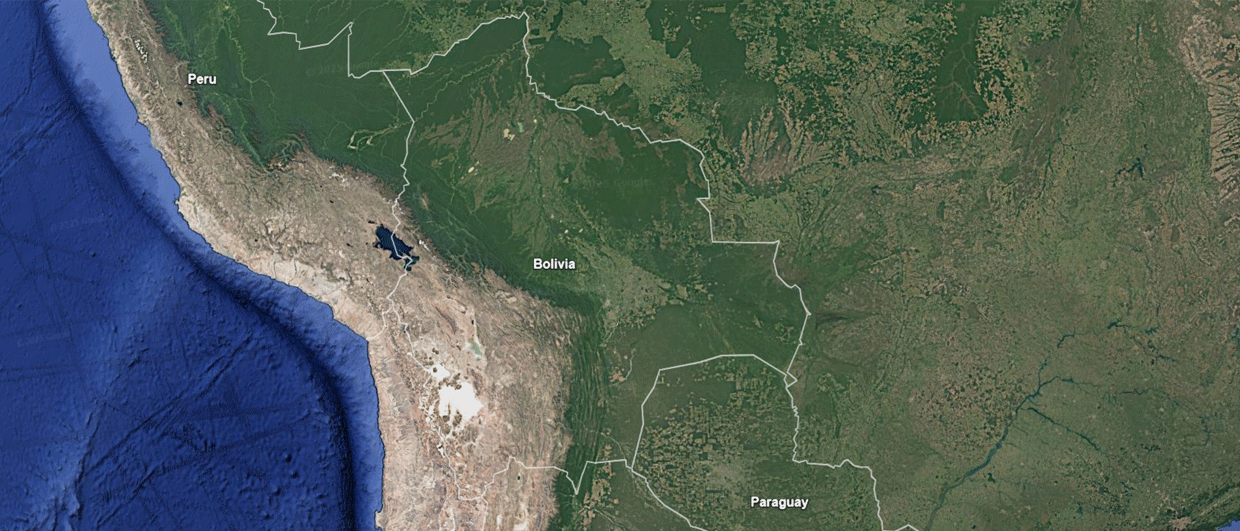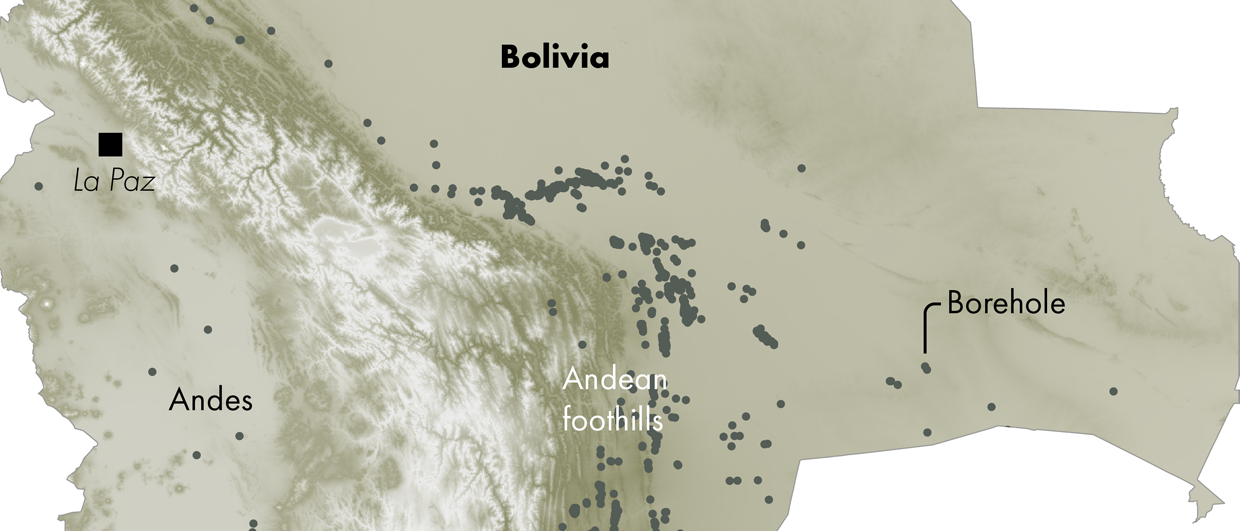

Oil and mostly gas exploration in Bolivia has always focused on structural traps in the Andes fold and thrust-belt. Not that it was easy to drill there; overpressure, hard-to-interpret land seismic, and difficult terrain don’t make up for ideal exploration conditions. However, successes were achieved, and for a long time, the country even functioned as an exporter of gas to Brazil. That, however, has now completely reversed, both due to natural decline from existing fields as well as a lack of foreign investment.
The petroleum system in the Bolivian fold and thrust-belt relies to a large extent on Devonian source rocks, deposited in a seaway that opened up in a northerly direction 400 million years ago. And it is this Devonian source rock that is the key when exploration shifts towards the more distal places of the present-day foreland, where subtle, tight, and unconventional resources may exist.
There are places in the world where the distal parts of foreland basins are very important when it comes to hydrocarbons. Devonian marine source rocks and associated oil and gas play types are well known in North American foreland basins, for example.
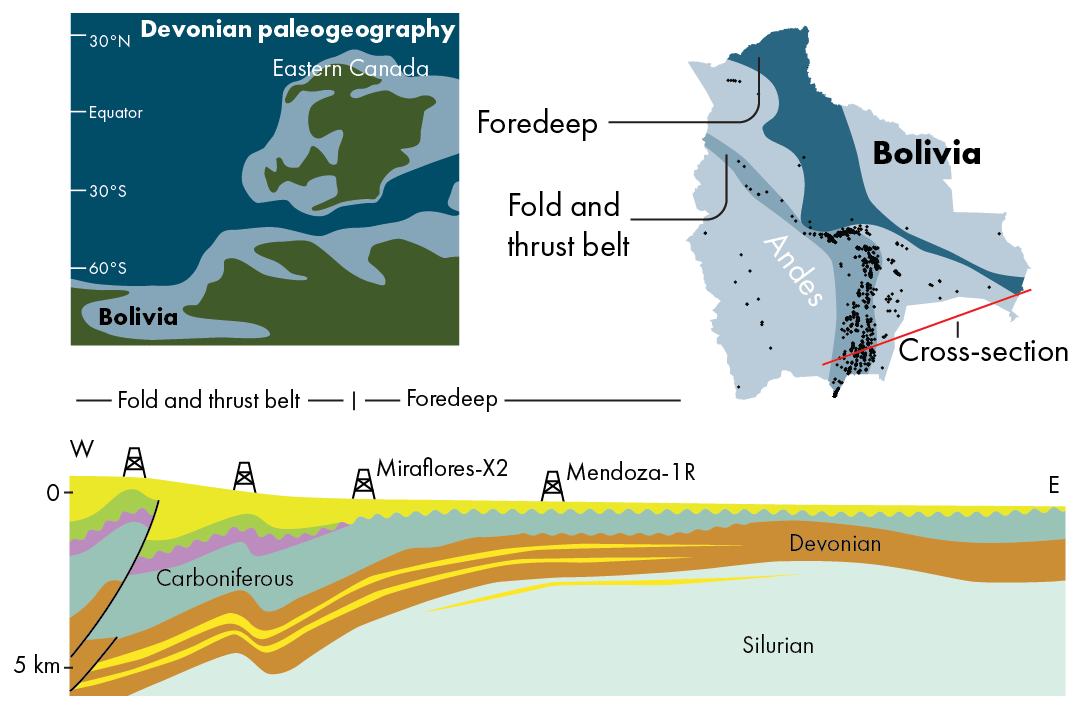
So, why is there no current production associated with Devonian source rocks in the more distal parts of the Bolivian foreland? This might be related to its paleo-latitude position. The area was situated at around 60 degrees southern latitude in Devonian times, and it could be the location in a cooler environment that might have prevented the deposition of oil-prone source rocks similar to the ones in Canada and the USA.
Does the challenge of the presence of an oil-prone source rock exclude the possibility of success? No, as more distal wells such as Miraflores and Mendoza already demonstrated, there is potential for the production of gas from Devonian and Silurian sandstones. But due to the more dispersed nature of the TOC in the Devonian source rock in Bolivia, as well as its type, oil plays may be challenging to find. Paleogeography and paleolatitude are key.