
Last year, we published an article about the presence of freshwater signals in deep-marine sandstones. It was an observation made by an explorer in the Pomboo well drilled in deepwater Kenya, where some people initially did not believe the lab outcomes, arguing that it was impossible to find fresh water in such a place. Yet, it was true.
This led to a follow-up post on LinkedIn that triggered a fair amount of feedback from our readers. One of the main reasons that came up to explain the presence of fresh water in such a setting was diagenesis, or illitisation. This process releases water, which then subsequently migrates to nearby reservoirs.
Then, a few months ago, Colin Percival told me during a conversation in Aberdeen that he didn’t buy the diagenesis story, based on his observations in the Faroe Shetland Basin (FSB), UK. I was intrigued; Colin has a wealth of experience as a geologist, and as such, we organised a meeting to further discuss.
Overpressured sands
“We’re talking about the Paleocene Vaila Formation,” says Colin as he kicks off the conversation. “In the FSB, the Vaila Formation sits beneath a regional seal, the Kettla Tuff. For that reason, it is slightly overpressured in many parts of the basin. Salinities range from 3,000 ppm to around 15,000 ppm, so well below the value of normal marine waters (35,000 ppm). In addition, we also see the presence of lots of wood fragments in the sands.”
“Let’s take a look at the paleogeography,” Colin says. “In Paleocene times, the FSB was a relatively narrow embayment, with lots of fluvial input, especially during the lowstands when the Vaila sands were deposited by hyperpycnal flows.” In other words, the basin may not have been fully marine at the time. “As such,” concludes Colin, “I think that the salinity of the waters we currently observe in these overpressured Vaila sands is a sign of the salinity of the basin at the time. In the North Sea, we don’t see these lower salinities in equivalent sands at all, which should be explained by the fact that the basin was much wider than the FSB.”
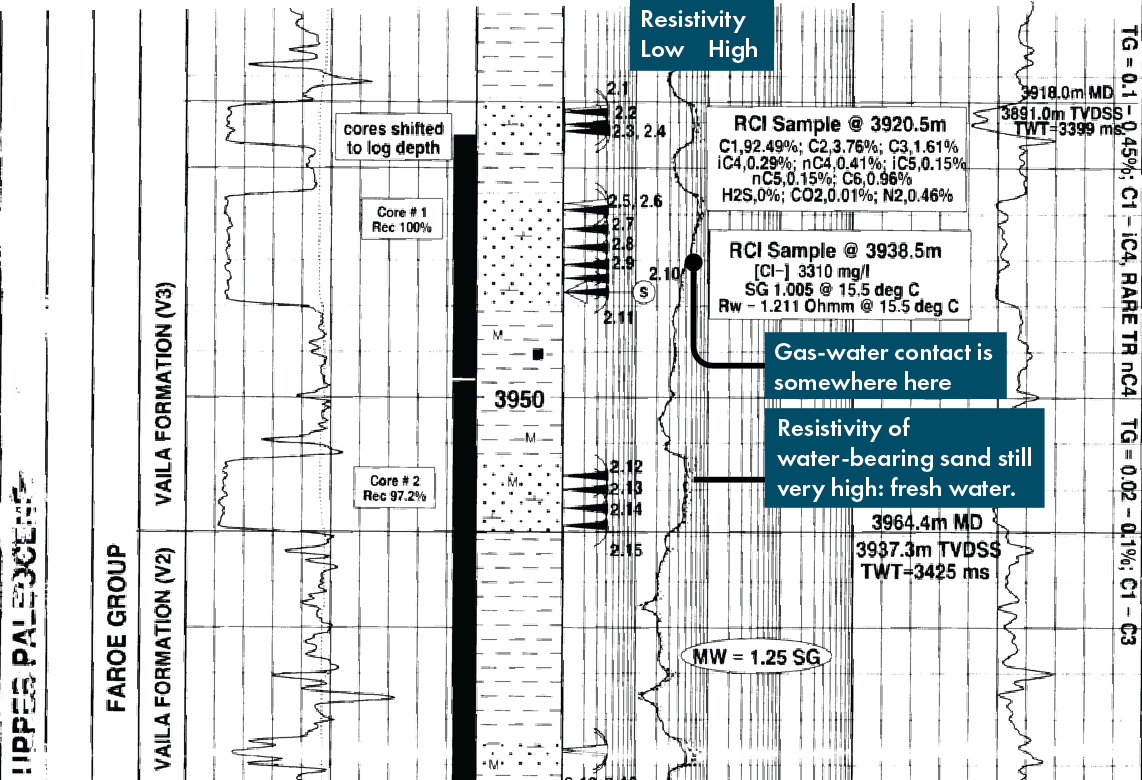
“In those areas of the FSB where the sands are more normally pressured and better connected, we see a higher salinity in general. I explain that by later fluid migration and mixing,” says Colin. “This mixing was more challenging in the less well-connected Vaila sands.”
“I did not study this phenomenon in great detail,” admits Colin, “but I just feel like you need a lot of clay transformation to freshen the pore water signal in deep-marine sands if you only rely on that mechanism.” In addition, in further support of his theory, he argues that there has not been a lot of diagenesis in the Vaila succession in the FSB yet; the depth of burial is only about 7,000 ft below mud line in general.
So, it sounds like we have another factor explaining a freshwater signal in deep-marine sands.