
44.01 named their company after the mass of the molecule that is central to their business: Carbon Dioxide. They use CO2 captured from industry or the atmosphere and dissolve it in water to create a carbonated injection fluid, a kind of sparkling water. The fluid is injected deep underground, where it dissolves minerals within mafic or ultramafic rock. This creates an ion-rich fluid that spreads through the existing fracture network while the captured CO₂ reacts and mineralises to carbonate.
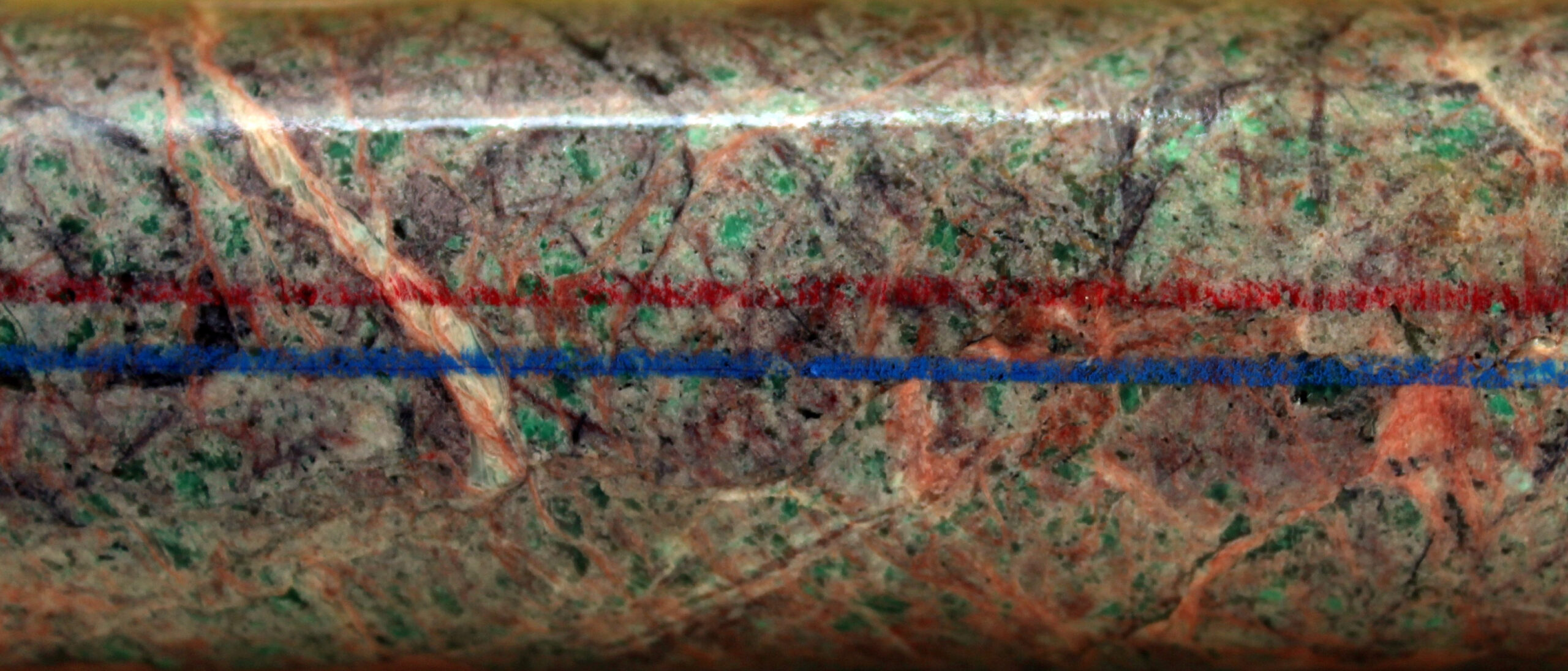
Carbon capture and mineralisation (CCM) mimics the natural process of silicate rock weathering. It entails the conversion of CO2 to carbonate minerals via fluid-rock reactions. The process is an accelerated version of surface weathering due to elevated subsurface temperatures and an increased CO2 concentration. During the carbonation process, atoms of magnesium and calcium in olivine and pyroxene combine with CO2 to form secondary carbonate minerals such as magnesite and calcite, permanently locking CO2 in the subsurface.
44.01 first trialled this concept in Oman; they injected CO2 captured at an ammonia plant into peridotite at 100 to 400 m depth. Monitoring the composition of the injected solution demonstrated that 88 % of the CO2 was mineralised as carbonate within 45 days of injection.
Of course, this raises the question of whether the newly precipitated minerals will clog up fluid pathways, thus preventing further injection. Interestingly, because carbonation of peridotite results in a volume increase, this could conveniently cause fracturing or so called ‘reaction-driven cracking’. This process increases permeability and leads to the exposure of fresh reaction surfaces, enhancing further mineralisation.
However, it is yet to be seen which process, precipitation or cracking, will dominate during injection on an industrial scale. It does seem likely that additional permeability enhancement, such as fracking, will be needed to accommodate injection rates.
A second test site is located in Fujairah. During the initial stage, direct air-captured CO2 was mixed with seawater and injected into peridotite. This resulted in the mineralisation of approximately 10 t of CO2. Now 44.01 has teamed up with its first industrial customer, Holcim, with the plan to inject CO2 captured from cement production. 44.01 has started injecting at a rate of 5 t/day and hopes to increase to 20 t/day. The borehole has an estimated CO₂ capacity of 25,000 t/year.
The Fujairah project will generate essential data on techno-economics, injection performance and long-term storage validation, insights that will guide 44.01’s future commercial-scale projects.