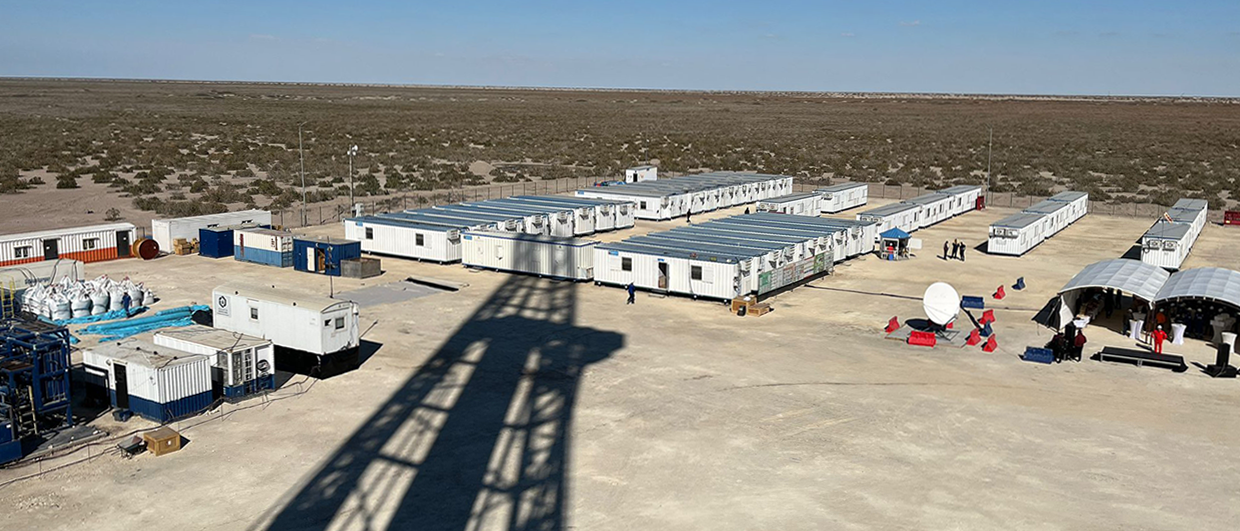

Domestic gas production has rapidly declined in Uzbekistan over the last few years, to the point where the country became a net importer since 2023 to meet demand. This has sparked the country’s leadership to take action and form a new state-supported explorer under the name of Yangi Kon. This new organisation, whose role is to find petroleum resources in areas previously overlooked, has now embarked on a drilling project in the Ustyurt region in the west of the country that will hopefully prove potential in strata that have never been properly explored.
Thus far, the country has focused on exploring Upper and Middle Jurassic reservoirs. With UDG-1 well being drilled now, the focus is on Lower Jurassic strata, looking beyond the traditional plays. Another important factor to bear in mind is that, based on information available from a shared investor pack, the well is testing a series of stratigraphic traps, in contrast to the more traditional four-way closures. If the sandstones in the graben structure show good gas saturations, there is the potential for a major gas development. But at the same time, the depth of burial – around 6.5 km – means that there is a risk of finding fairly cemented rocks that don’t flow that easily.
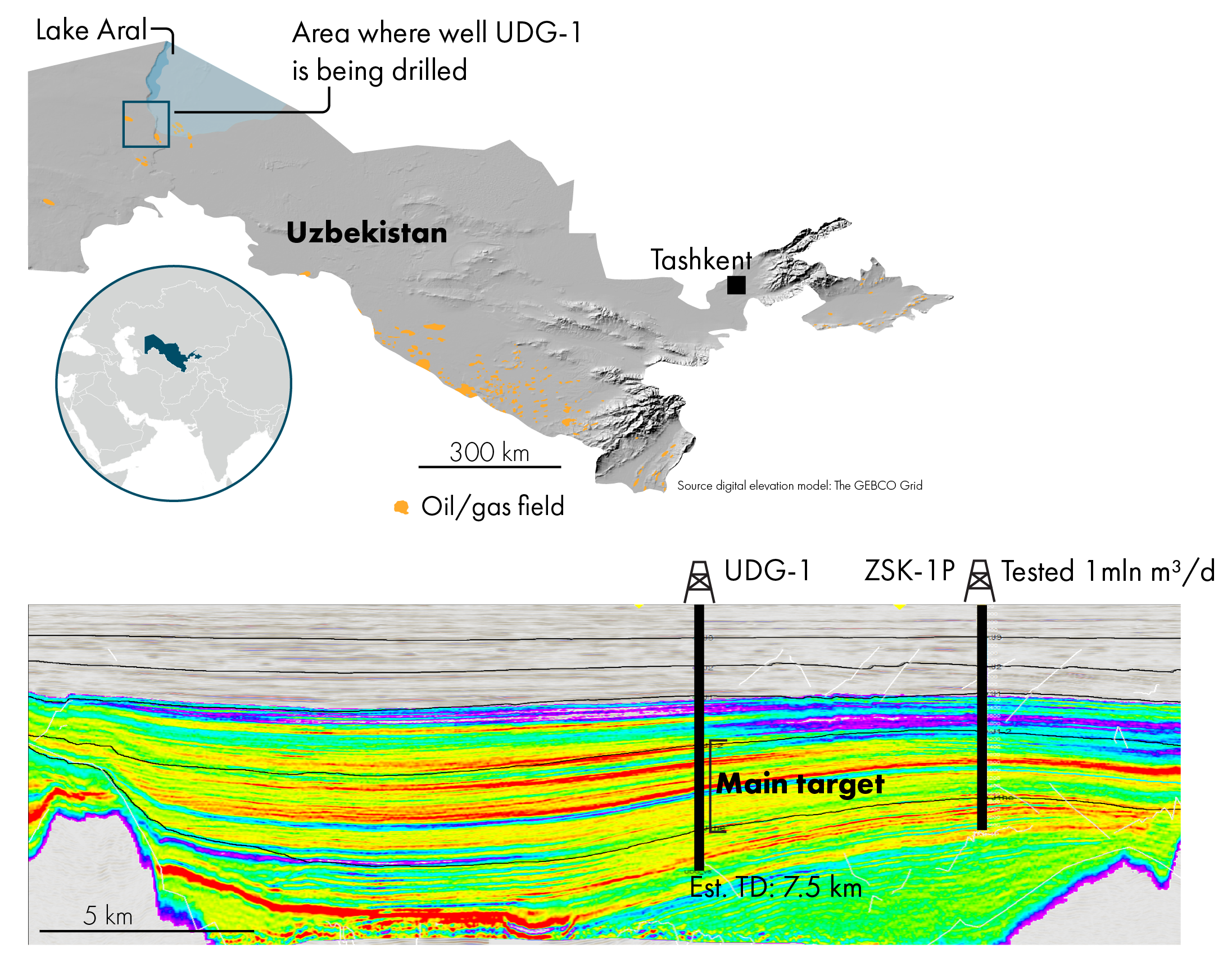
Another interesting aspect of UDG-1 is that the same Lower Jurassic strata were recently de-risked by another borehole (ZSK-1P), completed nearby. Instead of a stratigraphic trap, ZSK-1P targeted a structural closure, a bit shallower than UDG-1’s planned TD. ZSK-1 did prove gas though, which is a positive sign, and in fact de-risked the UDG-1 well.
The location of the well spud is also quite special because only a few decades ago, this area used to be Lake Aral. The boats that can still be seen dotted around form a stark reminder of the size of this once great lake.
All in all, the drilling of UDG-1 is an example of how countries respond to declining domestic energy resources. With the establishment of a new company, there is no doubt the desire to put in place a new organisation that looks at opportunities with fresh eyes, whilst from a subsurface perspective there is not only a push to explore deeper intervals, but also drill trapping styles that might previously have been ignored. A fascinating undertaking all in all.