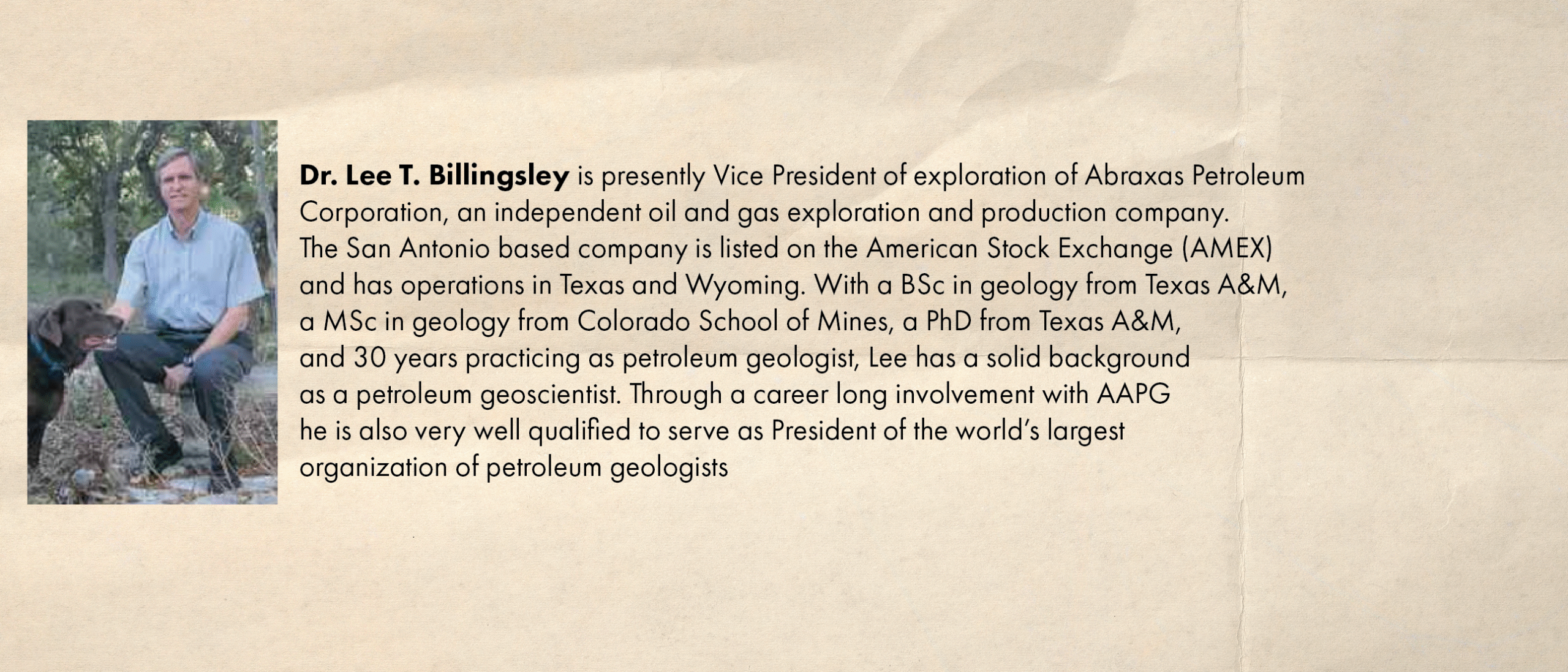

Being Vice-President of Exploration in an independent oil-company, and knowing all too well that this takes a lot of work, why did you agree to stand for election as President of AAPG?
First, Abraxas generously supported my request to run for the office, and they have continued their encouragement after my election. Second, AAPG affords me the opportunity to fulfil a basic human need, that of contributing to a greater good. In my short time as President I will strive to improve the careers of petroleum and related geologists by utilizing the resources of AAPG. Everyone that volunteers his or her time for an organization like AAPG gets rewarded by some degree of internal satisfaction. It seems that the more you give, the more you get. I really enjoy the resulting friendships with other professional volunteers and AAPG’s staff.
How did you get involved in AAPG?
As a young professional I began by helping with logistics and the technical program of AAPG conventions. Also, I served in the House of Delegates and participated in committees. I learned about management of the organization when I served as Treasurer in the mid-1990s. Serving as President reminds me of a long-distance bicycle ride with a group of riders in a pace line. Each rider takes a turn as leader to make the way easier for the others. So I decided to take my turn.
With 30,000 members to keep satisfied, and several more geoscientists that ought to be members, what is your ambition for AAPG?
AAPG must continue to execute on it strengths of services and products, namely conventions, meetings, publications, Explorer magazine, and continuing education. But we need to improve the communication of our services and products to both existing members and prospective ones. Some of our existing members are not aware of AAPG’s digital library, and all the resources available to them. The world’s energy needs will demand more professional petroleum geologists, and AAPG needs to both encourage more students to enter the career field and inspire existing geology students to become petroleum geologists.
You have not been afraid of expressing your opinion about CO2 and the environment. Can you elaborate upon your opinions?
From a long-term geological point of view we know that climate has been changing, not only through centuries, but also through millions of years, proving that The Earth is a dynamic system, even without human influence. In recent times human activities related to burning fossil fuels may be increasing CO2 levels in the atmosphere. Models predict that the projected rise in CO2 levels will cause Earth’s climate to change. The uncertainty lies in the magnitude of the effect of man’s activity. Since fossil fuels are the most cost efficient form of energy, restricting their use through government controls or taxation will have an economic cost. The increased cost is like an insurance premium that will be paid today in hopes of mitigating an as yet undetermined climate change in the future.
How do we then go about this problem?
As cost-effective precautions, we can utilize technology to reduce CO2 emissions by both conservation and capture. If allowed to operate, market forces will eventually reduce fossil fuel use, and alternative sources of energy will become cost effective. No matter which course of action the global community takes on CO2 emission reduction, I believe that cycles of climate change will continue. It is important that we continue to study and model climate change, so we are better equipped to put our scientific resources into adapting to the changes. Policies and resources focused on adaptation will have a more predictable outcome than policies based solely on uncertain prevention.
Getting back to the business we are working in, why should young people study geoscience and get involved in the petroleum industry?
Petroleum geoscience is critical to supply the increasing world energy demand. All projections show that we will still need fossil fuels as our primary energy source in the middle of this century. Renewable energy can supplement fossil fuels, but it is not going to replace them. Petroleum geoscience is a very rewarding career, and I would like young people today to have the same opportunity for a fun, fulfilling career.
Does the negative pr around CO2 emissions and the peak-oil debate concern you?
Yes, I get concerned because of the negative implications it may have on young people trying to decide on a career in petroleum geoscience. Geoscientists are basically conservationists, and we do not like to see consumers wasting our pro ducts. Humans will always need affordable energy, despite restrictions that some may view as necessary to save the planet. Geoscientists will make a difference in supplying growing energy demand.