Play diversity and untapped promise – A new licensing round opens fresh horizons in Cameroon
Opening the door to discovery
Cameroon’s 2025 Licensing Round, launched by the Société Nationale des Hydrocarbures (SNH), offers nine highly prospective blocks covering nearly 20,000 km² across onshore and offshore areas of the Douala/Kribi-Campo (DKC) and Rio del Rey (RDR) Basins. Open for bidding until 30 March 2026, the round presents a compelling opportunity to explore a region with proven petroleum systems, established infrastructure, and proximity to key markets.

Situated at the eastern edge of the Niger Delta, the RDR Basin continues to deliver from established fields supported by robust infrastructure. To the south, the underexplored offshore DKC Basin presents significant untapped potential, with proven petroleum systems and a range of Cretaceous and Tertiary plays. Discoveries such as Sanaga Sud, Ebome, Mvia, and YoYo have confirmed both oil and gas potential across shallow and deepwater settings.
As the exclusive data provider, Viridien is supporting the licensing round with a comprehensive exploration data package: 6,800 km² of reimaged 3D PSDM seismic, ~9,000 km² of enhanced 3D coverage, 37,500 km of processed 2D seismic, and interpretative data from over 150 wells.
Viridien’s 2021 regional 3D PSDM reimaging project, integrating ten legacy surveys across the DKC Basin, was undertaken using state-of-the-art technologies. Analysis of this dataset, coupled with recent integrated geological evaluation by Viridien and SNH, has provided a fresh perspective on the region, revealing insights on a regional scale. With modern imaging technologies and large regional 3D datasets, the subsurface picture is now greatly enhanced, with significant uplift in trap definition and structural imaging compared to legacy datasets. These advancements have highlighted areas of renewed exploration potential and further de-risked prospectivity.
Reimaging the past to refine the future
The 3D PSDM reimaging has delivered a step-change in data quality, with wave-equation deconvolution for multiple attenuation and joint source-receiver 3D de-ghosting technologies applied. Reflector continuity, signal-to-noise ratio, and bandwidth are markedly improved, particularly in deeper intervals. Depth positioning was refined through Full-Waveform Inversion (FWI) and multiple tomography passes, resolving ambiguities caused by complex velocity variations (Isakov et al, 2023). Compared to legacy time-domain data, the PSDM data offers clearer structural definition of prospective features.
Where play diversity drives exploration
In the offshore DKC Basin, diverse plays span post-rift Upper Cretaceous to Tertiary slope and basin-floor fans, hosted in structural, stratigraphic, and combination traps, potentially charged by multiple Cretaceous and Tertiary source rocks.
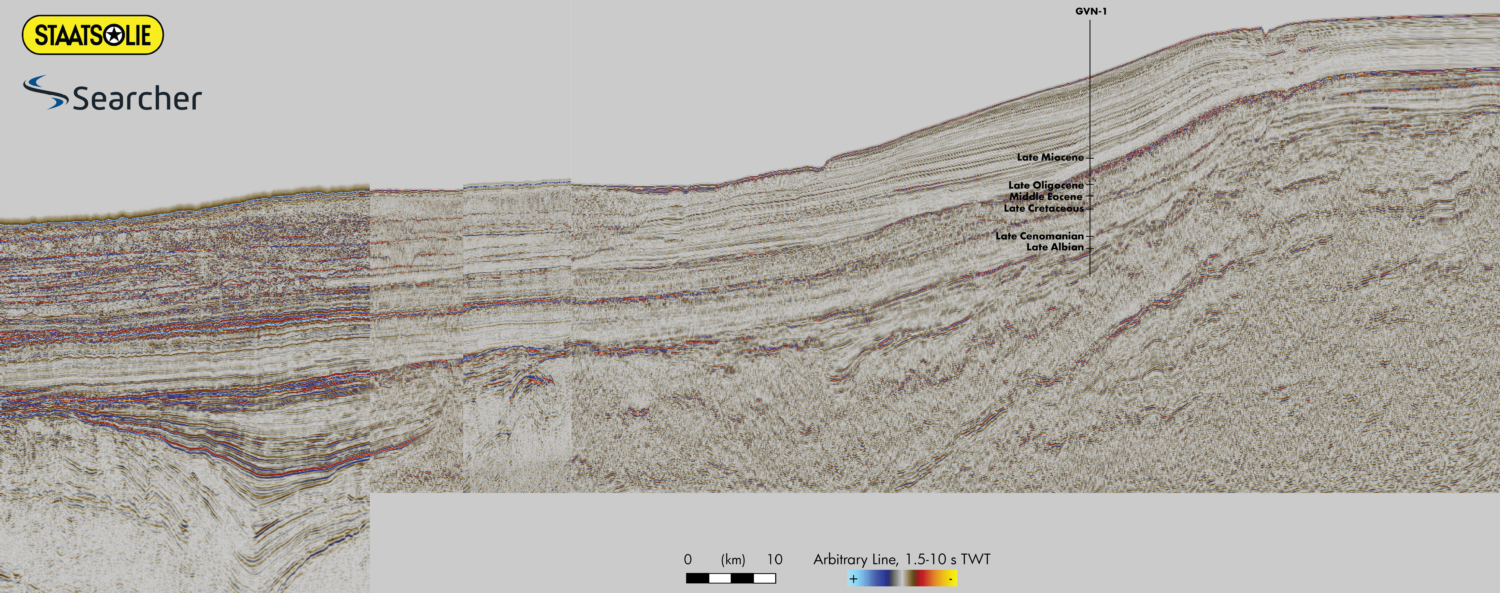
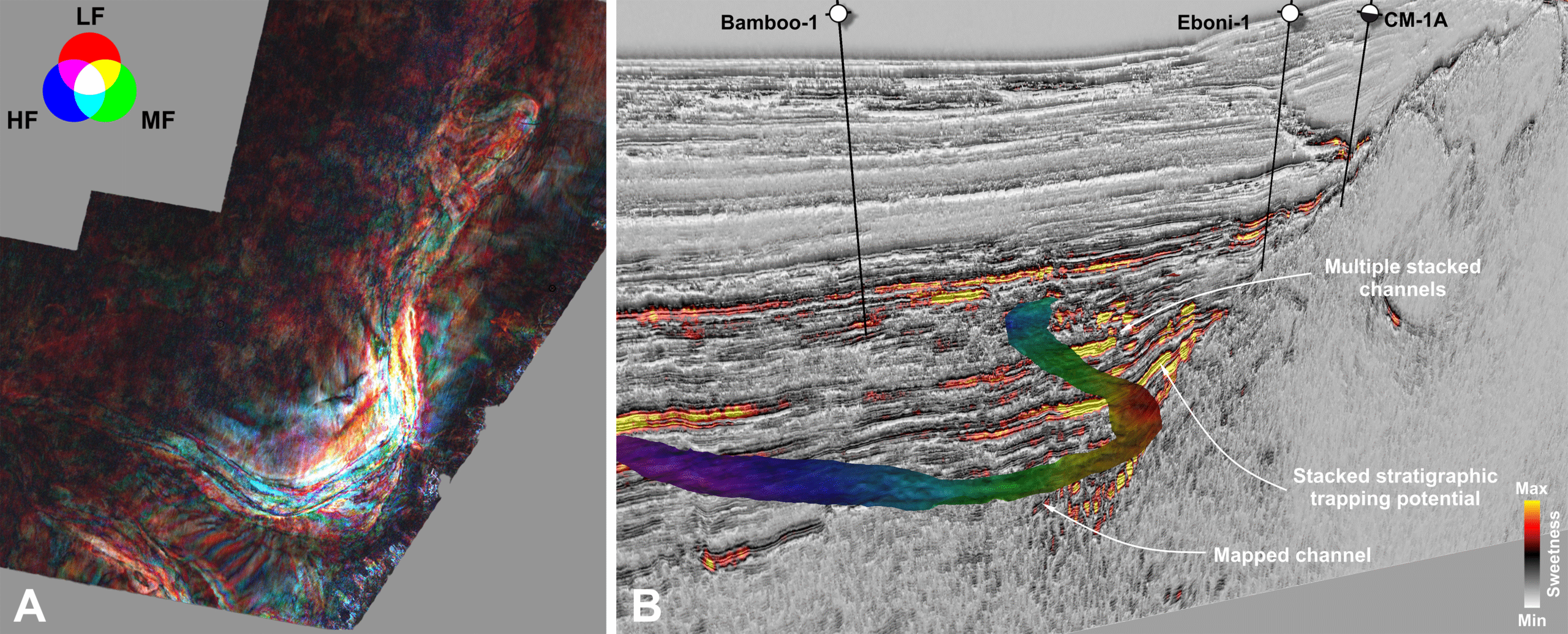
The new interpretation of the reimaged 3D data has highlighted significant prospect potential within Cretaceous and Tertiary plays. In the Ntem and Elombo blocks, refined PSDM imaging and attribute analysis reveal deeper, potentially sand-rich targets that have previously gone untested in earlier campaigns. Multiple large-scale stacked Upper Cretaceous channel systems and associated stratigraphic traps are now clearly defined (Figure 1). Spectral decomposition and high-resolution seismic attributes (Figure 3A) reveal large compound channels with strong amplitude contrasts and depositional geometries that indicate potential for sand-rich fills and promising trapping configurations (Figure 3B).
Within the Elombo block adjacent to the Kribi-Campo high, structural and stratigraphic plays linked to salt diapirs offer additional promise. An Aptian salt body was penetrated by Kribi Marine-1 (Figure 1), highlighting potential for salt-related traps. The Lower Cretaceous Mundeck Formation likely serves as the source rock, with Mundeck sands forming suitable reservoirs. These salt-related plays, though confined to the rift, offer intriguing analogues to productive systems farther south along the Atlantic margin.
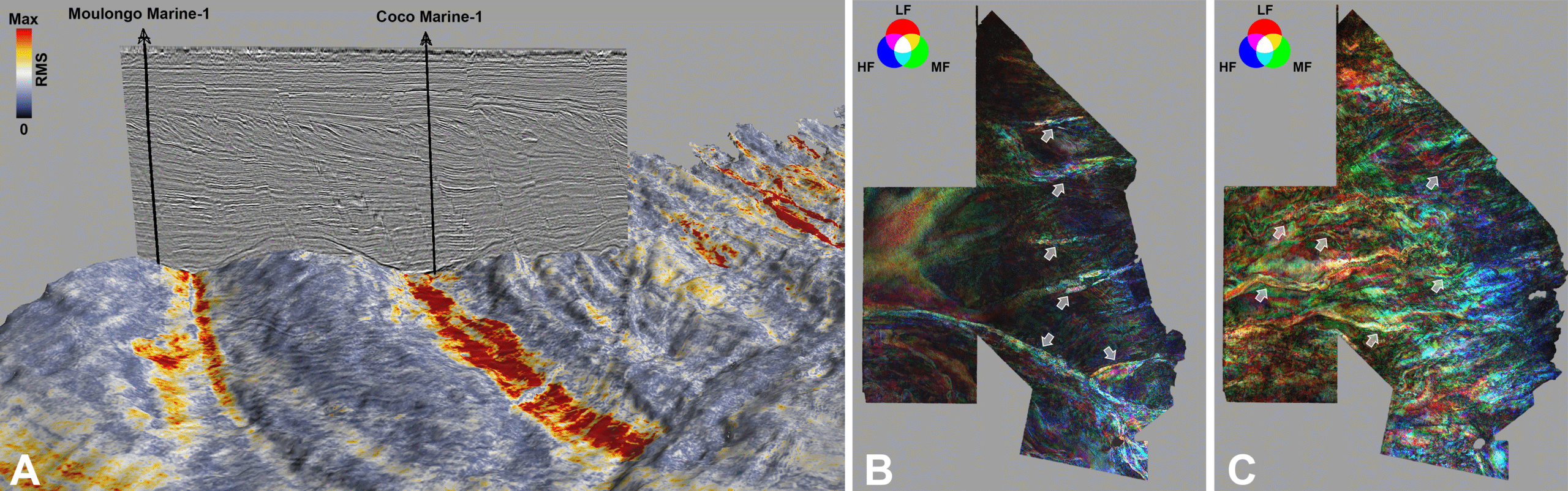
Across the Tilapia block, the Moulongo Marine-1X well, guided by 2D data, targeted an Upper Cretaceous submarine fan complex and missed the main basin-slope channel, while the nearby Coco Marine-1 well successfully encountered thick hydrocarbon-bearing channel sands that are clearly visible in Viridien’s 3D dataset (Figure 4A). Attribute extractions at the Palaeocene stratal slice reveal clear channel systems extending towards the south-west and demonstrate how Moulongo Marine-1X is located at the edge of the target channel. The latest reimaged 3D PSDM data refines structural and stratigraphic interpretation and boosts confidence for identifying and optimising viable drilling targets.
Tertiary stratigraphic traps dominate exploration in the north DKC area, as proven by the Coco Marine, YoYo, and Sapele discoveries. Targets include Miocene turbiditic and channelised sandstones (Figure 4B), with additional potential in Eocene and Palaeocene intervals. Further prospectivity has been identified in Upper Cretaceous plays, where channel systems have been revealed (Figure 4C) and hydrocarbon shows encountered. In the Etinde Exploration block, petrophysical analysis indicated missed pay in several wells (Jean-Pierre Loule et al, 2018).
In the RDR Basin, exploration has historically focused on prolific shallow Upper Miocene–Pliocene plays, many of which are now nearing depletion. Emerging Cenozoic turbidite plays such as Isongo, Oongue, and Nguti, once considered high-risk, are now seen as promising following analysis of enhanced seismic data.
An even greater opportunity may lie within the untested Cretaceous play, long overlooked due to thick Tertiary overburden. Outcrops of Campanian-Maastrichtian and Albian-Cenomanian shales, together with discoveries in equivalent intervals along the West African margin, indicate strong geological correlation and a viable petroleum system.
Together, the RDR and DKC Basins showcase a remarkable range of plays, from deep Cenozoic and untested Cretaceous prospects in RDR to stratigraphic and structural opportunities in DKC.
New data, new horizons
Recent imaging advances and renewed geological insight are reshaping the understanding of Cameroon’s subsurface. Continued application of modern technologies promises to unlock overlooked potential and refine interpretation across both basins. With the 2025 Licensing Round now underway, these developments set the stage for a new wave of exploration success.