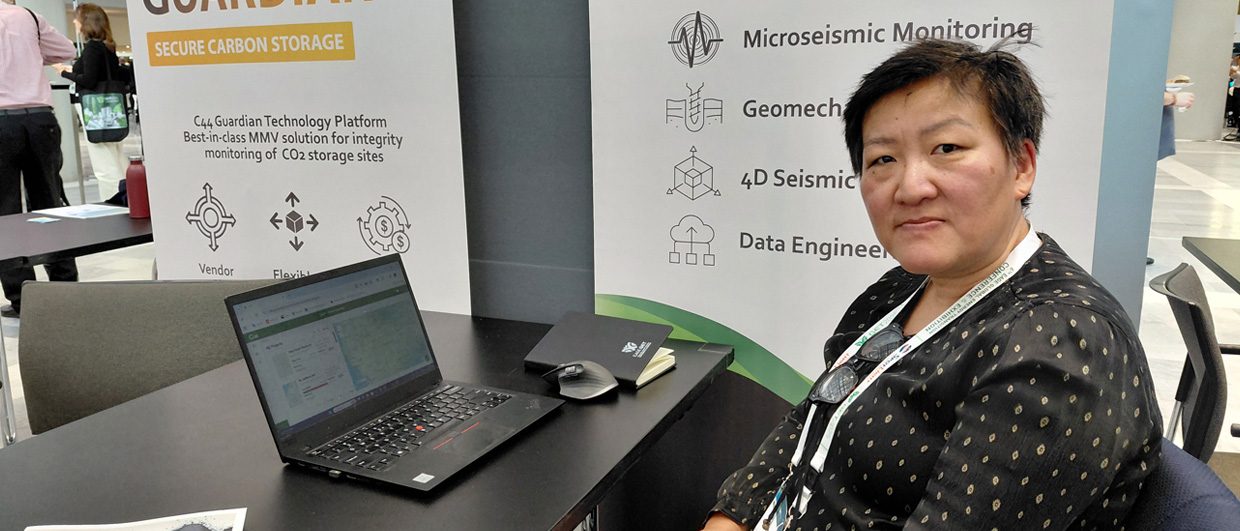

On the fringe of the EAGE GET Conference in Rotterdam, I meet with May Zhang, who is representing Carbon Guardian in the start-up zone. We previously met at the Annual Conference in Toulouse, France, so we picked up where we finished our conversation in early summer.
Carbon Guardian is a new start-up initiative founded by Martin Brudy, who has a rich background in well engineering and reservoir geomechanics. May, a geophysicist with more than 20 years of experience, is helping him launch C44TM – an integrated monitoring platform for geothermal and CCS applications. This time, we delve a bit deeper into what the company is building, as May walks me through a demo on her laptop.
No need to install new geophones
One of the features May highlights is the microseismic module. And it shows some interesting things that many operators may not be aware of. “When we start a project to monitor CO2 injection, and there is a need to measure microseismicity, we don’t always need to install a brand-new set of geophones,” May explains. “Look at this area in the Permian Basin in the USA,” she says, pointing at the screen, “there is already a network of public geophones in place, and the data they acquire can be downloaded from TexNet and analysed by anyone.”
“That does not mean there is no need to go into the field and install dedicated instruments,” she continues. “For detailed monitoring of a CO2 injection site, you typically want additional sensors close to the well. But it is always wise to check what is already available before planning additional deployment,” she says. “Our approach is to avoid over-engineering. We use free public data first, which helps keep costs down, which is only a good thing, both for us as well as for our clients.”
Multiple data sources
The team has developed a cloud-native architecture that allows operators to efficiently ingest data from multiple sources – in real time – to monitor seismic activity. It integrates both publicly available datasets and project-specific data from private stations. “Besides being a cost-effective way of working”, May adds, “combining private stations with public seismic data provides broader frequency and spatial coverage. Together with AI-assisted velocity model selection, this significantly improves the accuracy of event location.”
As geothermal and CCS projects expand, reliable monitoring becomes essential for effective risk management and regulatory compliance. C44 helps bridge that gap, giving operators the clarity needed to advance the energy transition safely and responsibly.