
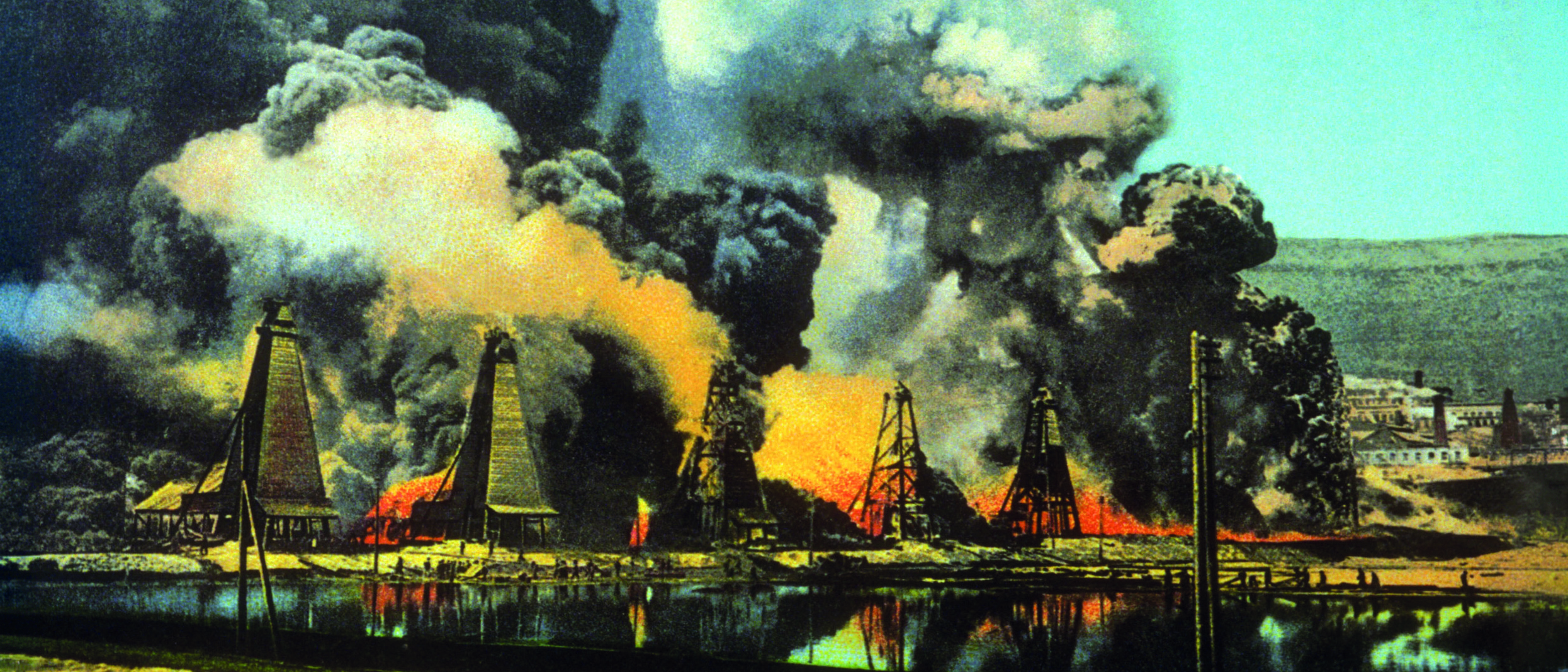
Old postcard of oil fires in the vicinity of Baku at the end of the 19th century. Source: Azerbaijan International Magazine.
Baku – Ten centuries of oil

“Near the Georgian border there is a spring from which gushes a stream of oil, in such abundance that a hundred ships may load there at once. Men come from a long distance to fetch this oil, and in all the neighbourhood no other oil is burnt.” — Marco Polo
As Marco Polo, renowned Italian traveller of the 14th century, so clearly depicts, oil has long been the currency of life in Baku, the modern-day capital city of Azerbaijan. Records of oil date back even to the 10th century, such as those by historian Istahri-Abu Iskhak, who described how the people of Baku used soil soaked in oil as fuel.
However, it was natural disaster rather than natural wealth that caused Baku to first become the central point of modern- day Azerbaijan. In the 12th century a crippling earthquake in Shamakhy, the capital of Shirvan (part of the modern Azerbaijan Republic), caused Shirvanshah’s court to move to Baku. Over the next two centuries, the people of Baku built huge fortifications to protect their city, some of which on the western and northern sides still stand today. Indeed if you walk through the inner city, down the labyrinth of winding alleys lined with street-vendors, it is easy to think yourself transported back to Azerbaijan International Magazine medieval times. The old city holds many of Baku’s finest pieces of ancient architecture, including the Maiden Tower, an eight- storeyed structure, the first three levels of which are thought to date back as early as possibly the 6th century BC. It is claimed that the site may have originally been used during the Sasanid era as a Zoroastrian temple. The rest of the tower was built in about the 12th century and historians have estimated that it may have been used during this period as an astronomical observatory, because of stone protuberances which correlate to the days of the month. As well as the Maiden Tower, the inner city also holds the Palace of the Shirvanshahs, built during the reigns of Shirvanshah Khalilulla I and his son, Faruk. Today, the magnificent building still contains many beautiful and authentic inscriptions and structures, giving us a window into the past.
Baku continued to prosper as a city in the centuries following, and by the 17th century its oil industry had been firmly cemented. A Turkish scientist of this period, Evliya Celebi, who travelled to Baku to study the oil fields, reported that “the Baku fortress was surrounded by 500 wells, from which white and black acid refined oil was produced”.
Paris of the East
In 1723, after a long siege and widespread chaos, Baku was forced to surrender to the Russian Empire. The Russians took control of oil production, forming the ‘otkupschina’ lease system, by which exclusive rights to produce oil were given to certain individuals. Oil extraction in these times was simplistic, made up mainly of shallow, hand-dug wells. Because of the monopoly of the system, there was relatively little improvement on this, as the individual owners had no reason to increase production.
By the early 1870s, however, the otkupschina system had been abolished in favour of the land being auctioned to local and Russian-born investors; in Balakhani, a suburb of Baku, for example, more than 149 parcels of land were sold. As a result of this, oil drilling began on a massive scale, creating the first oil boom of Azerbaijan.
This caused a huge financial boom within Baku, largely influencing the architecture seen today. European design influenced many of the buildings that cropped up during the early 20th century, earning the city its nickname of ‘Paris of the East’.
In 1898, the Russian oil industry exceeded the US oil production level and by 1901 Baku produced more than half of the world’s oil – 212,000 barrels of oil per day – and 55% of all Russian oil. During this period there was much improvement in well-drilling practices, so that techniques such as rotary drilling using electrical drive, metal derricks and compression during transportation of oil and gas became commonplace.
However, the prosperity of Baku did leave it vulnerable within the wider world. During World War II, because the Soviet Union supplied Nazi Germany with oil produced in Baku, Allied Forces planned ‘Operation Pike’, a major offensive to bomb the city’s oil fields and storage tanks. The plan appeared easily accomplishable, as Baku was particularly vulnerable to air attack because it could be approached from the sea. However, due to the fall of France in May 1940, the plans collapsed, as the Germans found secret documents detailing the plans for ‘Operation Pike’ in boxes evacuated from Paris.
Leading the world
Today, the extraction of hydrocarbons still leads the economy of Baku and, just as it always has been, Baku is a key part of development within the oil industry. In 2006 the second longest pipeline in the world, the Baku-Tbilisi-Ceyhan, was officially opened, delivering oil to the European markets by transporting crude oil from a terminal close to Baku all the way to Turkey. As well as this pipeline, further technical advances have been made, with the development of the Azeri-Chirag-Guneshli field and Shah Deniz gas field, and the expansion of the Sangachal Terminal.
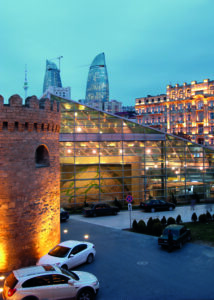
Modern Baku today is a busy metropolis, home to two million people, around 25% of the country’s population. It is a city of old with new, and east with west, all-glass buildings such as the Azerbaijan Tower standing side-by-side with the medieval walls of the old city. It is a city of many faces, a UNESCO World Heritage Site, as well as being (according to a Lonely Planet ranking) among the world’s top ten destinations for urban nightlife. Ultimately while oil and gas flow from the region, it will continue to grow and develop.
As Professor A. V. Williams Jackson of Columbia University concluded in 1911 in From Constantinople to the Home of Omar Khayyam, “Baku is a city founded upon oil, for to its inexhaustible founts of naphtha it owes its very existence, its maintenance, its prosperity”.