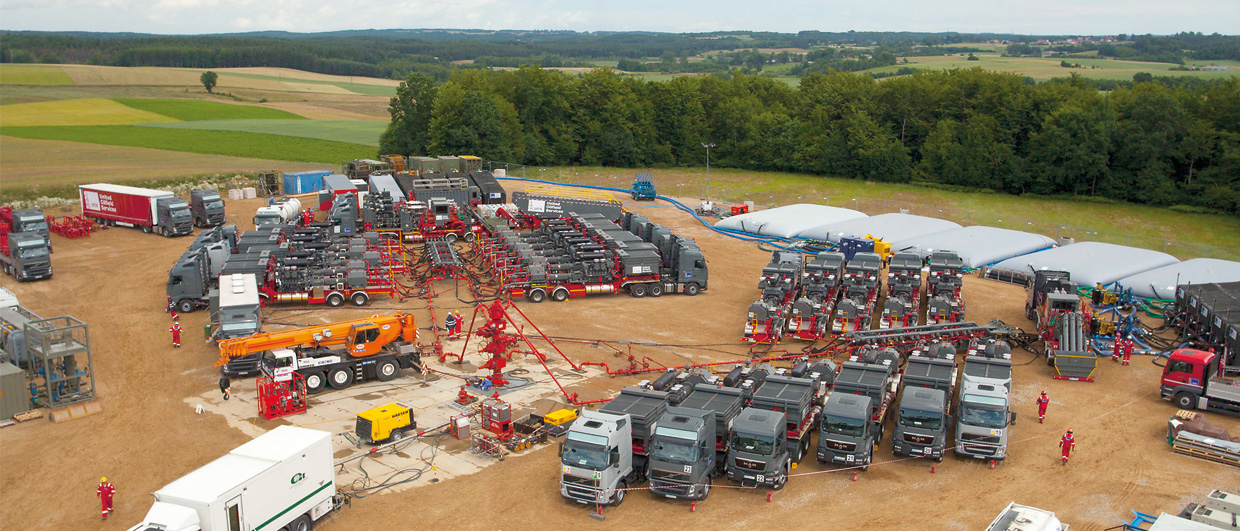
San Leon Energy flow testing in the Ordovician shales in the Lewino-1G2 well on Gdansk W Concession in Poland’s northern Baltic Basin. Photo: San Leon Energy.
Bad science for good reasons?
There is a clear desire within the industry to grow a European shale gas market

In his book Bad Science, Ben Goldacre expertly attempts to explain ‘why clever people believe stupid things’. When offered up so succinctly, the pitfalls to bad decision-making are obvious, if not unavoidable. Who amongst us can claim to never rely on bias or intuition from time to time at least?
When presented with complex problems, we all have a tendency to want to simplify them, to reduce the issue to its essence and concentrate on the things that matter. We know that the subsurface is complex and difficult to describe but we still build models and reduce the problem to a series of simpler issues. With more data and time we then attempt to quantify uncertainties, to reduce the risks to a manageable level. But mostly, all we really want is a simple tool with which to communicate a message to those with less knowledge.
The same is true the world over, not least for the well-intentioned environ mentalists and green cam paigners, where global energy issues seem to have been reduced to one simple message – ‘all fossil fuels are bad fuels, period’. This simplistic view gives those who do not have much time an easily conveyable message, a mantra and a rallying cry, a slogan to energise the masses. But we do not live in a simple world where issues can be boiled down to irreducible ‘facts’. Sometimes we need to take a more sophisticated approach, to consider the wider picture and attempt to integrate and reconcile all the data, to stop our ‘prejudices running unchecked and unexamined’, to borrow Ben Goldacre’s phrase.
A New Mantra
In Warsaw at the Shale Gas World 2013 conference, delegates attempted to do just that. Bringing together practitioners from fields as diverse as water management and directional drilling, the intent was to facilitate discussions between policy makers, industry key players and technology firms. One thing is sure; while the public is fracking in a context where they are not prepared to ban coal mining, and indeed, areas of Europe promote coal mining. Because when one thinks about the relative environmental impacts of the alternatives, coal mining is truly evil in comparison.” voice their concerns for the impact of shale gas on the environment, the industry is not simply sitting idle, ignoring the issues. Conferences like this show that it is capable of calling on experienced practitioners and well tested technologies and is prepared to go the extra few yards to ensure that risk is reduced to the lowest acceptable levels.
The desire within the industry, and within some sections of the political classes, to grow a European shale gas market is clear. Environmental issues aside, some caution is needed. At a recent UK House of Lords Economic Affairs Committee meeting Professor Dieter Helm said, “…normally…when the price of fossil fuels rises, that contains the seeds of its own destruction (as in the 1970s) and actually a lot more resource comes online. You can understand shale gas and shale oil as being a response to relatively high prices in the 2000s.”
That may be true but what if shale gas and oil are about more than providing us with a cheaper energy source? What if there are other benefits? Professor Helm went on to say, “I do find it extraordinary that people want to ban fracking in a context where they are not prepared to ban coal mining and indeed, areas of Europe promote coal mining. Because when one thinks about the relative environmental impacts of the alternatives, coal mining is truly evil in comparison.”
Shale gas deposits should be capable of relatively fast development times, providing a quick fix for governments attempting to meet increasingly strict carbon emissions hurdles by replacing coal in the energy mix.
There is a message here. It is not a simple one and it requires careful consideration but the new mantra should be clear – ‘fossil fuels are not all equal’. Recognising that is the first step – let’s rally behind good-science-for-the right-reasons and not bad-science-for good-reasons.