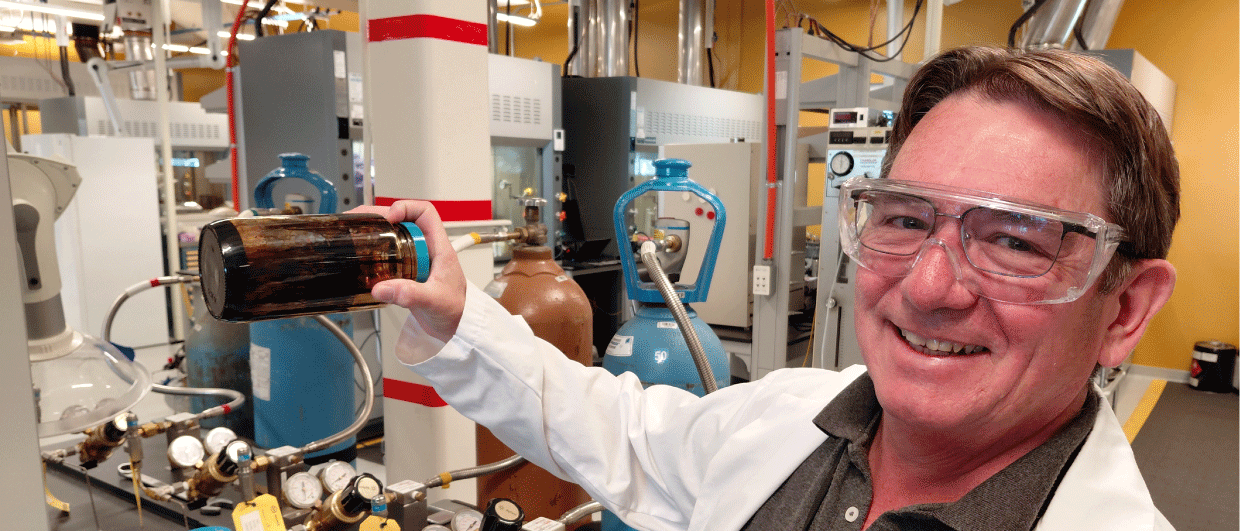
Gerald Desrochers showing a bottle of heavy crude. Photography: Henk Kombrink.
An imperial testing facility
What used to be ExxonMobil’s flagship heavy oil laboratory in Calgary is now available for any party to carry out research

“It was a $37 M donation from Imperial Oil, the largest to an educational institution in Alberta’s history,” says Gerald Desrochers when we meet for the lab tour he invited me to on a Thursday morning in May.
Just over ten years ago, ExxonMobil Canada – operating under the name Imperial Oil – built this world-class lab facility to perform cutting-edge research related to oil sands. But last year, the company decided that the facility was no longer needed. The Southern Alberta Institute of Technology, SAIT, a well-known educational institute in Calgary, has now taken ownership of it.
“We want to be in the middle between demands from operators and performing research that we can involve our students in,” says Gregory Maidment, who heads up the facility. “More and more operators are closing their own labs, but we know there is still a demand for testing things such as new inhibitors and new fluids to help produce the heavy oil more efficiently. It also very much helps that the Canadian government has recently formalised enhanced oil recovery within the CCUS Investment Tax Credit. This will probably provide a boost to research in this realm, and our facility can form an important vehicle to perform research in that space,” Gregory says.
We start the tour at the Once-Through-Steam-Generator. Here, SAIT tests a variety of different scaling inhibitors that are added to the steam generated to be used for steam-assisted gravity drainage (SAGD). “It is a domain where we continue seeing development of new types of inhibitors,” says Gerald, “and that needs to be tested first before being deployed in the field.”
For Ehsan Aminfar, his job as Scientific Director at the SAIT facility was a bit like coming home. “I carried out physical modelling experiments for my PhD when I started in the field of researching heavy oil production from sandstones.”
Now, Ehsan will be using the same setup of experiments again to continue this line of research. “The key in these experiments is that you need to speed up the reaction to create the steam chambers in a meaningful way,” Ehsan tells me, “otherwise you’ll be waiting forever.”
SAIT is now expanding the facility with an even more advanced setup of combustion tubes from another donating company. “Using this setup, we can run fireflood experiments simulating combustion-assisted drainage of heavy oil. And we use genuine core samples from the field for this, which are able to mimic subsurface conditions as closely as possible,” explains Ehsan.
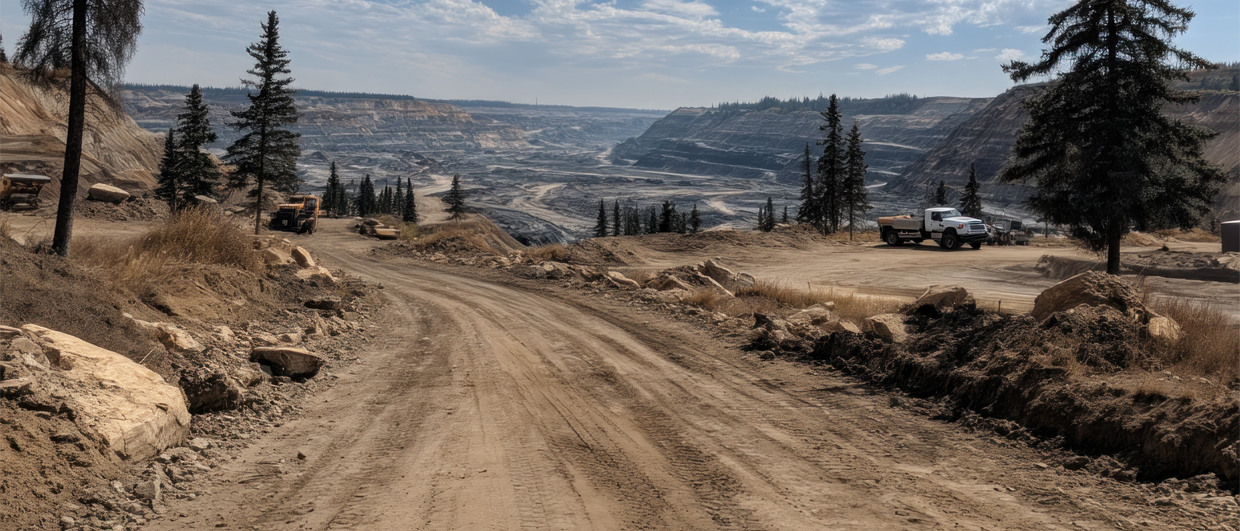
As we near the end of the tour and as a final example of the wide variety of research carried out at the facility, geologist and guide Jesse Wheaton then shows me a series of trays containing representative samples from mine tailings. “It doesn’t look like a spectacular experiment,” he admits, “but it’s been running for eight years already. It allows us to measure how effective certain polymers are in separating water from solids and how soil remediation works on longer timescales. Because at the end of the day, we want the current oil mining sites to return to unspoilt nature.”