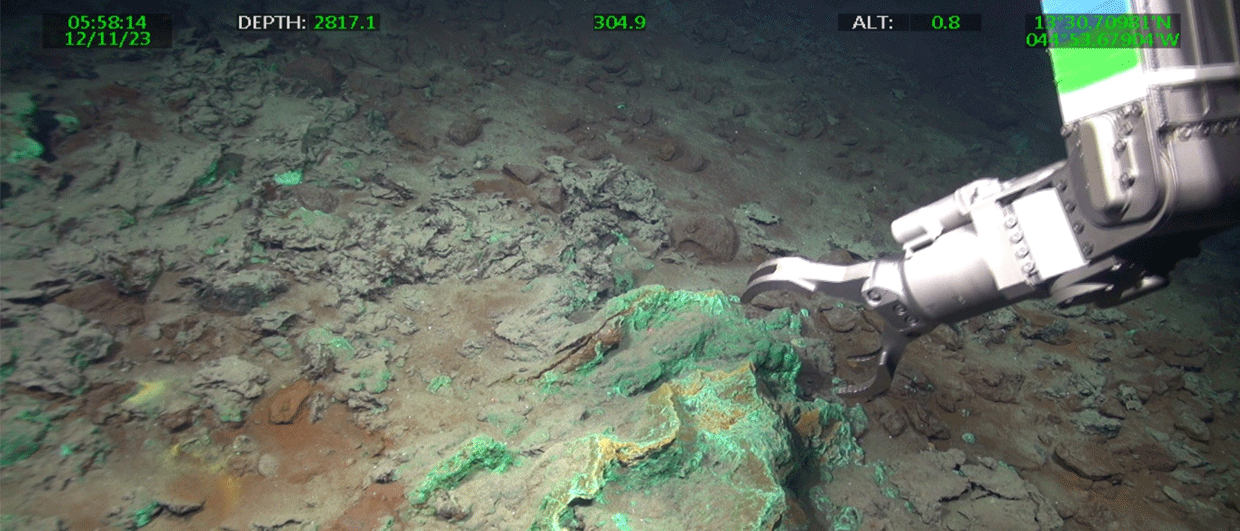

The Semenov hydrothermal fields along the Mid-Atlantic Ridge at 13° N, the same latitude as Senegal and Nicaragua, boast the world’s largest known Seafloor Massive Sulphide (SMS) deposits, with a volume well over 100 million tonnes (Mt). Globally, over 600 SMS fields are known; Norway claims about 15, including recent discoveries such as Grøntua and Gygra. According to estimates by the Norwegian Offshore Directorate (NOD), Mohn’s Treasure on the Mohn’s Ridge could hold just over 2 Mt. However, SMS exploration in Norwegian waters is still at an early stage, with plenty of potential for larger discoveries to be made.
Seabed ore factories
Hydrothermal SMS deposits are formed by seawater circulating through the hot rocks beneath mid-ocean ridges. They strip out various elements, particularly metals, which are then deposited at the seabed as the fluids emerge and cool at hot water vent systems. This process builds chimneys and mounds highly enriched in a wide range of metals, including copper, zinc, cobalt, gold and silver.
Slow cooking
The project ULTRA team has been mapping and collecting data from the Semenov fields. “It’s a bit of a paradox”, notes Bramley Murton, project leader and professor of Marine Geology at the National Oceanography Centre. Fast-spreading ridges host more hydrothermal vents due to higher heat budgets, while slow-spreading ridges like the Mid-Atlantic or Mohn’s have fewer. “However, the accumulative volume of SMS deposits is larger at slow-spreading ridges.”
At the slow spreading, amagmatic ridges, detachment faults can be active for hundreds of thousands of years. They maintain high temperatures, fluid pathways and continuous hydrothermal circulation. Slow-spreading ridges are like slow cookers – they do their job over a long period of time, allowing more minerals to accumulate.
Green exploration flags
ULTRA also investigates how SMS deposits evolve. Christian Bishop, a postgraduate researcher at the University of Southampton, shares his insights on weathering.
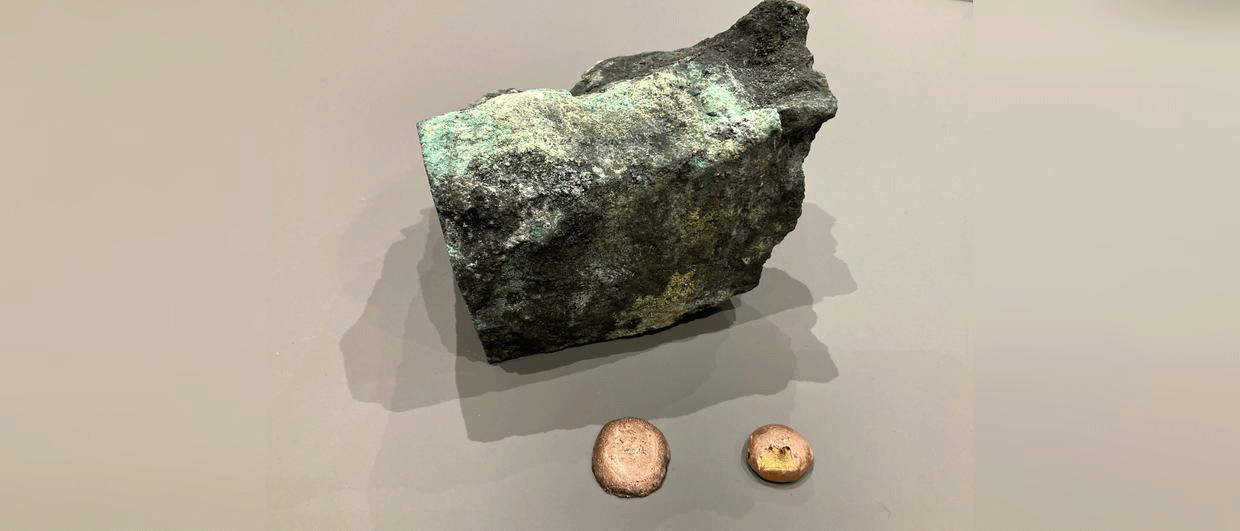
As the deposits age and interact with seawater, their composition changes. A weathered deposit forms a rusty crust of Fe-oxyhydroxide, sometimes laced with bright green atacamite veins. Bishop’s team found that atacamite flags copper-rich zones below and within the crust, while Fe-oxyhydroxide does not reliably signal the presence of deeper metals.
Atacamite has been observed along the Mohn’s Ridge at the Grøntua, Fåvne and Gnitahei fields. The NOD announced that the green mineral is also spotted at the Gygra deposit along the Knipovich Ridge.
The relevance of project ULTRA to Norway’s deep-sea mineral exploration is evident. The geological features found at Semenov are similar to the Norwegian ridges, including slow spreading rates, limited volcanic activity, and secondary atacamite mineralisation.
There is huge potential to discover extensive sulphide deposits in the Norwegian Exclusive Economic Zone. Although Norway’s first licensing round hit a delay, ongoing scientific work is crucial in advancing knowledge and preparing for future operations.