
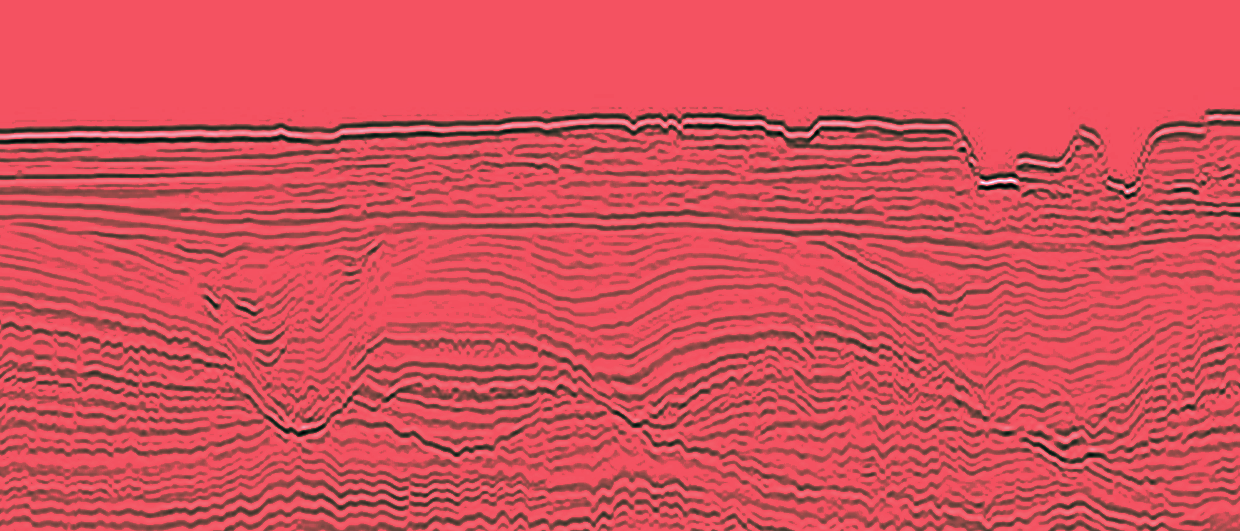
Detail of a seismic profile from the Great South Basin, SE New Zealand Continental Margin, displaying the erosional and depositional features of a mixed depositional system. Source: Figure 4 from Ibezim et al. (2026) - New Zealand Journal of Geology and Geophysics. Please check this article for an interpreted version of the line.
A conversation about contourites
And how they mix with gravity-driven turbidite systems

“Even in the chaos, there is an order,” says Sara Morgado Rodrigues when we have a call whilst she is working on a project in Buenos Aires, at one of YPF’s offices. Sara is a postdoctoral researcher at the Andalusian Earth Sciences Institute in Granada, Spain, and works on mixed depositional systems in the group that is led by Javier Hernández-Molina.
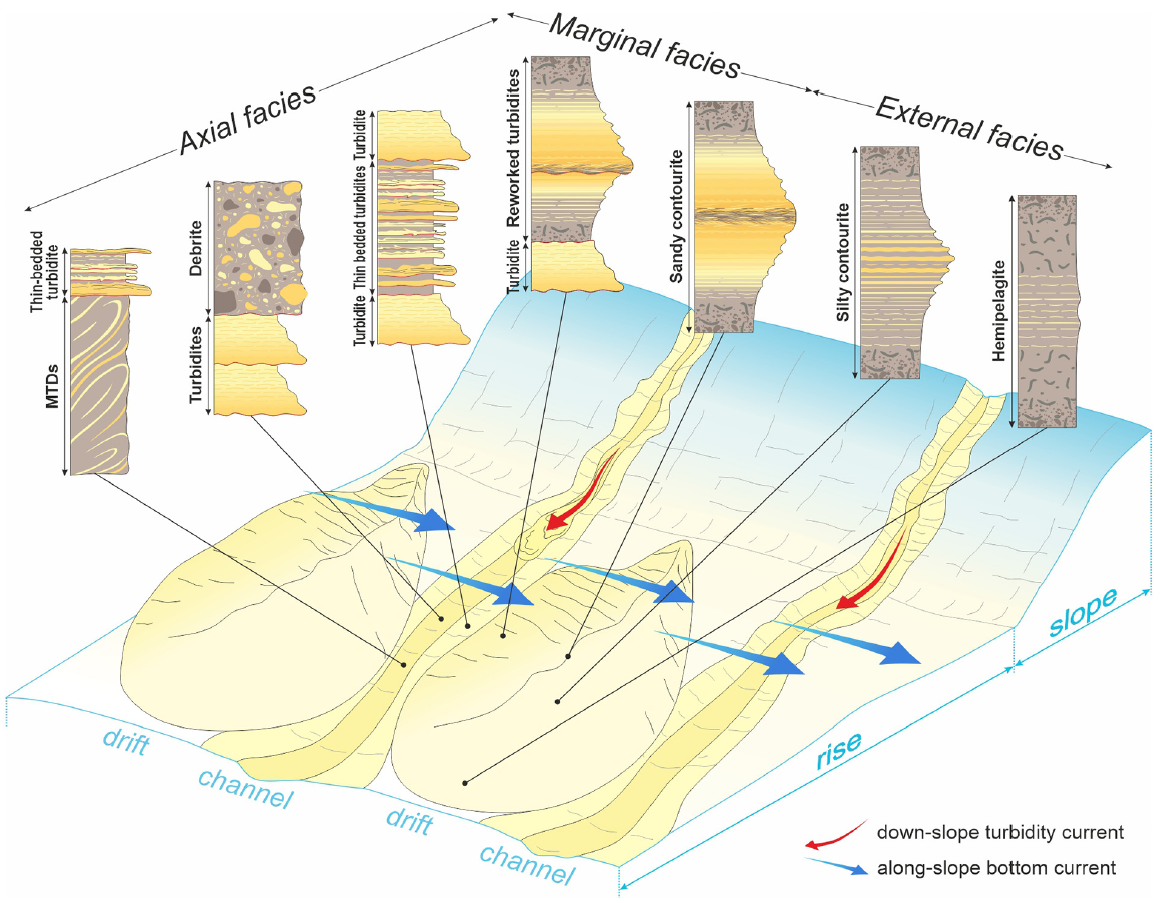
Mixed depositional systems are characterised by an element of gravitational flow (turbidites) and bottom-water flow (contourites), and have become a hot topic in recent years on the back of discoveries in which the reservoirs display a combination of the two processes.
To make more sense of what may initially look like a chaotic array of different sedimentary profiles that can result from the interaction between turbidites and contourites, Sara and her co-authors published a paper in 2022 proposing a new classification system. The project followed on from a PhD during which she studied mixed systems at three locations worldwide, so she was well introduced into the matter. The paper also includes a graph illustrating how the number of publications on mixed systems has exploded over the past 20 years, reflecting the growing interest from both industry and academia.
It is now well known that some deepwater oil or gas fields display a clear bottom current component in the way the reservoirs formed, such as the Coral Field in Mozambique. “But there are probably more,” says Sara. “It’s just because the industry does not always share their insights straight away. For instance, I do know that Petrobras in Brazil is operating some oil fields in the Campos and Espírito Santo Basins where there is a system of deep-marine channels that was severely reworked by bottom currents, even creating barchan dunes and ridges amongst other structures. The Sirius discovery offshore Colombia is probably the most recent example of a reservoir that has been shaped by bottom currents,” Sara says. It is interesting that Sirius is also operated by Petrobras.
“On the back of all these developments, I see that energy companies are hiring more people with knowledge about deepwater processes,” says Sara. “I guess that’s also why you are currently in Argentina?” I ask. “Sure,” she says, “even though for me, this is also a continuation of work I already did here before. But yes, there is a lot of interest here, as the offshore of northern Argentina leading to Uruguay is an area where we see a broad zone of mixed deepwater systems in the Cretaceous. And with more 3D data now becoming available, there is more of an opportunity to study these deposits. As another example, I was invited by ENI to give a talk at their office the other day, and they also showed us not only the Coral and Mambo cores, but also from a recent discovery in the far east. There is more willingness to share data.”
Two PhD students in Sara’s group are currently studying the time when bottom currents became active in the South Atlantic. “The earliest we see turbidite systems switching on is during the latest Aptian to early Albian, with bottom currents starting to rework these deposits slightly earlier in the south of Africa, followed by the same thing happening simultaneously in Namibia and Argentina,” she explains. “And then it continues all the way to the end of the Cretaceous, at which point the contourites take over during the Cenozoic. The reason is that turbidite systems became smaller, whilst at the same time, due to the continued opening of the Atlantic, bottom currents strengthened. So, it is really an evolution from only turbidites as the ocean opens, followed by a mixed system during the Late Cretaceous, juxtaposed by a contourite-dominated system during the Cenozoic.”
“But I’m not here to say that all turbidite systems show a bottom-current influence or reworking,” Sara reiterates. “For instance, the Bengal, Congo and Mississippi systems show very little bottom current reworking at all, because of a combination of strong turbidity currents and a weak bottom current. And we can project that principle into the past, even to a single location. For instance, we see in Brazil that one reservoir interval is strongly reworked by bottom currents, where the sands below and on top show a dominant gravity system signal.” Conditions can change all the time.
Mixed systems in core
When it comes to recognising bottom-current activity in cores, Sara says that a big difference between turbidites and reworked sediments is the continuous presence of sedimentary features through the latter. “In turbidite systems, we often see an erosional base and structureless sands on top. That’s not what you tend to see in bottom current reworked intervals,” she says; “you see laminations throughout.”
Looking at grain size variations, Sara explains that based on thin section work, it can be concluded that turbidite systems have a tendency to have a greater percentage of fines mixed with the sand, where in bottom-currents that is more limited because of their ability to remobilise the fines. Trace fossils are also very good indicators. “In turbidites, we tend to see a lack of trace fossils, especially at the base of the deposits, where in bottom-current deposits we see trace fossils throughout.”
One of the main questions the research community is focusing on now is to better define the moment when bottom currents start to rework sediments. “There are both numerical and flume tank experiments taking place to gain a better understanding of that,” Sara says, “with China being an epicentre of the numerical modelling side of things.” And there are the more regional studies too. “In that space, we are trying to understand if the process we are seeing whilst the Atlantic opened also apply to other oceans. There is still a lot to do.”