
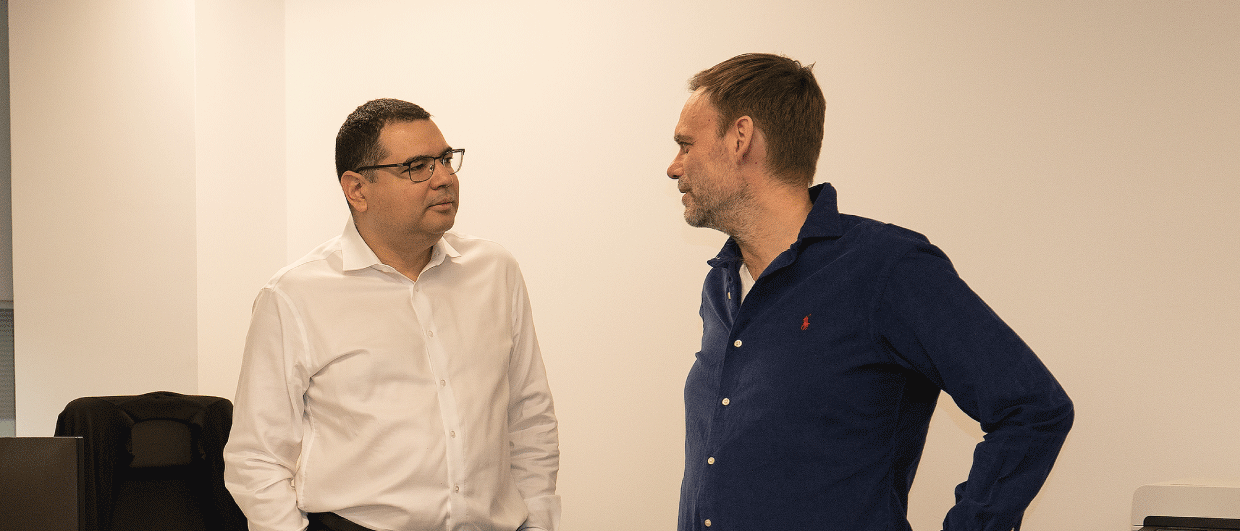
Raul Cova (left) and Qeye co-founder Henrik Juhl Hansen (right) casually talking about the future of quantitative interpretation methods at the Qeye Calgary office in March 2026. Photo: Qeye.
Chasing more subtle changes
A catch-up with Raúl Cova – geophysics manager at Qeye – about the changing quantitative interpretation market

“Reservoirs are getting tighter and dirtier, and on the back of that, the role of quantitative interpretation (QI) is evolving too,” says Raúl Cova when we meet on Teams. “In other words, the signals are becoming more subtle, and a more advanced toolbox is required to identify the best opportunities. Where AVO used to be sufficient to identify and derisk a prospect 20 years ago, today there are not so many of those opportunities left across the world.”
One response to that is the advance of FWI, which has been and continues to be mainly used to get a better handle on velocity changes in the subsurface. “We use the results of FWI in our QI workflows,” says Raúl. “More recently, we have also incorporated elastic FWI, which means that, in addition to P-wave velocities, the output now includes S-wave velocities and density data.”
Raúl also identifies the incorporation of anisotropy, especially when it comes to amplitudes. “In AVO, amplitude anisotropy has never been used that much,” he says, “because there was a line of thinking that the anisotropic difference was so small compared to the difference in amplitude versus offset. And to an extent, that is probably correct when you look at the “good and relatively easy” prospects, but those days are over and we now see that anisotropic differences are at the same order of magnitude as the AVO signal. It makes more sense now to apply it,” he says.
Another thing Raúl sees changing in the years to come is for the QI and (e)FWI disciplines to merge into one integrated service. “Somehow, they are still two separate worlds,” he says, “but I think these will become one workflow in the next few years on the back of FWI processing costs coming down.”
Raúl started his career with PDVSA in Venezuela where he worked in processing geophysics. He was then selected to participate in a one-year training programme that was facilitated by IFP in France to become a more rounded G&G professional. “This really taught me to include as many instruments as possible to better understand the subsurface,” he says. Raúl moved to Calgary in 2012 to embark on a PhD in geophysics. He joined Qeye in 2019, also in the Canadian oil capital.
“Since the start of the company in 2012, we have always done the QI work inhouse,” says Raúl when we get to talk about the current business model. “But that is about to change,” he adds, “because we have now entered a partnership with GeoSoftware to build a new QI platform (QeyeStudio) to produce a toolbox for our existing and possibly new clients to embark on themselves. We have had many requests over the years for such a product,” he continues. “Now, we can say that this will be a reality!”