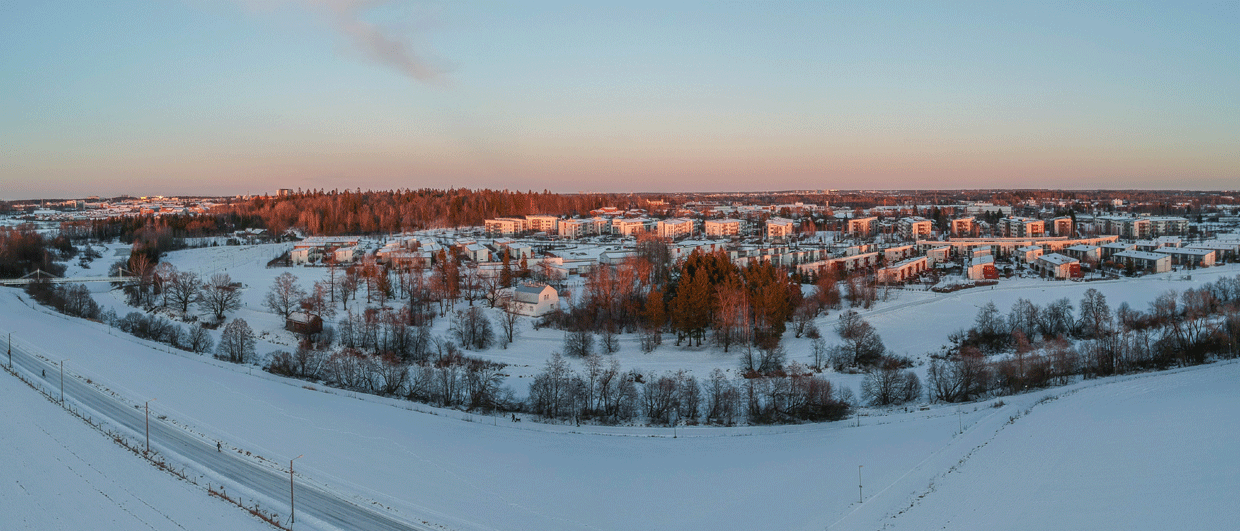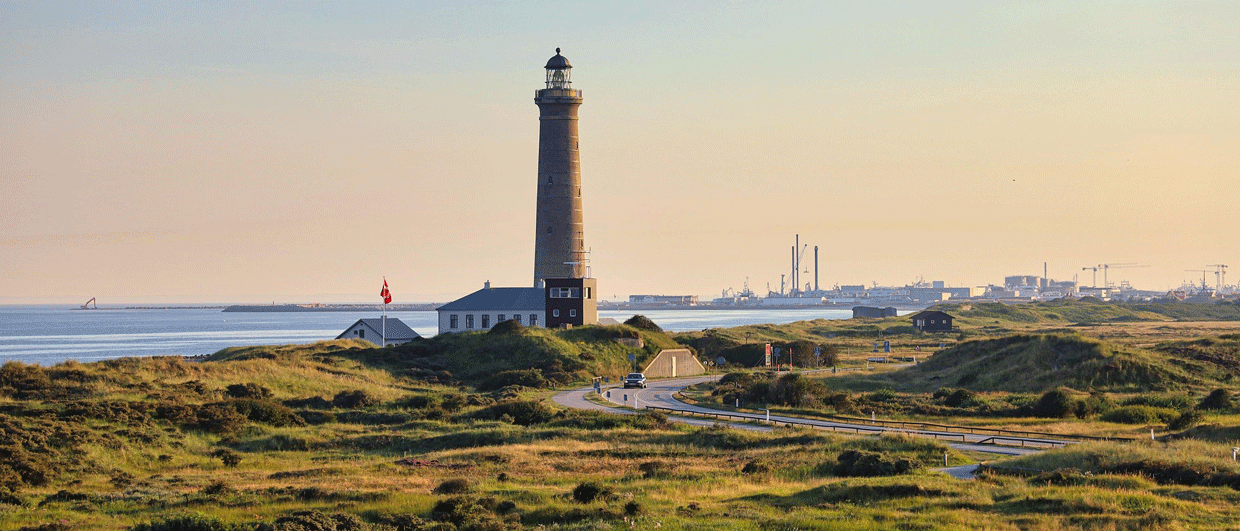
A Danish land- and seascape. Photo: Julian Hacker via Pixabay.
The subsurface is a key factor in explaining the poor result of the recent Danish CCS tender
With the majority of applicants dropping out at the last minute, the combination of stringent rules, penalties and subsurface uncertainty proved too much of a hurdle for most potential candidates, even when a fund of €4 B awaits

Denmark is one of the countries that aims to be a leader when it comes to climate change mitigation measures. That’s why the government launched a tender process in October 2024 for businesses to apply for a juicy pot of €4 B to fund carbon capture and storage projects.
The idea was to have a competitive tendering process, hoping that companies would submit equally competitive bids, thus driving down the costs of the individual project plans.
The tender process seemed to attract interest, with 16 companies applying to be prequalified, and 10 ultimately qualified to tender. But as the deadline was approaching, one after the other dropped out, to the point where only one company remained. Why did that happen?
Read also: Denmark’s CCS Tender: Failure Or Reality Check? – by Carbon Herald
Apparently, the imposed timelines for development of the chosen projects were so strict that applicants did not see this work. Penalties were introduced, too, which provided further reason for companies to withdraw.
From a government point of view, it can be understood that there is a desire to put a deadline on projects relying on subsidies in order to justify the spending.
But the reality of CO2 storage site screening, validation and construction has been proven to take longer than two years, as previous cases have shown. In the UK, some have been on the go for a decade and have still not progressed to FDP.
“We tried to stop this process at the very start,” someone with knowledge on the matter told me during a phone conversation, “because we could see the time and money being lost on proposals that were ultimately not going to be submitted.”
And that’s exactly what has now happened. At the last minute, just before the round closed in February this year, a second bidder came in, preventing just one being submitted, but the result was a lot poorer than expected at the start.
The website of the Danish Energy Authority lists the revisions in the tender documents that were made following initial criticism of the imposed timelines. More flexibility was introduced to make a change in plans if a site turned out to be unsuitable. It was also allowed not to proceed with development at all, following a detailed geological assessment.
But it was either too late or the rules were still too stringent. The Danish CCS tender process is now regarded as a failure.
Is there the possibility that the CO2 will be carried abroad when the process to look for a site in Denmark itself is so challenging? “There are no criteria in the tender to use Danish storage sites,” writes Tobias Johan Sørensen from the Danish organisation CONCITO in an email to us. The evaluation is strictly 80% costs and 20% project maturity, with maturity obviously dragging the Danish sites down compared to Northern Lights, for example. However, Aalborg Portland (one of the submitters) has publicly stated that they are aiming for the CO2 storage to take place onshore Denmark.”