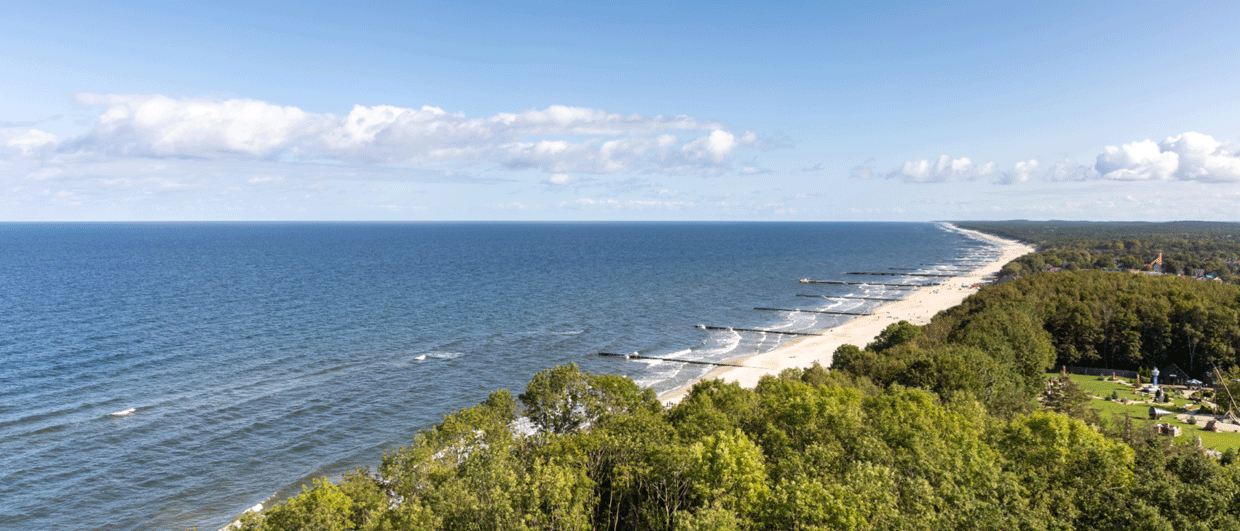
Wolin Island, Poland - home to the promising Wolin East discovery. Photo: infoludek.pl.
A round-up of key development projects across Europe – a subsurface summary
A wave of new large oil and gas developments is set to be brought online over the next five years, with investment of $55 B set to recover 4 bnboe. We dive into the subsurface to reveal some of the plays delivering this volume

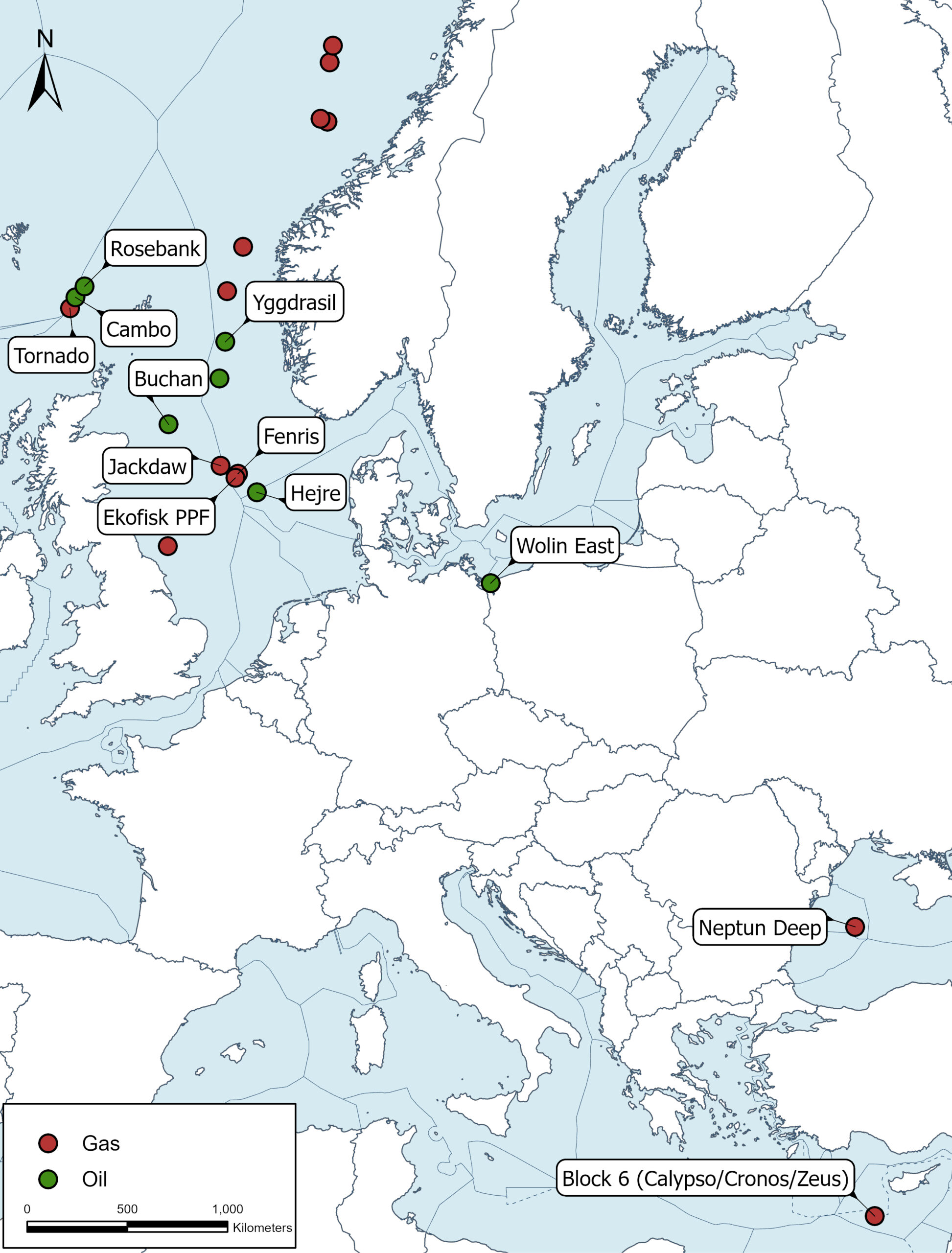
Production in the North Sea and in most oil and gas-producing countries in continental Europe is largely in decline. The upstream investment landscape in Europe is challenged by a combination of local and global factors, including fiscal regime changes and E&P companies exercising caution with capital deployment. Despite this, 21 new fields, each with reserves of >50 MMboe, are set to be developed across Europe, with start-up expected by the end of 2030. Here, we review a selection of those projects.
Corona Ridge – Cambo, Rosebank, Tornado
Cambo and Rosebank are large, remote, deepwater projects with good quality Tertiary reservoirs, primarily in the Colsay (Rosebank) and Hildasay (Cambo) sands, sitting towards the southwestern extent of the Corona Ridge in the Faroe Shetland Basin, West of Shetlands. Well control is high; however, development costs, combined with subsurface challenges including intra-volcanics at Rosebank, along with changes in ownership, and most recently revised environmental guidance, have slowed development. Upside both within the field area and in the surrounding acreage, including Blackrock, an intra-volcanic Colsay (oil) and Hildasay (gas) discovery, could see over 500 MMboe recovered from the area. The formation of Adura (Shell / Equinor in the UK) and a concerted West of Shetland strategy by Ithaca Energy means they are now as close as ever to reaching production. Together, both companies are also working to develop the Tornado gas condensate field, at the far south of the Corona Ridge, targeting ~350 bcf in Paleocene sands (T38c interval) of the Lamba Formation.
Central Graben HPHT– Fenris, Hejre, Jackdaw
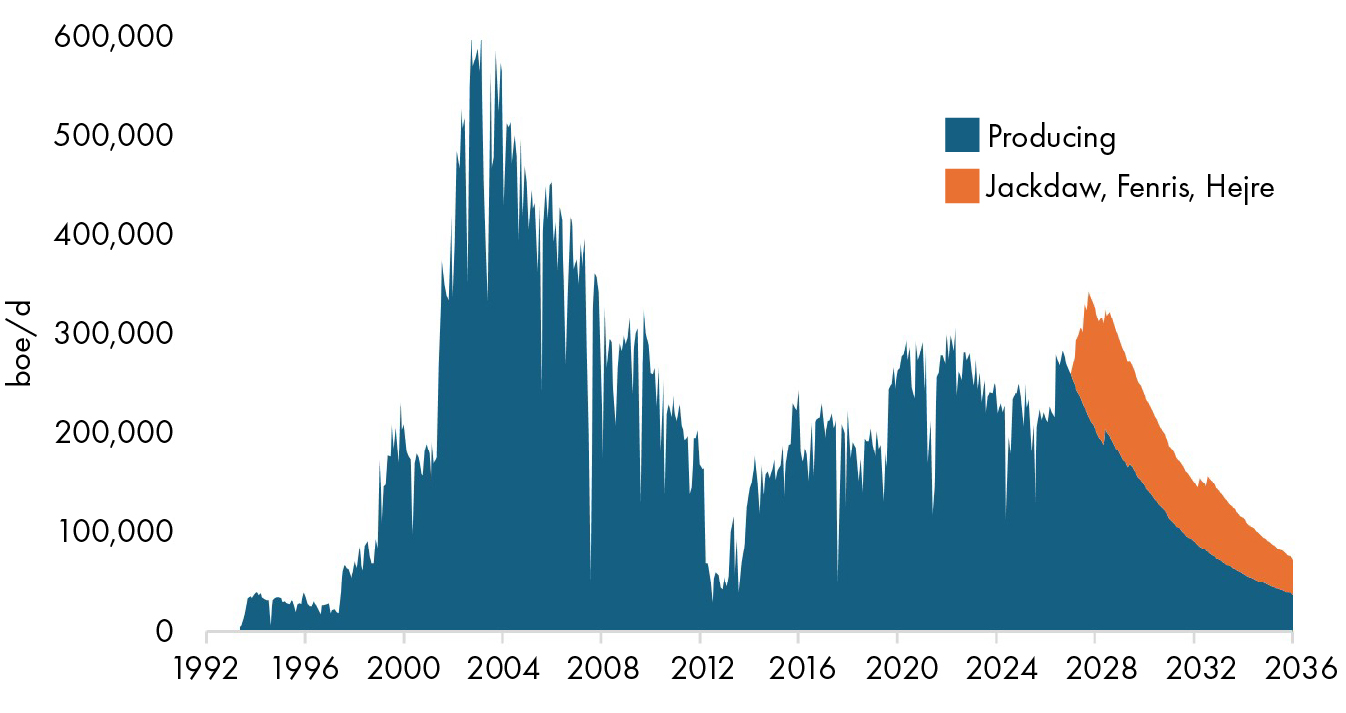
Combined, the Fenris (Norway), Hejre (Denmark) and Jackdaw (UK) projects are set to contribute to the HPHT Central Graben plays, delivering their highest production rate in 20 years. Fenris has an Upper Jurassic reservoir in turbidites of the Farsund Formation at over 5,000 m depth, along with potential in shallow marine sandstones of the underlying Ula Formation, making it the deepest development on the Norwegian Continental Shelf. To the northwest, Jackdaw comprises a ultra-HPHT Heather Formation reservoir in a series of tilted fault blocks, which Adura is developing via tieback to Shearwater. In Denmark, INEOS’ Hejre development is located in the Feda Graben with Upper Jurassic Fulmar-type sandstones at a depth of 5,100 m. Following discovery in 2001 and appraisal in 2005, DONG previously sought – but failed – to develop the project owing to a combination of factors, and ultimately its exit from oil and gas.
North Sea mature plays – Buchan, Ekofisk Ppf, Yggdrasil
There remains significant potential in even the most mature North Sea plays. The combination of well-understood areas, with a wealth of data, makes for a clear investment case.
The Buchan redevelopment (NEO NEXT) comprises a tilted fault block with four-way dip closure, with reservoir in fractured and over-pressured Upper Devonian to Lower Carboniferous Buchan Formation sandstones. At shut-in in 2017, less than 30 % of the oil in place had been produced, and current plans are to recover ~70 MMbbl in the redevelopment. In Norway, the Ekofisk Previously Produced Fields (PPF) redevelopment includes the Albuskjell, Vest Ekofisk and Tommeliten Gamma fields, targeting gas condensate in the Maastrichtian Tor and Paleocene Ekofisk formations. While Buchan will form a new hub, PPF is set to help extend the life of the vast Ekofisk hub.
To the north, in the Middle Jurassic Brent play, the cluster development of ten discoveries forming Yggdrasil is currently the largest oil development in Europe with potential for over 700 MMboe, largely in the Middle Jurassic, but with additional volumes in the Eocene.
Baltic Sea – Wolin East
One of the most exciting projects outside the North Sea, the Wolin East discovery well drilled by CEP in 2025, found a 62 m hydrocarbon column in the Zechstein Main Dolomite of the Upper Permian. An appraisal sidetrack is planned this year, with production start-up mooted for 2030. Prior to the award of the Wolin concession in December 2017, CEP had successfully worked up multiple targets in Germany and extended these concepts across the border into Poland for the first time. Upside in the area has the potential to double current resources, while parallels have been drawn with play concepts further afield in the Southern Permian Basin, including to the west in the UK Southern North Sea.
Southern Europe Gas Plays – Neptun Deep, Block 6 (Calypso / Cronos / Zeus)
OMV’s Neptun Deep concession is set to deliver a wave of new gas into Romania, and is transformational for the country’s energy supply. One of the biggest development projects in Europe, it is set for start-up later this year ahead of target. Comprising a stacked interval of fine-grained turbiditic Miocene sands, the project has sparked wider interest across the Black Sea, both locally and further south in Bulgaria, where the latest follow-on well, Krum-1, is targeting multi-Tcf potential in Pliocene-Miocene sands. Between the Black Sea, the Levantine basin offshore Cyprus with Eni / TotalEnergies’ Block 6 project – also a multi-Tcf development that is set to be transformational for its country’s energy mix – and upcoming frontier exploration in Greece, all eyes are on southern Europe gas.
This analysis was taken from Welligence’s report: The next 4 bnboe – Key upstream developments
to 2030, published in February 2026.Please contact david.moseley@welligence.com for the full report.