
Photo: Tim Mossholder via Pixabay
When energy stopped being treated as real
For most of the twentieth century, European energy systems were planned under an explicit assumption: energy was governed by physical limits. Supply was understood as the product of geology, depletion, production rates, infrastructure capacity, and engineering reliability. When those limits were reached—as they were most visibly during the oil supply disruptions of the 1970s—the consequences were immediate and material. Prices moved, economies strained, and governments responded. Energy security was therefore treated not as an abstract objective, but as a practical engineering problem, demanding physical solutions

The policy responses of that period reflected this understanding. France invested heavily in nuclear power to reduce exposure to imported fuels. The UK committed capital and labour to developing the North Sea. Germany reinforced domestic coal production and grid infrastructure. Across these systems, capacity margin and redundancy were deliberately built in, reflecting an explicit acceptance of depletion, outage risk, and supply disruption as normal operating conditions rather than exceptional events.
From the late 1980s onward, many of the pressures that had shaped this approach diminished. Oil prices fell, Cold War–era geopolitical risk receded, and mature producing assets delivered stable baseload supply. Infrastructure built during periods of scarcity continued to perform reliably. Although depletion was ongoing, its effects were gradual and increasingly masked by legacy capacity and offshoring. Energy constraints did not disappear, but they became less visible in daily decision‑making.
As physical constraint receded from view, the framing of energy systems changed. Decision‑making shifted away from questions of production capability—such as volumetric sufficiency, rate deliverability, storage, and recovery time—toward optimisation within existing systems. Energy was increasingly managed through targets, portfolios, and regulatory frameworks rather than direct engagement with production decline, construction lead times, and material throughput.
This shift did not remove risk from the system. Instead, it redistributed it. Capacity margins were progressively reduced. Redundancy came to be treated as cost rather than protection. Domestic production declined, while demand remained broadly persistent. The resulting shortfall was met through imports of fuels, processed energy, and energy‑intensive materials. The physical constraints governing supply remained unchanged but were increasingly located outside the immediate institutional frame.
The effect of this transition is visible in long‑term energy data. Since the mid‑1990s, European primary energy consumption has remained relatively stable, while domestic primary energy production has declined steadily. The resulting divergence reflects the progressive loss of local supply rather than a reduction in material demand.
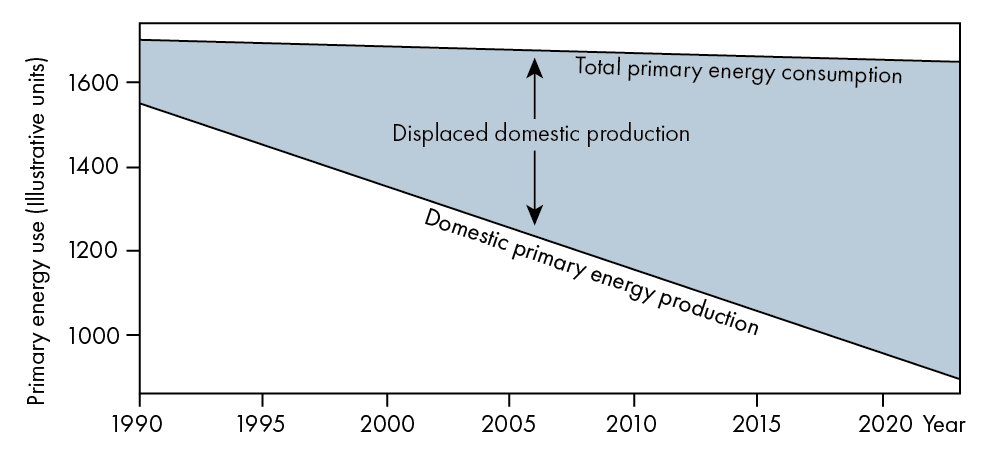
Relocating production does not eliminate physical constraint. Decline rates, access limitations, and disruption risk continue to govern supply behaviour, but they manifest through price volatility, supply interruption, and geopolitical exposure rather than through routine operational signals. As production occurs further from consumption, feedback between system performance and decision‑making weakens.
In the UK, one of Europe’s earliest and most mature producing regions, the long, unmanaged decline of North Sea production illustrates this clearly. As legacy infrastructure masked depletion, domestic optionality eroded quietly. By the time import dependence became visible again, the system had lost much of its ability to respond through production, leaving price and security as the remaining adjustment mechanisms.
The contrast with the United States underscores the importance of retained production capability. Europe entered the late twentieth century with a heavily depleted resource base, having already extracted much of its most accessible hydrocarbons and coal. The US retained a larger and more diverse endowment and kept energy production as an active domestic industry. When price and technology conditions changed, supply responded. The shale expansion reflected subsurface opportunity, capital deployment, and operational risk tolerance—not a redefinition of adequacy.
A consistent pattern emerges. When systems are designed under conditions of visible stress, they incorporate margin, redundancy, and rate flexibility. When those stresses recede, optimisation tends to take precedence. In Europe, the continued performance of legacy infrastructure delayed recognition that optionality was being lost.
The key point is simple and factual: energy systems are governed by depletion, production rates, material flow, and time, regardless of how they are managed institutionally. When these constraints are no longer encountered directly, they do not disappear. They accumulate—until they re‑enter the system abruptly, without regard for policy intent or narrative alignment.
That is not a failure of intent or intelligence, but of institutional framing. When energy governance drifts away from physical constraints and toward abstraction, risk is not eliminated—it is displaced. How that drift occurs, and why geology and engineering must be restored to the centre of energy realism, is the subject of my forthcoming book, Rock Hard Truths: A Critique of the Consultancy Class in Energy Reality Discussions.
Energy systems are not stories we can simply write; they are physical systems that enforce their limits on their own terms.