Illustration: Gemini generated by Dan Austin.
Norway’s AlphaGo moment: Why 2025 changed the game
With 2025 marking the best year for exploration in a decade for Norway, the industry is asking a critical question: Is this a final flush of luck in a mature basin, or have we finally cracked the code?

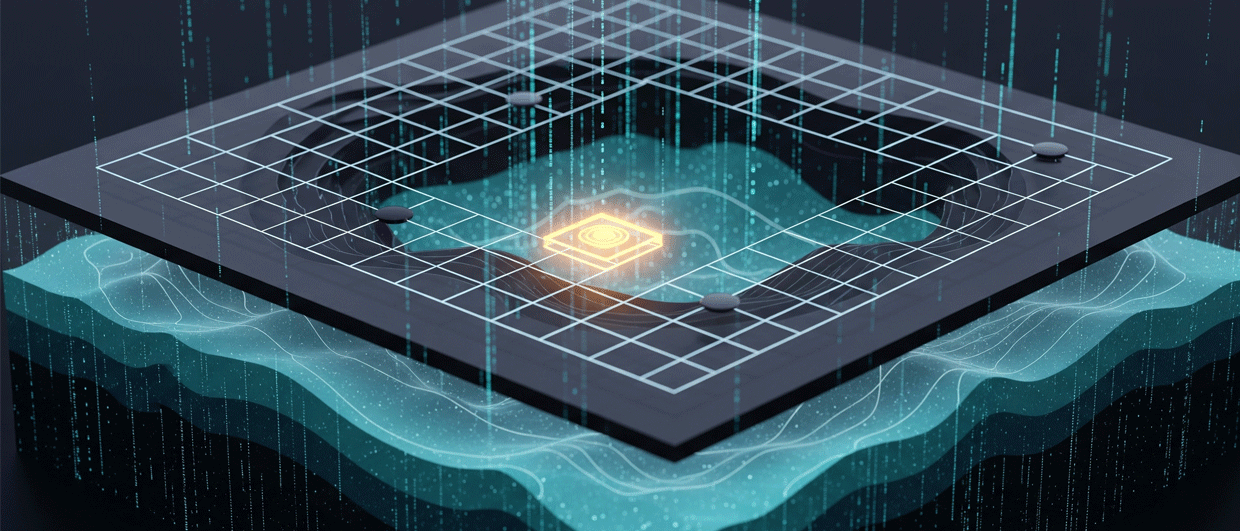
In 2016, Google’s AlphaGo played “Move 37” against Lee Sedol – a move that looked bafflingly wrong to human experts but ultimately secured the win. In 2025, the Norwegian Continental Shelf (NCS) experienced its own “Move 37.” Just as AlphaGo proved that machines could “see” moves humans couldn’t, we are finding more not because the geology changed, but because our ability to see it did.
Equinor has been vocal in attributing their recent success to AI. The operator reported that Artificial Intelligence contributed approximately $130 M in value creation and savings in 2025 alone.
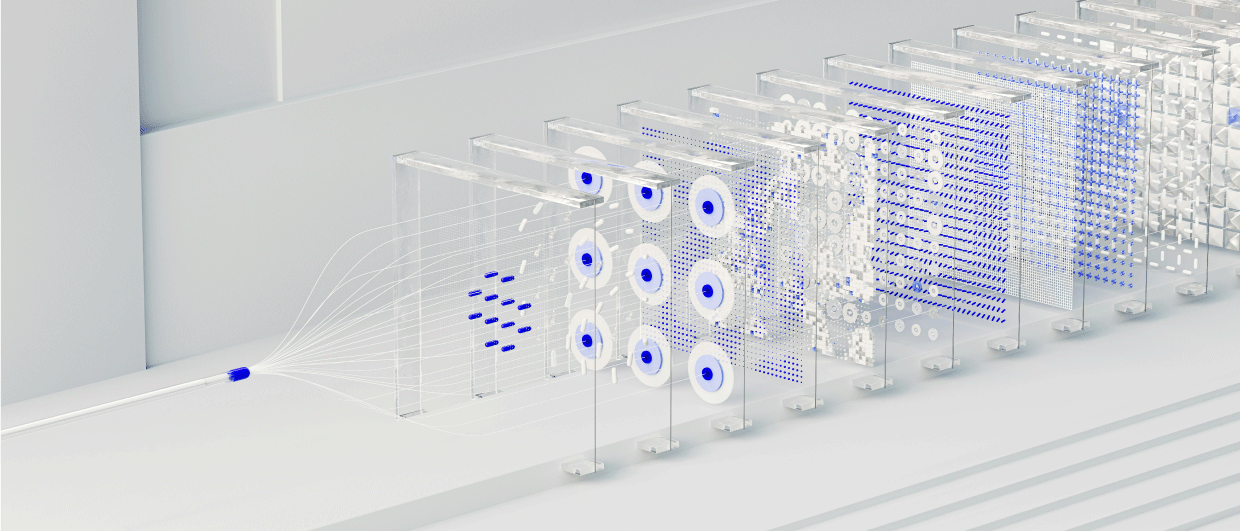
In 2025, 2 M km2 of seismic data were interpreted using AI tools, and geoscientists have increased their capacity to screen vast acreages of the mature shelf tenfold. Meanwhile, AI-driven well planning has saved $12 M on Johan Sverdrup Phase 3 alone through improved hit rates and optimised well placements.
Elsewhere on the shelf, Aker BP is fundamentally changing how an oil company thinks. Their latest strategy to become “AI-First” moves beyond simply buying new software tools. Instead, they are redesigning their workforce and daily operations around artificial intelligence. Aker BP is training its own staff to be the experts – they want their engineers and geologists to build and control their own digital tools. Before recruiting a person for a role, they now ask, “Could an AI do this?”, ensuring that human talent is reserved for complex, creative problem-solving, while machines handle repetitive data work.
Aker BP also now treats AI models like standard industrial machinery – reliable, secure, and available to everyone in the company. By organizing their data in a central, secure library that anyone can access, they have turned AI from a novelty into a daily utility, as essential as a drill bit or a wrench.
Their success in 2025 – headlined by discoveries like Lofn/Langemann and Omega Alfa would suggest that this is paying off.
2025 also marked the 30th anniversary of the creation of Diskos. Once a static library, Diskos has grown into a dynamic engine powering the industry’s new foundation models. The sheer volume and quality of standardised data on the NCS have made it the perfect training ground for advanced machine learning. Reported data have increased by almost six petabytes, from 16 in 2023 to 22 in 2025.
Crucially, this software revolution is matched by a hardware one. The “full stack” includes the physical layer – modern rigs, automated drilling control, and Ocean Bottom Node (OBN) seismic acquisition. The ability to place sensors precisely and drill autonomously allows the digital models to be executed with unprecedented accuracy. The feedback loop between physical hardware and digital twins has closed, reducing execution risk and cost.
The digital assists from Aker BP and the AI-driven confidence of Equinor suggest that for the NCS, the best years of efficiency might still be ahead. The exploration success of 2025 wasn’t driven by brute force or blind luck, but by a level of strategic intuition provided by AI that human teams alone could not achieve.