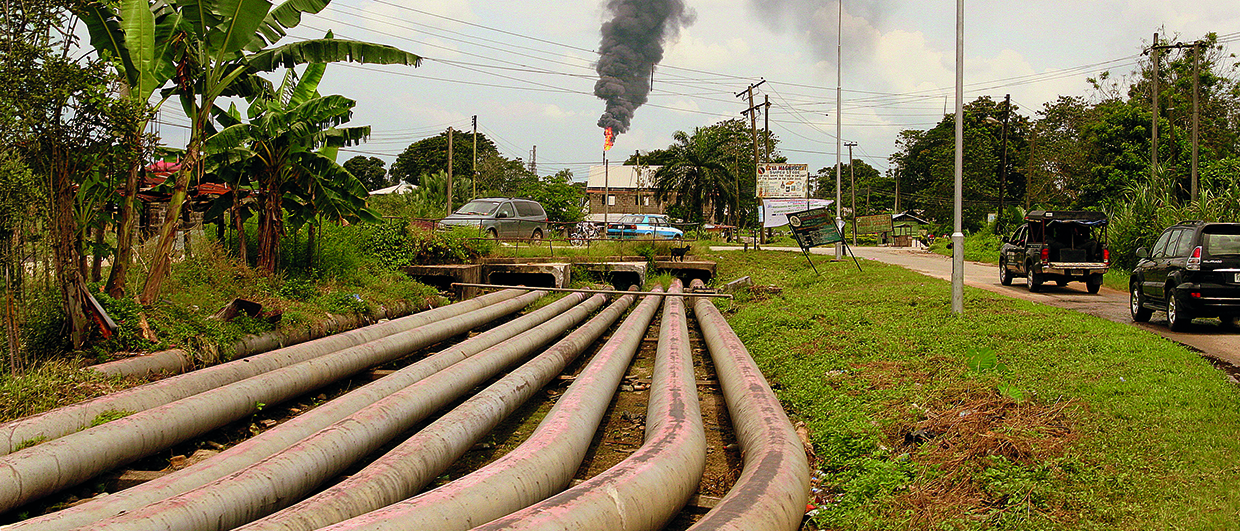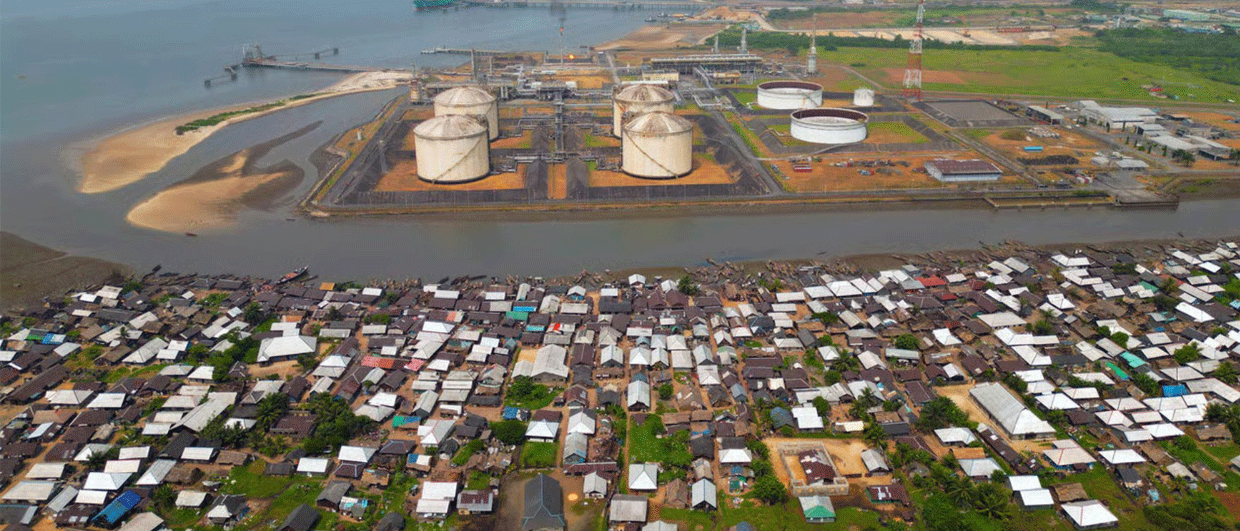
View of Bonny Island NLNG. Photo: Panos via economist.com.
A new frontier for Nigeria’s stranded associated gas
Underground gas storage in the Niger Delta

Nigeria’s Niger Delta remains one of the world’s most prolific hydrocarbon provinces. Yet, the region continues to grapple with the challenge of managing and monetising associated gas (AG) in oil fields developed ahead of gashandling infrastructure. In many offshore developments, early oil production proceeds long before gas export routes are ready, leaving operators with few options beyond routine flaring.
A pioneering shallow-offshore project by FIRST E&P is now demonstrating a pragmatic, geoscience and engineering-driven alternative: Temporary underground storage of stranded AG in a virgin gas reservoir. This approach enables cleaner early-phase oil production while preserving gas for future monetisation once downstream infrastructure comes online.
A first in offshore Nigeria
In this case, two shallow-water fields – Anyala (PML 53) and Madu (PML 54) – producing to a shared FPSO – lacked immediate access to a gas-export system. Rather than flare 30-35 MMSCF/d of separated AG, FIRST routed the gas through a 23 km subsea pipeline into a dedicated virgin reservoir (M-8000) via a newly drilled well (M-8), designed to operate initially as an injector and later as a producer.
The results have been striking. In 18 months, the project successfully stored more than 10 BSCF of AG, with flaring intensity dropping from nearly 80 % at project start to below 5 %. These achievements position the development firmly within the category of “advantaged oil”.
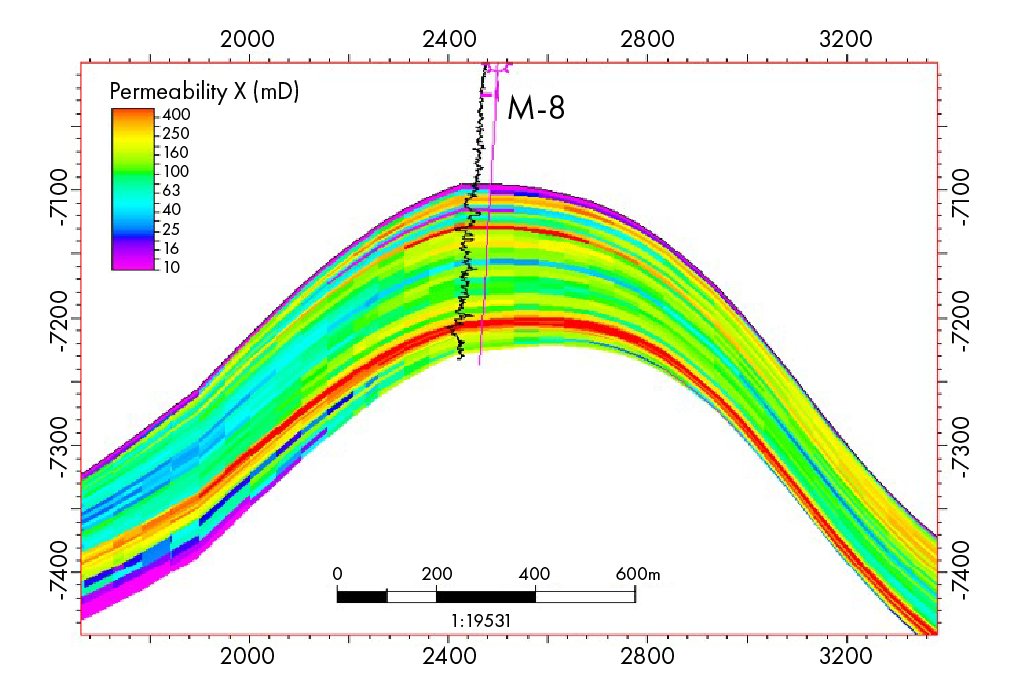
The reservoir’s response has been exemplary. Bottomhole and wellhead pressures remained stable, indicating a laterally extensive permeable reservoir capable of sustained injection without adverse pressure buildup. Injectivity transitioned seamlessly from early transient behaviour to a stable pseudosteady state, with rates reaching 30-39 MMSCF/d.
Three pressure fall-off tests confirmed no induced fracturing, validating that injection remained well below fracture-initiation thresholds. Skin factor reductions reflected progressive near-wellbore cleanup, and benchmark analyses placed well M8 in the top decile of global open-hole gravelpack gas injectors.
Our dynamic reservoir simulation model, updated with 18 months of surveillance data, predicts minimal aquifer movement – only about 5 ft – even after more than two years of continuous injection. This indicates strong containment and a low risk of early water encroachment during future production of both stored and native gas.
A blueprint for emission reduction and effective resource management
Beyond its technical significance, the project offers a compelling model for emissions reduction and responsible resource management. For Nigeria, this storage solution provides a scalable, sustainable and economically sound approach. It enables early oil revenues without compromising environmental performance and safeguards molecules essential to the country’s long-term gas utilisation strategy. To that effect, surveying has already started to build a short pipeline required to connect the gas storage site with the existing Eastern Offshore Gas Gathering line that connects to an onshore LNG plant. Once this is all in place, FIRST plans to produce 70 MMSCF/d initially, ramping up to 100 MMSCF/d. It will be a good moment to start reaping the benefits of the investments made.