
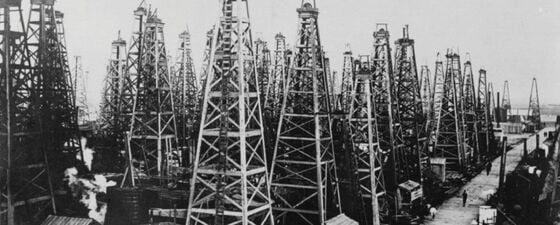
Densely packed derricks in Spindletop’s Boiler Avenue. How to make sure that one owner doesn't produce what belongs to the neighbours? Source: Tyrell Historical Library
Venezuela, Greenland, Iran and oil
Against the backdrop of creaming US shale plays, could recent geopolitical events be seen as a renewed quest for more control over foreign oil resources by the US?

Javier Blas wrote in a recent post that “the US shale revolution hands the US a much stronger hand in controlling prices.” That’s why he suggested that the oil price will not reach the same heights during the current upheaval in the Middle East as it did during previous crises, when that cushion did not exist.
But how long will production from shale in the US remain key in determining the oil price when sudden global events unfold? “Growth in the US shale market is undoubtedly slowing and an overall decrease in oil production is forecast for 2026,” Eve Thomas wrote in Offshore Technology late February. Shangyou Nie, in his latest AAPG Explorer column, included an item of the same nature in his top five news events for 2025.
Here, I’d like to add a few recent observations that, in my modest opinion, could link a creaming local shale resource with US actions abroad as they have unfolded in Venezuela, Greenland, and now in the Middle East.
It is very well-known that Venezuela has enormous oil and gas potential. It is also well known that Exxon’s chief called the country uninvestable in its current status. This was not the response Trump wanted to hear. So maybe it is not the big conglomerates that go back to Venezuela straight away, but I caught someone in Houston the other day who said that a well-known geologist and his company are currently “mobilising” in Venezuela. The same geologist also formed part of a group of people who seemingly advised senior US leadership on Venezuela’s oil and gas potential.
Greenland is the other region that featured in the news, again in close relation to the US. Instead of oil, the public narrative very much focused on the critical minerals that are supposed to be abundant. However, it should be noted that it is an American company that is planning on drilling for oil in Greenland later this year. Even when most geologists argue that the chances are slim of finding a new important play, it is an interesting development nonetheless.
Then we get to the Middle East. This week, I attended a presentation by Wood Mackenzie, during which Andrew Latham explained that the future of oil production is in the hands of the NOC’s, will focus on onshore developments, and then mostly through gains in recovery factors from existing assets. The typical frontier exploration that features the headlines in the oil and gas news is not going make the big difference.
The interesting thing is that Andrew mentioned that it is countries like Iraq and Iran where recovery factors to date have been very low. “There is an upside of 10’s of per cent in a country like Iran,” he said. And similar to Venezuela, where interim president Delcy Rodríguez is supposed to be listening to what US leadership says, Trump also announced yesterday that he wants to be “involved” in the appointment of Iran’s next leader.
So, three countries feature heavily in the news this year because of actions instigated by the US, and all three have a prospect of producing lots of oil, be it from different starting positions. Has the creaming of US shale plays anything to do with this? I am not an expert enough to confidently make that claim, and there are surely other factors at play too, but it is worth a thought, I guess. At the end of the day, the economy is energy.

