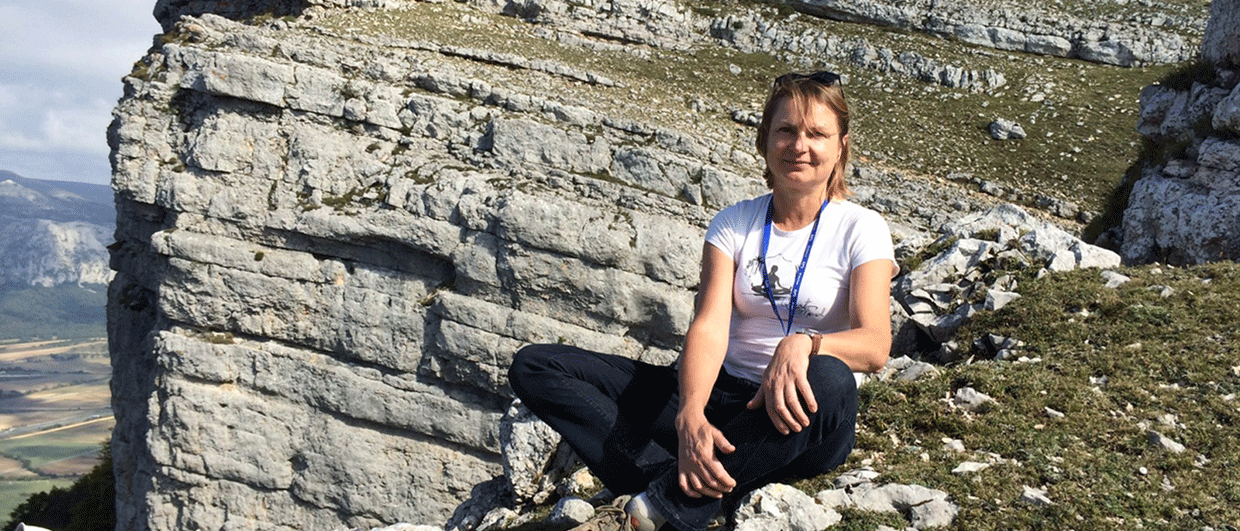
At the top of the outcrop during the field trip, Pyrenees, Spain. Photo: Katya Casey private archive.
What words mean
A conversation with Katya Casey about her fascinating career in New Venture exploration
Do we both have the same concept in mind when we talk about a 3D model? “No,” says Katya Casey, “surely not.” That notion shaped her career and the style in which she works. “It is important to be sure that there is a shared understanding, otherwise there is the danger that conversations derail, and nothing gets done.”
It paints Katya’s desire to be an integrator, bringing together specialists from different disciplines. It is something she excelled at while working for a variety of explorers, and something she still does today in her role as co-owner of U3 Explore.
Here, Katya talks about her career, which took her from Moscow to Houston, where she joined an industry that explored the same seas she had explored in Russia, but for different reasons. And how in both worlds, she was driven to bring technology to the table, being able to identify early the benefits it offers.
Growing up in the Soviet Union
Katya grew up in Moscow, Russia, surrounded by well-educated people devoted to science and exploration. Their interests and respect for everyone were evident in everyday life: “I never heard a curse word until I went to university,” she laughs.
Her decision to study geology and geophysics was not driven by oil and gas. “My father was a sea captain who was on scientific cruises a lot. The stories he brought home, many of which were shared by his friends who worked on the ships, fascinated me; I wanted to know more about the deep oceans and the world,” says Katya.
“I did some things backwards during my life,” she continues. “When I graduated from university in Moscow, I married straight away and had two children while working at the Academy of Science.”
In that position, she was part of a large research project called InterRidge, where scientists from the program’s founding countries worked together to better map and explore the world’s oceans. Having the ability to map the ocean floor during these cruises already sparked her interest in basin formation and tectonics.
“Mind you,” Katya says, “it was the time when plate tectonics came up. Since then, this concept has always been of interest to me, and I always try to put things into a platetectonic setting. It was not at the forefront of everyone’s mind who worked in oil and gas. For that reason, one of my coworkers called the concept ‘Katya’s religion,’ she laughs.
It was during one of the cruises that Katya met Jack, a professor from the University of Houston who actively invited people to come to the USA to join their graduate program.
“…everyone has a different appreciation of what words mean to them, based on their experience. That became an important reference for me. I wanted to make clear that we are all on the same page”
This happened at a time when the Soviet Union was falling apart. “I was experiencing the same thing in my private life,” says Katya, “and combined with my observation that the value of education had diminished in those transition years in the early 1990s, I decided to pack my bags and take my two children to Houston to start a new life.”
“It was the most difficult thing I have done,” she says. “I made a decision not only for me but also for my two daughters, and I went to graduate school in Houston while caring for two kids at the same time. I financed our simple life by working as a teaching assistant at first. I was in the first group of students from the Soviet Union; everyone at the university helped us, and we found a routine.”
Amoco
Later in her graduate studies, Katya also worked at Amoco during the summer. “American companies were actively looking at acreage in the former Soviet Union states, and they needed help translating technical documents that were obviously all written in Russian,” she says.
“I was not only a translator but also populated a database with geological information. It was a fascinating period of brain development, which you only see when you look back after a number of years.”
After finishing graduate school, Katya joined Amoco as an exploration geophysicist, working on projects in Kazakhstan and Azerbaijan.
She felt welcomed and appreciated in a great group of exploration professionals. With a nose for technology, she was motivated to implement new ways of working. “Digital technology was in the early days of development, with a lot of promise, but it was met with resistance from some people,” she says. “Yet I did have support from most of my colleagues and my management.”
It was during those years that Katya first encountered GIS. She quickly realised it was a great analytical tool for geologists. GIS technology was developing rapidly, but companies were organised in such a way that technicians operated the GIS software. It is still considered a secondary skill by some managers today.
“I feel that is wrong,” says Katya. “Software enables people to conduct real-time analysis themselves, rather than having someone else do it for them. I believe, especially when interpretation is involved, that it is important for people to do it themselves. That’s when you have to start thinking, and that’s where the power of using software comes to fruition.”
Did you ever ask the question “what is a grid?”
When Amoco merged with bp, it led to a big round of redundancies, of which Katya was part as well. Four months later, when she found a job with Vastar, a subsidiary of ARCO that operated in the Gulf of Mexico, it marked a sharp new turn in her career. Here, she was designing new digital workflows and deploying emerging technologies. This required many discussions with colleagues that opened her eyes to how important a common understanding of technical definitions is.
“I worked with a geophysicist who was supposed to hand over a grid to the basin modellers. While discussing it, it dawned on me that he thought he needed to hand over the picture of the grid as he saw it on the screen. Without realising that it was not the picture itself the basin modellers were interested in, but the set of xyz coordinates behind it.”
“Of course, I did not want to talk to him as if he were in kindergarten, but you do need to explain that a grid is not a picture but rather a spatial dataset of which we see an expression on the screen. If you are so misaligned during a conversation, there is nothing but to try to land on the same page.”
Katya’s time at Vastar did not last long in the end, as bp came knocking on the door again. “This time, I was not going to stick around,” she says, “despite many people telling me that Vastar was doing so much good work in the GOM. I was determined not to go through a second merger with bp.”
What is the best option to move forward?
After only a year with Vastar, Katya received an offer from BHP through a headhunter. “It was a headhunter I developed a good relationship with,” says Katya. “It was the same person who got me the position at Vastar, too.”
“Looking back now,” she says, “it reminds me of how times have changed. Because I knew this headhunter, she was able to really help me with specific opportunities. Do you think you will achieve something like that with LinkedIn these days? I don’t believe so.”
But times were different in the early 2000s. “Over a period of around ten years, from 2005 to the crash in 2014, I received calls from headhunters all the time,” says Katya. “When I changed my job title on LinkedIn to reflect a change in position within the company, I immediately got a flood of calls, and I had to tell them that I was quite happy in the role. It was a clear sign of how deepwater experience for the Atlantic, which was my speciality at the time, was valued.”
Yet, Katya stayed with BHP for almost 13 years. “It was amazing to be part of their growth, and I could apply my creativity,” she says. “Until we got a new CEO who was a micromanager.”
At BHP, Katya saw the same things she had seen throughout her career. She saw how new technologies became available to the market, but how slow the uptake was internally. Through her natural interest in these matters, she soon rose to the Global Geocomputing Manager level, until she realized that she also needed to demonstrate the benefits of the technologies she was promoting.
“You have to lead by example,” she says. “That’s an important reason why I went back to a technical position in a newly reopened New Ventures team. Of course, money is nice, but it is not the ultimate driver for me.”
In addition to GIS, Katya promoted 3D seismic interpretation methodologies. “At the time, we did not call it AI, but auto-picker,” she says. “But hey, it was the same thing with a different label. This technology came with some shocks, and some people didn’t like it at all. Because it increased the resolution with which you can interpret things.”
“It reminded me of my early days at the Academy of Sciences in Russia, where we used to hand-contour maps based on ship tracks,” says Katya. “When I produced my first computerised map, my boss said that it was not smooth enough, it didn’t look good. But what if there is more data behind the new map, data that would be hard to ignore?”
“It might not look good, but it tells us something we don’t yet know,” says Katya. “The same applies to the auto-tracker. Only when you see a surface appear, and the mudcracks jump out at you in map view, do you see that it actually interpreted something that made sense. Except that it might look very wiggly when looking at it on a single in- or cross-line!”
During her time at BHP, Katya had another insightful experience regarding the meaning of words. “On one occasion,” she says, “I was describing a regional 3D model we built using 2D seismic data. But as the conversation evolved, it dawned on me that my colleague had a different model in mind. We were not talking about the same thing at all. He was alluding to voxels in 3D seismic cubes, while I was talking about a stack of 2D grids that make up a 3D volume in GIS.”
ON THE SAME PAGE
“Now I see how you work!” a colleague told Katya when he saw how she prepared for a meeting by talking to all participants beforehand to ensure they were aware of the topic. “Of course,” she said, “if I don’t do that, it will only lead to participants making their points without listening to each other very well. The preparation is key to making sure that we are all on the same page.”
“Based on that conversation, I concluded that the words grid and map are the most difficult in our geoscience domain, as everyone has a different appreciation of what these words mean to them, based on their experience. That became an important reference for me. I wanted to make clear that we are all on the same page,” she says.
“Explaining things off the cuff is not enough,” says Katya. “If people don’t really understand what you are talking about, they will not listen to you. They will share value only when they see that something really matters. That’s the shared value that companies always talk about.”
“In my view, alignment in company values comes with having lots of conversations, because only in geo-science already, there are so many different disciplines, you can’t have the overview and understanding of the entire spectrum.”
“That’s what I think is the risk with the current rounds of layoffs and the desire to keep only an organisation with people who are specialists in their own small domain,” she adds. “The risk of ending up in a very siloed organisation is high because these specialists are not the best candidates to scout around and find out what their peers in other disciplines do.”
Riding the waves of new venture exploration
The timing of Katya joining BHP was right. In many ways, the skills she learned in the past and what was now needed came together. It was the time of yet another attempt to have a New Ventures team in the company, and Katya was going to be part of it.
“Our focus was the entire Southern Atlantic,” says Katya. “In this area, ION had just begun acquiring deep lines as part of the SPAN project, and together with gravity and plate tectonic reconstructions, we were tasked with finding the regions that could be most prospective.”
For an integrator like Katya, it was a great time. Because now, seismic data wasn’t only used to find traps, it was used to map basement, major lineaments and volcanic strata, all to better understand where a petroleum system could potentially exist, with a valid source rock. But it came with risks too, such as the Falklands, where the company drilled a dry hole.
Regional exploration skills in the Deepwater Atlantic were in high demand, and Katya joined Apache Corporation in Houston to grow the company’s exploration portfolio. The company wasn’t particularly known for frontier exploration, but during those years of high oil prices, even Apache’s of this world were looking more frontier. One of those areas was the Suriname-Guyana Basin.
“I never drilled my own well,” Katya says, “but I did help choose the blocks where others drilled a discovery.” The Suriname-Guyana Basin is an example of that, where Apache made the first deepwater discovery in Block 58 after Katya had already left the company. When Katya started working in the basin, people said the Guyana Basin was just like the Tano Basin in West Africa. But that wasn’t the case, as we have Jurassic sediments in the Guyana Basin, whereas in the Tano Basin, it is only Cretaceous, associated with the Atlantic opening.
THE LITTLE PLANET
On the very first research cruise Katya joined while still working for the Russian Academy of Sciences, she had a bit of an epiphany. “We sailed from Kaliningrad through the Baltic Sea to the Atlantic,” she says, “and by doing so in less than a week, I suddenly realised how small our planet actually is and that we need to take care of it. The waters in the Atlantic were pristine, but as we came back into “civilisation,” more and more debris was floating around at sea. It made me aware that we need to take care of this small place better.”
“That’s a starting point for building your regional understanding, which led us to point to Block 58, where the reservoir and petroleum charge came together. And let’s be clear, this was all done based on 2D seismic data at the time,” Katya reiterates. “I did not map the prospects themselves; others did that after I had already left Apache.”
Following her time at Apache, Katya joined Murphy for a few years. The company had its eyes on the Southern Atlantic too, with the Falklands coming into focus. “The company was interested in the area south of the Walvis Ridge,” she says, “and when you want to understand this region, you have to understand the Falklands, because the area from the Walvis Ridge to the Falklands is different, with salt basins to the north of the Walvis Ridge and no salt to the south. It made me aware that you always have to expand your understanding of basin evolution,” she says.
Katya’s time at Murphy came to an end in 2016, two years following the oil price crash. “There is only so much you can do,” she says. “Decisions are made at a level I would not be able to influence. The only thing I could influence was that I did not want to be unhappy in my job, so I moved from one company to another. As soon as the global appetite for New Venture exploration dried up, people with big-picture thinking were made redundant.
Going independent
After her redundancy from Murphy, Katya needed to reinvent herself. “I did not want to become the sour person in the corner of the room,” she says. But becoming an entrepreneur is not for everybody. “You have to be able to weather it emotionally, especially if you look at the financial side of things.”
“Looking back, I prepared myself for that moment since I was made redundant from Amoco at the start of my career. It was a great lesson in that sense.”
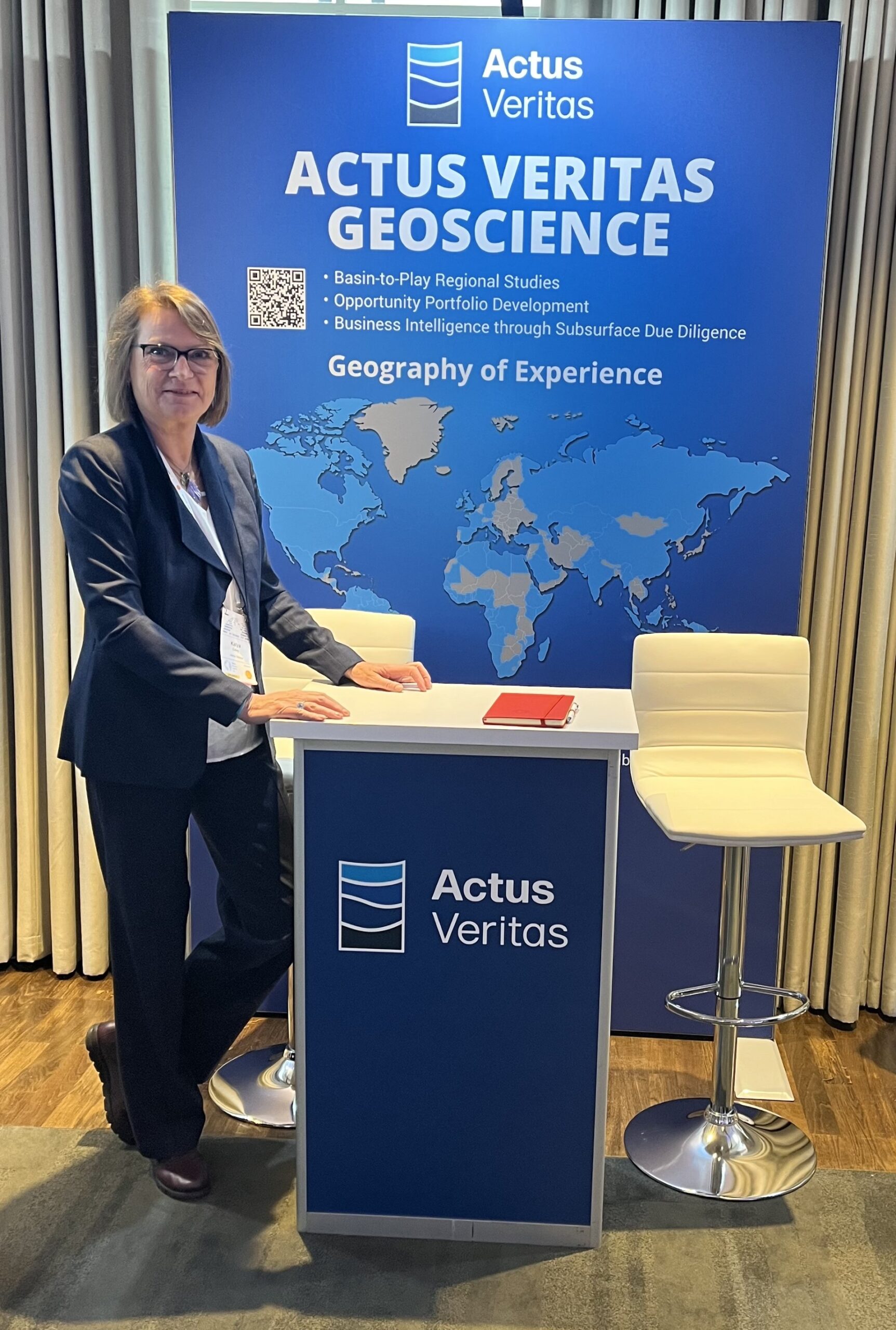
Together with Marel Sanchez, a former colleague at Murphy, Katya founded Actus Veritas Geoscience, a consulting firm in the exploration space. In addition, they also run U3 Explore, an initiative that focuses on collecting exploration knowledge and stories for places where significant potential remains, such as Venezuela.
“Our patience was tested to the limit,” Katya explains. “Around 2017, geoscientists were going out of fashion, in favour of data scientists. Then came the movement toward companies going green and not needing exploration. Then came Covid, and projects with delayed payments. At each of these points, you can give up. But I’m still a firm believer that things will get going at some point. It is just very difficult to predict. You have to be very resilient and accept that nothing goes to plan.”
“Looking back over the past fifteen years of my life,” says Katya, “it makes me realise how good it was. As you progress through your career, the frequency of your activities decreases. Where you jump from one thing to the other in your 30 and 40’s, it will slow down in later years. And that is a good thing, as you can reflect on things better and assess the decisions you made in the past. Because in many cases, you don’t know if a certain decision is the right one or not when you take it. You only see that when you are ten years down the line.”
“I also feel like my actions have had much more meaning,” Katya says as our conversation comes to an end. “Simply because nobody tells you what to do, nobody tells you to do something that you may not agree with. You have to do it all yourself. But luckily, at a certain age, you lose the fear of being judged all the time. That is something I’m not worried about anymore, which is liberating. It is freedom.”